
Matt RaibleMatt Raible is a writer with a passion for software. Connect with him on LinkedIn.

The Angular Mini-Book The Angular Mini-Book is a guide to getting started with Angular. You'll learn how to develop a bare-bones application, test it, and deploy it. Then you'll move on to adding Bootstrap, Angular Material, continuous integration, and authentication.

Spring Boot is a popular framework for building REST APIs. You'll learn how to integrate Angular with Spring Boot and use security best practices like HTTPS and a content security policy.

For book updates, follow @angular_book on Twitter.

The JHipster Mini-Book The JHipster Mini-Book is a guide to getting started with hip technologies today: Angular, Bootstrap, and Spring Boot. All of these frameworks are wrapped up in an easy-to-use project called JHipster.

This book shows you how to build an app with JHipster, and guides you through the plethora of tools, techniques and options you can use. Furthermore, it explains the UI and API building blocks so you understand the underpinnings of your great application.

For book updates, follow @jhipster-book on Twitter.

10+ YEARS


Over 10 years ago, I wrote my first blog post. Since then, I've authored books, had kids, traveled the world, found Trish and blogged about it all.

Ext JS Tag Library

James Carr in Making extJS More Accessible to Java Developers:

With my recent interest in extjs, I was playing with the idea of making a Struts2/WebWork component library or a tag library to handle a lot of the boilerplate extjs code (i.e. creating layouts and such) but, luckily, discovered someone beat me to the punch!

I randomly came across ExtTLD this morning while sifting through my rss feeds, and I must say I am rather impressed. Although I consider myself a pretty good javascript developer, there seems to be a lot of java developers who aren?t that hot at javascript... which is why whenever I attend any java related conference there is always several sessions touting "javascript free ajax!" frameworks like GWT, Ajax4JSF, or IceFaces. Although I've always been skeptical of such frameworks, I do see their benefits... especially for the java developer who excels at serverside JEE development but generally sucks when it comes to adding javascript behavior to the presentation layer.

I can definitely see how Ajax-with-IDE-code-completion would appeal to many developers. However, I do have to agree with James:

So far it looks good, but I haven't had a chance to play with it yet. Basically, I'll have to see if it passes my "good javascript generator framework" test. I?m a pretty staunch advocate of unobtrusive javascript, and generally hate any presentation layer framework that seeks to dump several hundred (or thousand) lines of javascript inline in the html document.

For development shops that have UI-only developers for the front-end and Java developers for the controller/validation part of an application, frameworks that generate JavaScript usually don't make sense.

ExtTLD's license:

ExtTLD is published under GPL 3.0 license however restricts use by companies participating in animal abuse, such as animal testing laboratories etc.
Posted in Java at Jan 22 2008, 10:01:27 AM MST 5 Comments

AppFuse Light 1.8.1 Released: includes upgrades to Spring 2.5 and Wicket 1.3

AppFuse Light 1.8.1 is a bug fixes release that includes an upgrade to Spring 2.5 and Wicket 1.3 RC1. See the Release Notes for more information on what's changed since the last release.

What is AppFuse Light? Click here to find out.

AppFuse Light now offers 60 possible combinations for download:

  • Web Frameworks: JSF (MyFaces), Spring MVC (with Ajax, Acegi Security, JSP, FreeMarker or Velocity), Stripes, Struts 1.x, Struts 2.x, Tapestry, WebWork, Wicket
  • Persistence Frameworks: Hibernate, iBATIS, JDO (JPOX), OJB, Spring JDBC

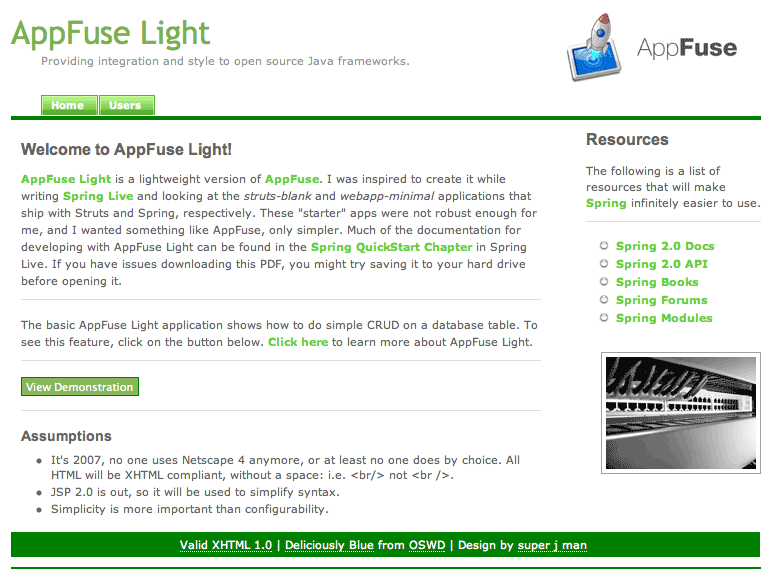
AppFuse Light Screenshot - click on the box at the bottom right of AL to activate StyleSheet Switcher

If you have any questions about this release, please subscribe to the AppFuse user mailing list by sending a blank e-mail to [email protected]. You can also post questions in a forum-like fashion using Nabble: http://appfuse.org/forum/user.

If you're a developer of one of the frameworks that AppFuse Light uses - I'd love a code review to make sure I'm "up to snuff" on how to use your framework. I'm also more than willing to give commit rights if you'd like to improve the implementation of your framework.

Live demos are available at:

What's on tap for AppFuse Light 2.0? Here's what I'm hoping to do:

  1. Drop the seldom-used persistence frameworks: JDBC, JDO and OJB.
  2. Drop Struts 1.x and WebWork as web frameworks (replaced by Struts 2).
  3. Support the same persistence frameworks as AppFuse: Hibernate, iBATIS and JPA.
  4. Re-use appfuse-service, appfuse-hibernate, appfuse-ibatis and appfuse-jpa in AppFuse Light. I'll likely include the core classes (User, Role) since AppFuse Light is more "raw" than AppFuse.
  5. Require Java 5.

Let me know if you disagree with any of these items or would like to see other enhancements.

Posted in Java at Nov 29 2007, 09:28:06 AM MST 3 Comments

AppFuse Light 1.8 Released

AppFuse Light 1.8 adds CSS Framework integration, as well as support for Stripes (1.4.2) and Wicket (1.2.6). It also has significant upgrades for JSF and Tapestry; to versions 1.2 and 4.1.3 respectively. See the Release Notes for more information on what's changed since the the beta release of 1.8.

What is AppFuse Light? Click here to find out.

AppFuse Light now offers 60 possible combinations for download:

  • Web Frameworks: JSF (MyFaces), Spring MVC (with Ajax, Acegi Security, JSP, FreeMarker or Velocity), Stripes, Struts 1.x, Struts 2.x, Tapestry, WebWork, Wicket
  • Persistence Frameworks: Hibernate, iBATIS, JDO (JPOX), OJB, Spring JDBC

AppFuse Light Screenshot - click on the box at the bottom right of AL to activate StyleSheet Switcher

If you have any questions about this release, please subscribe to the AppFuse user mailing list by sending a blank e-mail to [email protected]. You can also post questions in a forum-like fashion using Nabble: http://appfuse.org/forum/user.

If you're a developer of one of the frameworks that AppFuse Light uses - I'd love a code review to make sure I'm "up to snuff" on how to use your framework. I'm also more than willing to give commit rights if you'd like to improve the implementation of your framework.

Live demos are available at:

Yes, I realize that 60 combinations is ridiculous. I didn't create the frameworks, I'm just integrating them so you don't have to. ;-)

Unfortunately, it's a real pain to create Maven archetypes or they'd all be as easy as mvn archetype:create. Rumor is that the archetype plugin will allow you to create-from-project in the future. When that happens, I'll make sure all the combinations are available as archetypes.

Posted in Java at Sep 14 2007, 11:01:46 AM MDT 2 Comments

AppFuse Light 1.8 Beta Released

AppFuse Light 1.8 Beta adds CSS Framework integration, as well as support for Stripes (1.4.2) and Wicket (1.2.6). This is a beta release so we can work out some kinks before the final release.

AppFuse Light now offers 60 possible combinations for download:

  • Web Frameworks: JSF (MyFaces), Spring MVC (with Ajax, Acegi Security, JSP, FreeMarker or Velocity), Stripes, Struts 1.x, Struts 2.x, Tapestry, WebWork, Wicket
  • Persistence Frameworks: Hibernate, iBATIS, JDO (JPOX), OJB, Spring JDBC

AppFuse Light Screenshot - click on the box at the bottom right of AL to activate StyleSheet Switcher

If you have any questions about this release, please subscribe to the AppFuse user mailing list by sending a blank e-mail to [email protected].java.net. You can also post questions in a forum-like fashion using Nabble: http://appfuse.org/forums.

If you're a developer of one of the frameworks that AppFuse Light uses - I'd love a code review to make sure I'm "up to snuff" on how to use your framework. I'm also more than willing to give commit rights if you'd like to improve the implementation of your framework.

Live demos are available at:

Update: Based on Martin's blog post, I've added the version numbers for Stripes and Wicket (1.4.2 and 1.2.6, respectively). While the Wicket guys recommended I use Wicket 1.3.0, I was already knee deep in 1.2.6 when I read their recommendation. If 1.3.0 really is that much better than 1.2.6, it should be a pleasure to upgrade (and a good learning experience too boot!).

Posted in Java at Apr 26 2007, 02:23:22 AM MDT 10 Comments

Equinox (a.k.a. AppFuse Light) 1.7.1 Released!

Equinox 1.7.1 contains a number of dependency updates, and not much else. This will be the last release with the Equinox name. This project is changing its name to AppFuse Light and will be referred to by that name going forward. The project will be moving its source code to http://appfuse-light.dev.java.net. The equinox.dev.java.net project will remain because Cool URIs don't change. In addition to the name change, I'd like to try to merge the AppFuse and Equinox user communities. Since the technologies are so similar, and AppFuse 2.x will use some of Equinox's Ant scripts, it makes sense to bring these projects closer together.

In AppFuse Light 1.8, I plan on adding support for Stripes and Wicket as well as integrating the CSS Framework (like AppFuse uses).

50 possible combinations are available for download:

  • Web Frameworks: JSF (MyFaces), Spring MVC (with Ajax, Acegi Security, JSP, FreeMarker or Velocity), Struts 1.x, Struts 2.x, Tapestry, WebWork
  • Persistence Frameworks: Hibernate, iBATIS, JDO (JPOX), OJB, Spring JDBC

All of the frameworks used in Equinox, as well as most of its build/test system is explained in Spring Live. Going forward, documentation will be put on the AppFuse site.

A summary of the changes in this release are below:

  • Removed custom JavaScript and CSS for MyFaces Tomahawk's
  • Dependent packages upgraded:
    • Ajax4JSF 1.0.6
    • Cargo 0.9
    • Commons Collections 3.2
    • Commons DBCP 1.2.2
    • Commons Lang 2.3
    • Commons Validator 1.3.1
    • DWR 2.0 RC2
    • FreeMarker 2.3.9
    • JPOX 1.1.7
    • JUnit 3.8.2
    • Hibernate 3.2.1
    • iBATIS 2.3.0
    • MyFaces and Tomahawk 1.1.5
    • Spring 2.0.4
    • Spring Modules Validation 0.8
    • Struts 2.0.6
    • Tapestry 4.1.1
    • Velocity 1.5
    • Velocity Tools 1.3
    • WebWork 2.2.5

For more information about installing the various options, see the README.txt file. Live demos (thanks to Contegix!) are available at:

If you have any questions, please read the comments from the 1.7 release or ask them on the AppFuse mailing list.

Posted in Java at Apr 21 2007, 05:27:33 PM MDT 2 Comments

Large sites powered by Java web frameworks and Tiles + WebWork

Yesterday, I delivered a Comparing Web Frameworks seminar that included Struts, Spring MVC, WebWork, JSF and Tapestry. This was for a client that's in the process of re-working an extremely high traffic site (50+ servers currently) from Servlets + JSPs to a web framework. They love the idea of Tiles (and know how to use it) as well as plan on integrating many Ajax features.

We quickly eliminated Struts because of ActionForms since they're planning on moving to persisted POJOs. Spring MVC and JSF had a notch up because they work with Tiles. However, JSF has reportedly had scalability issues. Furthermore, it's the most-complained about framework out there. One attendee noted how she was impressed with the low number of complaints about WebWork.

WebWork doesn't integrate with Tiles (but probably will soon) and they were concerned about SiteMesh performance with large pages (1MB + of text). While I believe SiteMesh can do almost everything that Tiles can do, I also agree that Tiles is a good technology. Furthermore, the "advanced features" of SiteMesh to be largely undocumented, which can be a barrier for adopting it as a "development standard".

Spring MVC was dinged because it doesn't have built-in Ajax support like WebWork and Tapestry (via Tacos). However, it's support for Tiles might just make it the one they choose - especially since they plan on using Spring in the middle-tier/backend. While they loved the idea of Tapestry, they didn't think they could afford the learning curve and I don't know enough about the @Border component to verify if it has all of Tile's functionality.

One interesting thing that came up was the list of high-volume sites using these various web frameworks. Tapestry seems to come out on top when you look at the list of well-known sites. However, I'm sure there are plenty I don't know about. If you know of high-volume sites using any of these five frameworks, please let me know. I'm looking for major sites with millions of hits per day. Here's my current list (extra points for fancy templating with SiteMesh/Tiles + Ajax widgets):

  • Struts: None that I know of off the top of my head, but I'm sure there are plenty.
  • Spring MVC: None that I know of.
  • WebWork: JavaBlogs (don't know if this exactly qualifies as high-volume, there aren't that many Java developers). WebWork also has a few products based on it (i.e. Jive, JIRA, Confluence), but these companies also employ WebWork committers.
  • JSF: None that I know of.
  • Tapestry: NHL.com, TheServerSide.com (similar comments to JavaBlogs) and Zillow.com.

Thanks!

Related: How To use Tiles like SiteMesh and SourceLab's Web application technologies comparison (with performance numbers!).

Update: FWIW, I figured out How to use Tiles with WebWork and wrote a short howto for doing dependency injection with SiteMesh.

Posted in Java at Feb 15 2006, 11:55:57 AM MST 30 Comments