
Matt RaibleMatt Raible is a writer with a passion for software. Connect with him on LinkedIn.

The Angular Mini-Book The Angular Mini-Book is a guide to getting started with Angular. You'll learn how to develop a bare-bones application, test it, and deploy it. Then you'll move on to adding Bootstrap, Angular Material, continuous integration, and authentication.

Spring Boot is a popular framework for building REST APIs. You'll learn how to integrate Angular with Spring Boot and use security best practices like HTTPS and a content security policy.

For book updates, follow @angular_book on Twitter.

The JHipster Mini-Book The JHipster Mini-Book is a guide to getting started with hip technologies today: Angular, Bootstrap, and Spring Boot. All of these frameworks are wrapped up in an easy-to-use project called JHipster.

This book shows you how to build an app with JHipster, and guides you through the plethora of tools, techniques and options you can use. Furthermore, it explains the UI and API building blocks so you understand the underpinnings of your great application.

For book updates, follow @jhipster-book on Twitter.

10+ YEARS


Over 10 years ago, I wrote my first blog post. Since then, I've authored books, had kids, traveled the world, found Trish and blogged about it all.
You searched this site for "jsf". 312 entries found.

You can also try this same search on Google.

New weather.com site built using AppFuse

From Jeff C (a Sr Developer for forgetaway.com, a new unit of weather.com) in Lightweight Java Development with Webwork, Spring, and iBatis:

Our new site, ForGetaway.com, launched 2 weeks ago, and its built on WebWork, Spring, and iBatis. Using those 3 frameworks as the backbone of the site was a great experience. I think that combination of frameworks can be considered lightweight, especially from a development standpoint.
...
Even the development/testing process is quick. Thanks to Matt Raible's AppFuse (which was used to get this app started), we have a sweet build.xml file that allows us (on our dev machines) to reload our app by having the build script talk to tomcat. So, even when a properties file or java class or static field changes, its just a matter of running the reload task in the build.xml file and tomcat reloads the app with all changes in under 5 seconds. Yeah, rails is probably quicker, but i can spare 5 seconds of my time to let my changes get reloaded by tomcat.

Reloading your application in Tomcat to see your changes sucks. However, AppFuse 2.0 will allow you to use the Maven 2 Jetty Plugin, which aims to eliminate the whole deploy cycle. This plugin is powered by Jetty 6, which has been rewritten for Continuations, NIO, Servlet 2.5. Hopefully we'll start to see more appserver plugins written for Maven 2.

I love hearing success stories like Jeff's. That's why I (and many others) work on AppFuse - to simplify Java web development. We know that it's more painful to develop web applications in Java than in scripting languages, but we continue to do it because tools like AppFuse make it enjoyable. Even though tools and languages are important for simplification, I believe that most project's success is determined by people. If you have good people, effective processes and a lack of politics - a project should have no problem being successful, regardless of the tools.

Did you know the new SourceBeat site is also powered by AppFuse? We chose the WebWork+Spring+Hibernate combination and were quite pleased at how easy it was to develop everything. We had 90% of the site done in the first two weeks of development.

In other AppFuse-related news, the demos have been running solid for 70 days straight. I'll admit that's not a very log time, but it does prove there's no memory or connection leaks in the software. ;-) The number of currently active sessions is as follows:

The default session timeout is set to 10 minutes in AppFuse.
Posted in Java at Sep 28 2006, 11:40:55 AM MDT 6 Comments

Maven, Cargo, Struts 2 and working outside

Life is pretty good today. I'm currently working outside - in a courtyard area near the 30th Street Station in Philadelphia. There's 4 restaurants in the courtyard, all with outside seating. It's 72°F and beautiful. I plan to work for a few hours, then hop on the 5:00 train to NYC.

The reason I'm writing this post is to point out a few useful tidbits I've picked up today. First of all, Andrew Glover has written a developerWorks article on Cargo titled In pursuit of code quality: Repeatable system tests. In this article, he shows how to use jWebUnit as well as DbUnit. While the article uses Ant, Andrew mentions that Cargo also works with Maven (and has a Java API too).

Equinox uses jWebUnit, Maven and Cargo, but it doesn't currently support running Cargo from Maven. The major reason for this is I tried to automate running jWebUnit tests from the antrun-plugin and couldn't get it to work (I only tried for 10 minutes). Does anyone have any insight for including jWebUnit tests alongside your regular tests, excluding them from Maven's "test" phase, and running them in the "integration-test" phase? The good news is AppFuse 2.0 uses Maven as well, and we have Cargo + Canoo WebTest working just fine. BTW, did you know that Mergere’s Maestro (a free product) includes Equinox? If you're looking to learn Continuum and you're familiar with Equinox, downloading Maestro is probably a good start.

Speaking of web testing, I've been playing with Selenium lately. I was able to easily integrate it into Thomas and I's Spring 2.0 Kickstart application thanks to these Maven and Selenium integration instructions. The only issues I've run into so far are specifying an initial URL that works in Selenium core as well as Selenium IDE and integrating Selenium with CruiseControl. If you're interested in learning more about Selenium checkout Catching up with Selenium on InfoQ.

Last, but certainly not least, Struts 2.0 was released today. I've already integrated this into the Struts version of AppFuse 2.0. If you like living on the bleeding, you could dig in and try it out today. Unfortunately, I haven't had a chance to put a whole lot of documentation together yet. I hope to install Confluence on appfuse.org sometime this week to start documenting how bad-ass AppFuse 2.0 will be ;-).

Speaking of 2.0 releases, wasn't Spring 2.0 Final supposed to be released yesterday?

Posted in Java at Sep 27 2006, 11:40:42 AM MDT 7 Comments

Comparing Web Frameworks Presentation

I've uploaded my Comparing Web Frameworks presentation I delivered today. This presentation is still somewhat outdated - all the stats I have in it are from February of this year (2006). I've also updated the Equinox framework-comparison page to have links to some more readable papers.

Deciding which Java web framework to use when developing your applications can be a difficult choice. I've often wondered which one is "best" myself. Since 2004, I've been playing and developing with the top five web frameworks for Java: JSF, Spring, Struts, Tapestry and WebWork. For my most recent opinion on which one is my preferred choice, see What Web Application framework should you use?. You might also checkout the following whitepapers I've written at virtuas.com:

Posted in Java at Sep 26 2006, 02:37:50 PM MDT 3 Comments

Integrating Hibernate Validator with Spring MVC

Remember when I wrote about Better client-side validation with Prototype back in May? Ted Bergeron responded to my post with the following comment:

Now that I am using Hibernate Annotations Validator, I stopped using commons validator. You can use the hibernate validator without using hibernate for persistence. I wrote some jsp 2.0 tag files to handle binding my form fields with spring mvc, and I use reflection to check for the validation annotations. This makes it no work to have a js calendar for all Date fields, or have class="required" added to all fields that have a @NotNull annotation. I'd be happy to send you the code for appfuse 2.0.

Ted followed up by sending me the code. I took a look at it, and reviewed a well-written PDF he'd written for his work. I told him he should publish it as an article, hooked him up with some folks at IBM developerWorks - and voila! Ted's article, titled Hibernate can meet your validation needs was published yesterday. Nice work Ted!

I'm looking forward to trying to leverage Hibernate Validation annotations for all the web frameworks in AppFuse. Should be interesting hacking into the cores of the frameworks to modify how their validation engines work.

Posted in Java at Sep 13 2006, 11:17:46 AM MDT 14 Comments

AppFuse 2.0 Status

Last week I managed to get AppFuse to compile with Maven 2, this week I got all the tests passing. This week, I struggled with Maven's WAR dependencies and how AppFuse will be used by end-users. It was frustrating, but I think I got most everything figured out. Unfortunately, there's still many issues to be sorted out.[Read More]

Posted in Java at Aug 26 2006, 02:41:26 PM MDT 7 Comments

High Performing Java Web Frameworks

Steven Haines appears to be gearing up for a showdown among Java web frameworks. In his Web Frameworks article (found via dzone), Steven notes the following:

There are many factors that you need to consider when choosing an application framework, including but not limited to:

  • Suitability for your specific business needs
  • Developer productivity
  • Performance
  • Support and community activity
  • Technology maturity
  • Developer prowess
  • Business relationships

He goes on to say that he's planning on comparing a number of web frameworks, and his study will give special attention to how these frameworks perform. He'll be comparing Struts 1.x, Struts 2.x, Shale and Spring MVC. If you think your framework can compete, Steven invites you to send him an e-mail.

If anyone has a compelling reason why we should add an additional framework, please contact me and I will be glad to consider it in this endeavor.

I'm looking forward to reading Steven's articles, I just hope I can find them again when they're published.

Posted in Java at Aug 21 2006, 08:42:40 PM MDT 9 Comments

AppFuse 2.0 Status

I managed to get most of AppFuse's code moved over to a Maven 2 structure this week. I have tests working in the hibernate/ibatis projects, as well as the service project, but not in the web tier projects yet. I do have everything compiling though. ;-)

[INFO] ------------------------------------------------------------------------
[INFO] Reactor Summary:
[INFO] ------------------------------------------------------------------------
[INFO] AppFuse ............................................... SUCCESS [2.228s]
[INFO] AppFuse Common Data Module ............................ SUCCESS [1.681s]
[INFO] AppFuse Hibernate Module .............................. SUCCESS [0.809s]
[INFO] AppFuse iBATIS Module ................................. SUCCESS [0.630s]
[INFO] AppFuse Data Modules .................................. SUCCESS [0.008s]
[INFO] AppFuse Service Module ................................ SUCCESS [0.696s]
[INFO] AppFuse Common Web Module ............................. SUCCESS [2.817s]
[INFO] AppFuse JSF Module .................................... SUCCESS [4.410s]
[INFO] AppFuse Spring MVC Module ............................. SUCCESS [4.038s]
[INFO] AppFuse Struts 2 Module ............................... SUCCESS [4.954s]
[INFO] AppFuse Tapestry Module ............................... SUCCESS [4.042s]
[INFO] AppFuse Web Modules ................................... SUCCESS [0.007s]
[INFO] ------------------------------------------------------------------------
[INFO] ------------------------------------------------------------------------
[INFO] BUILD SUCCESSFUL
[INFO] ------------------------------------------------------------------------
[INFO] Total time: 26 seconds
[INFO] Finished at: Fri Aug 18 15:06:54 MDT 2006
[INFO] Final Memory: 11M/26M
[INFO] ------------------------------------------------------------------------

If you'd like to review any of the work done thus far, I've uploaded my latest work to:

http://static.appfuse.org/downloads/appfuse2-20060817.zip

The major issue I've encountered to date can be reviewed on the Maven user mailing list. If you happen to try things out, the best thing to do is post feedback to the dev list. I'm considering another device-free weekend, so I may not respond until Monday.

Posted in Java at Aug 18 2006, 03:17:31 PM MDT 14 Comments

Denver JUG Tonight: Echo and Wicket

Looks to be a good show at tonight's DJUG: Justin Lee will be talking about Wicket and Tom Poindexter is presenting on Echo2.

BTW, did you know that Wicket may become an Apache project? I consider the main web frameworks in Java to be: JSF, Spring MVC, Struts 2 and Tapestry. RIFE, Stripes and Wicket follow close behind, but are generally very unheard of in the Java community at large. It's kinda wierd to see most of the Java web frameworks (save Spring MVC) end up at Apache, isn't it?

Update: This was a good meeting, mostly because both speakers were excellent. Relaxed, comfortable and good humored. Justin has a recap (and downloadable presentation) on his blog.

Posted in Java at Aug 09 2006, 07:15:33 AM MDT 4 Comments

7 simple reasons to use AppFuse

IBM developerWorks published my "Seven simple reasons to use AppFuse" article today. Here's a summary:

Getting started with open source tools for the Java™ platform such as Spring, Hibernate, or MySQL can be difficult. Throw in Ant or Maven, a little Ajax with DWR, and a Web framework -- say, JSF -- and you're up to your eyeballs just trying to configure your application. AppFuse removes the pain of integrating open source projects. It also makes testing a first-class citizen, allows you to generate your entire UI from database tables, and supports Web services with XFire. Furthermore, AppFuse's community is healthy and happy -- and one of the few places where users of different Web frameworks actually get along.

While you're there, you might be interested in reading the "Introduction to Spring 2 and JPA" tutorial. I don't know if we'll get JPA support into AppFuse 2.0, but it's certainly a possibility.

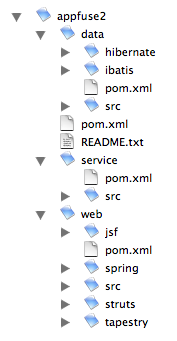
As far as AppFuse 2.0, here's the current structure I've started on for Maven 2:

appfuse
    - data
        - hibernate
        - ibatis
    - service
        - pom.xml
        - src
    - web
        - jsf
        - spring
        - struts
        - tapestry

After code is moved into the directory structure above (or completely re-written), I'd like to move to working on creating single module archetypes and multi-project archetypes (data, service, web) with Maven 2.

After getting the Maven 2 structure checked in, hopefully we can start looking at replacing AppGen. Scott Ryan has done a fair amount of work on this so far with his AppFuse Maven Plugin.

I plan on documenting the plan of attack and milestone features for 2.0 sometime this week.

Update: I started working on the Maven 2 conversion last night. The above structure has changed slightly. Now there's a project in data and web (notice the pom.xml and src in these directories). These projects will contain the classes/files that are common to their sub-projects. The fact that these projects even exist will likely be transparent to the end user.

AppFuse 2 Structure

Posted in Java at Aug 08 2006, 01:14:15 PM MDT 17 Comments

AppFuse Videos updated for 1.9.3

I've created new AppFuse demo videos that are up-to-date with version 1.9.3. The setup video is around 3 minutes, and the AppGen one is around 3:30.

New Project and Feature Tour
Setup Screenshot

Code Generation with AppGen
AppGen Screenshot

If you have any suggestions on making the above movies more effective, please let me know. I used SnapZ Pro X to shoot them and QuickTime Pro to compress.

In other AppFuse news, a couple of new tutorials have been written:

Props go out to Chris, Matt and Luciano for taking the time to write these detailed tutorials. Well done gents!

Posted in Java at Jul 24 2006, 08:58:06 PM MDT 10 Comments