Matt RaibleMatt Raible is a writer with a passion for software. Connect with him on LinkedIn.

The Angular Mini-Book The Angular Mini-Book is a guide to getting started with Angular. You'll learn how to develop a bare-bones application, test it, and deploy it. Then you'll move on to adding Bootstrap, Angular Material, continuous integration, and authentication.

Spring Boot is a popular framework for building REST APIs. You'll learn how to integrate Angular with Spring Boot and use security best practices like HTTPS and a content security policy.

For book updates, follow @angular_book on Twitter.

The JHipster Mini-Book The JHipster Mini-Book is a guide to getting started with hip technologies today: Angular, Bootstrap, and Spring Boot. All of these frameworks are wrapped up in an easy-to-use project called JHipster.

This book shows you how to build an app with JHipster, and guides you through the plethora of tools, techniques and options you can use. Furthermore, it explains the UI and API building blocks so you understand the underpinnings of your great application.

For book updates, follow @jhipster-book on Twitter.

10+ YEARS


Over 10 years ago, I wrote my first blog post. Since then, I've authored books, had kids, traveled the world, found Trish and blogged about it all.
You searched this site for "jsf". 312 entries found.

You can also try this same search on Google.

[ANN] AppFuse 1.8.1 Released

This release is mostly a bug fix release with no new features. It also includes many upgrades to the core libraries (Hibernate, Spring, iBATIS, MyFaces). Thanks to all the sponsors who have contributed products and free hosting to the AppFuse project. You guys rock!

To see how AppFuse works, please see the following demos:

Comments and issues can be sent to the mailing list or posted to the AppFuse Issue Tracker.

Posted in Java at Jun 15 2005, 11:00:42 PM MDT 8 Comments

Updated Presentations: Spring, AppFuse and Comparing Web Frameworks

As part of my trip to Norway last month, I had an opportunity to update many of the presentations I've delivered at JUG meetings and conferences. Of course, there's not a whole lot to these slides because I believe the real value is seeing them delivered. ;-)

The presentation on Test-Driven Development with Spring and Hibernate (a.k.a. AppFuse) will serve as the basis for my AppFuse Tutorial at OSCON. If you're planning on attending that tutorial and would like to see any enhancements, please let me know. All of these are downloadable in PDF format.

Enjoy!

NOTE: I updated this site to the latest code from Roller's CVS this morning, so please let me know if you see any issues.

Posted in Java at Jun 07 2005, 12:36:43 PM MDT 4 Comments

AppFuse 2.0: JDK 5, Annotations and JSP 2.0

For the most part, I haven't used JDK 5 on any of my recent projects. You can compile and run AppFuse with JDK 5, but it doesn't use any JDK 5 features. After doing a code review at Bouvet last week and seeing how much cleaner their code is with Generics, Varargs and the Enhanced for Loop, I think it's time to dig in. I don't know how soon we'll start, but I think it's time to start creating a branch for AppFuse 2.0 - which will use these features. For AppFuse 2.0, I'd like to go whole hog, bleeding-edge and use all the stuff that's out there to make developer's lives easier. This includes JSP 2.0, Annotations (especially for Hibernate and Spring, as well as Tapestry) and all the JDK 5 features that seem useful.

Since most developers won't be able to deploy on a JDK 5-compliant server for quite some time, we'll continue to maintain the 1.x branch as JDK 1.4-compliant. I expect to release AppFuse 1.8.1 later this week (with mostly bug fixes + latest releases of Hibernate/Spring) and 1.9 in the next month or so. From there, we'll likely do 1.9.x releases with bug fixes and do all the major upgrades (i.e. Tapestry 4.0.x) in the new branch. Working with new features in JDK 5 should be a lot of fun.

I'm hopeful that we can get rid of XDoclet and we may even give Maven 2 a run for its money. Last week in Norway, I found that most Java developers were using Maven on their projects and I also discovered that many of the core Maven 2 developers are getting paid to work on it full time. There were even claims that Maven 2 is going to be twice as fast as Ant - which definitely intrigues me.

Later: I just realized the hardest part of this migration is going to be replacing AppGen. It currenly uses XDoclet templates for all the class templates - and we'll need a new solution based on annotations. Oh well, it's kind of ugly anyway, but it'll likely be difficult to figure out a new solution. Hopefully we can create some sort of tool that involves easy-to-customize templates and a GUI to drive it all.

Posted in Java at May 30 2005, 12:41:52 PM MDT 27 Comments

My Next Big Adventure

I mentioned last week that my next professional endeavor was going to provide more time to work on AppFuse and Spring Live. Now I guess I should explain what my next big adventure is. ;-)

As most of your know, I've been writing Spring Live for SourceBeat. When I signed up with them in March of last year, their grand vision for the company wasn't just to write books - it was to become a training and consulting provider as well. They wanted us as authors to eventually write training that we could deliver on-site, as well as at our facilities in Denver. As far as consulting, they wanted to provide consulting in the true sense of consulting - where we give advice and help people implement open-source in their environments. Not the code-monkey kind of consulting/contracting, but rather the big dollar kind of consulting.

Now they've got an outlet for that venture.

Not only have they gotten funding for developing training programs and providing open-source mentoring to CIOs and CTOs, they've got the connections to make it work. Furthermore, we think we've established a team that will make this a tremendous success. Many of us have been independent consultants for quite some time - so we all have a certain desire to make things happen for ourselves without having any loyalty to a particular company, or person in charge. We've all decided to give up our independent status to build a company together - because we think this venture can actually provide more freedom than independent consulting provides.

If we do it right, we plan on doing training and consulting for a week or two per month, and then working on driving the open source movement the rest of the time. All of us expect to dedicate more time to the books we're authoring, as well as contribute more to open source projects. We also plan on writing more articles and trying to help out the community more - to promote open-source tools and make them easier to use through good documentation.

At this point, you might be wondering who "We" is. As of this point in time, Matt Filios is heading up the show. He's the current CEO of SourceBeat, and it's his ideas that've made SourceBeat a unique and fun publisher to work for. Starting this new company has been in his "idea bank" for quite some time, so it's great to see his enthusiasm and energy in getting this thing off the ground. He has a lot of connections and excellent business sense to make this new company a sure success. It's great to have someone in charge that you trust and feel confident about.

Having a business leader makes good sense for a company, but you also need a technology leader. For that, Bill Dudney has stepped up to the plate and will try to keep us focused and make sure we're not goofing off all the time. Bill's role is as Vice President per se.

From there, we're establishing a number of "Practice Leaders" that are experts in a particular area, and can provide training and high-level consulting for particular technologies. I will focus on my core expertise as the Spring and Web Frameworks Practice Leader. We have also added Bruce Snyder and Jeff Genender with their in-depth knowledge and expertise in application servers and databases, and will continue to add Practice Leaders in a host of areas, including operating systems (Linux of course), databases, and other applications.

The new company's name is Virtuas, and our headquarters will be in downtown Denver. Our new office is only a few blocks from my last contract, so I'm pretty pumped that I can continue to ride my bike to work. The best part about this new job is it's not really a job. It's starting a company, pursuing a passion, and doing the stuff I normally do at night and on weekends. I won't need to switch gears anymore when I go to "work", but rather just learn, promote and teach the technologies I'm passionate about. How cool is that?! :-D

Posted in Java at May 26 2005, 08:15:57 AM MDT 28 Comments

Java Jobs: broken down by web framework

I updated my Web Framework Comparison presentation today. Rather than updating the graph that shows today's job availability, I did one that compares today to 6 months ago. Struts is still the clear winner (and growing). Spring is definitely growing. Tapestry has about the same amount of jobs (9 vs. 8). WebWork lost 10 opening (down to 4) and the demand for JSF skills has grown as well.

Is WebWork a dying framework? I've heard folks complain about its small community, and there still aren't any books is only one book about it. Is that a jab at Patrick, Jason and Kris - or a jab at Manning? I'm not sure. ;-) The good news is WebWork in Action and WebWork Live should both be out this summer.
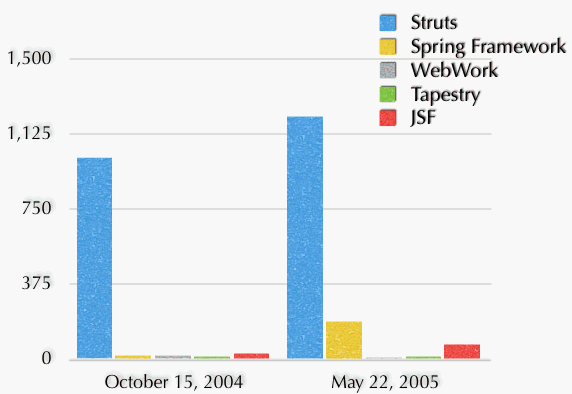
Web Framework Jobs

My search criteria for all of these was "framework and java" from the front page on dice.com. I did filter a bunch out for WebWork b/c there's some product called "WebWorks" that folks want to hire for.

In my own experience, these numbers are not as accurate as you might think. Since I gave my original presentation, I've been contacted a number of times to work on projects. It's about even between Struts, Spring MVC, WebWork and JSF. I haven't had a single inquiry to do Tapestry development. The bad part about Struts jobs is there's so many of them, that rates are likely pretty low (i.e. 35-45/hour), whereas the others can get you upwards of 80-90/hour.

So what do these numbers mean? Do they mean you should tailor your learnings and skills to the most popular frameworks? In a sense, it's important to do so. If nothing else, Struts skills are import so you can migrate all the Struts applications to your favorite framework. However, I don't think these numbers are that important when choosing a framework to start your project with. I think the most important thing in choosing a framework is passion. Which one do you want to work with the most? It's likely that your productivity will be higher if you're enthusiastic about the framework, rather than bored with all the skills you've accumulated using it. Then again, if you're motivated by productivity more than enthusiasm - using your skills to crank out applications quickly is probably a good idea.

You might think that the number of skilled developers for framework X is important too. I don't think it is. I think the most important thing is to hire smart developers. A good developer can come up to speed on any framework in 2 weeks and be highly productive in 4 weeks. If not, the developer isn't that smart or the framework isn't that good. ;-)

Just for kicks, I did some searching for other web frameworks as well:

  • Rife: 0
  • Wicket: 0
  • Echo: 3
  • Ruby on Rails: 1
  • ASP .NET: 2876

Now the question is - what kind of rates are these skills getting? I'd like to know what the average Rails and ASP .NET developers make. In Denver, Java developers seem to make between 65-85/hour when they're experienced contractors.

Posted in Java at May 22 2005, 07:28:01 AM MDT 13 Comments

[OSCON] AppFuse Tutorial and Spring MVC vs. WebWork

AppFuse Home Now that the OSCON 2005 site is up, I might as well advertise the two things I'm doing: an AppFuse Tutorial and a session titled WebWork vs. Spring MVC Smackdown with Matthew Porter. I wasn't planning on doing the AppFuse Tutorial, but I was asked to do it - so what the heck. The title has "Struts" in it, but I'm willing to do whichever one (JSF, Struts, Spring MVC, Tapestry or WebWork) the audience chooses. If we're good, maybe we'll have an Eclipse Plugin done by this conference to simplify the new project and code generation process.

OSCON 2005

Posted in Java at May 07 2005, 08:45:40 PM MDT 2 Comments

AppFuse Videos

I know I said I'd never do an AppFuse video, but after having many requests - I decided to go ahead and make a couple. The first one is a demo of creating a new project and then installing and browsing that project in your browser - to see all the out-of-the-box features.

The 2nd one basically all the stuff that's done in the tutorials - using Spring MVC for the web framework. I create a Person.java object and then use AppGen to generate all the code for it. In this one, I make a number of mistakes (but solve them all). I thought about going fully happy-path, but then decided it was important to show some gotchas that might occur.

I used the trial version of Camtasia Studio to create these videos. Thanks to Keith at KGB Internet for hosting the demo site for AppFuse. If you need Tomcat hosting, Keith offers an excellent service at a very good price.

Update: You can also download these videos for off-line use.

Update 2: I updated these videos for AppFuse 1.9.3.

Posted in Java at May 04 2005, 09:48:40 AM MDT 32 Comments

AppFuse Demos moved to demo.appfuse.org

I bought the appfuse.org domain name sometime last year. I haven't done anything with it for the most part and I've just pointed it to this site. It's amazing how many people actually use it - it's my 4th largest referrer! The demo site I have at Kattare (demo.raibledesigns.com) has a whole slew of demos installed on it, so I contacted Keith (at kgbinternet.com) to set me up a new domain for AppFuse-only demos. These can now be found at http://demo.appfuse.org or by clicking on of the URLs below. The site is currently running AppFuse 1.8 with JDK 5 and Tomcat 5.5.7.

The "Issues" link on this site won't work yet - I'm in the process of setting up JIRA at http://issues.appfuse.org. Hopefully we'll have it done sometime this week. Contegix has been gracious enough to offer free hosting of AppFuse's JIRA instance.

Update: AppFuse's JIRA is now up. Thanks again to Atlassian for a great product and to Contegix for hosting it. The quick installation and support from Contegix has been outstanding.

Posted in Java at May 03 2005, 09:54:30 AM MDT 10 Comments

JSF needs better tools

In general, I don't like the fact that JSF is designed for tools vendors. However, after seeing a Visual Studio .NET 2005 demo - I can understand why that's Sun's motivation. Visual Studio is *very* cool and seems to greatly simplify ASP.NET development. That's why it's disturbing to see Why do JSF tools suck so bad?.

If the JSF Tools are going to suck (compared to Visual Studio), why don't we just make it more developer-friendly (instead of being so tools-friendly)? Of course, the better solution is to make the tools better, but that doesn't seem to be happening. Maybe we should just try to get Visual Studio to support JSF. ;-)

Posted in Java at Apr 19 2005, 09:38:07 AM MDT 14 Comments

How do we bake Ajax into Struts and Spring MVC?

I see a trend happening here. The next version of WebWork, as well as Tapestry and JSF are all embracing Ajax technologies. By "embracing", I mean they're not only using them, but they're making it easier for us to use them.

After using XmlHttpRequest in my last two projects, I think this is a must for Struts and Spring MVC as well. The technology is very cool and customers absolutely love it.

The question is how do we bake it in? WebWork makes it easy because its tag libraries are backed by customizable Velocity templates. With Struts and Spring MVC, it seems the best way would be to use tag libraries, but maybe there's better alternatives. Do they each need an AjaxAction/AjaxController or something that allows DWR-type stuff?

What are your thoughts? You might argue that using DWR should suffice, but w/ everyone else (even Rails) baking it into the framework - I see no reason why Spring MVC and Struts shouldn't do the same. You are using these frameworks to develop kick-ass UIs aren't you?

Posted in Java at Apr 15 2005, 06:20:28 AM MDT 13 Comments