

Matt RaibleMatt Raible is a writer with a passion for software. Connect with him on LinkedIn.

The Angular Mini-Book The Angular Mini-Book is a guide to getting started with Angular. You'll learn how to develop a bare-bones application, test it, and deploy it. Then you'll move on to adding Bootstrap, Angular Material, continuous integration, and authentication.

Spring Boot is a popular framework for building REST APIs. You'll learn how to integrate Angular with Spring Boot and use security best practices like HTTPS and a content security policy.

For book updates, follow @angular_book on Twitter.

The JHipster Mini-Book The JHipster Mini-Book is a guide to getting started with hip technologies today: Angular, Bootstrap, and Spring Boot. All of these frameworks are wrapped up in an easy-to-use project called JHipster.

This book shows you how to build an app with JHipster, and guides you through the plethora of tools, techniques and options you can use. Furthermore, it explains the UI and API building blocks so you understand the underpinnings of your great application.

For book updates, follow @jhipster-book on Twitter.

10+ YEARS


Over 10 years ago, I wrote my first blog post. Since then, I've authored books, had kids, traveled the world, found Trish and blogged about it all.

RE: Mock Shmocks!

After I finished reading Open Source Programming and all the of the feedback from my Mock Shmocks post, I've realized that I need to learn more about Mocks. I need to learn how to streamline my TDD process. It's just taking too long right now. So where do I go from here? AppFuse currently contains, from what I can tell, only integration tests. All the tests depend on the database or the container to run. It works great, and all of AppFuse's tests complete under 3 minutes, but obviously this time increases as the project grows. So should I remove some integration tests and replace them with unit (mock) tests? If so, which ones? Should UserDAOTest talk to the database, but LookupDAOTest only use a Mock? How do you decide which tests should be real (integration) and which tests don't need to be (mocks)?

If the answer is "create a unit tests to sit next to each one of your integration tests" - then that seems like a waste of time. Am I supposed to have 2 *Test.java classes for each real class? I need a book that'll explain all of this and make me the TDD guru I long to be.

Even if I figured out all the answers to the above questions - which package should I use? There's a whole slew of them: Mockrunner, MockObjects, EasyMock and jMock. How do you decide? It's easy when testing Java classes - you use JUnit. When you want to test servlets, you use Cactus. Why all the choices for Mock testing?
Posted in Java at Jan 28 2004, 10:18:17 PM MST 6 Comments

Tapestry vs. Struts

I've been watching the Tapestry mailing lists in hopes of picking up some tips before I start learning it. In reality, I'm waiting for Tapestry in Action, which will hopefully make it easier to learn. Today, there was a very interesting thread comparing Tapestry to Struts. It looks to me that Tapestry is easier to develop with once you get the hang of it, but apparently, it has a steep learning curve.

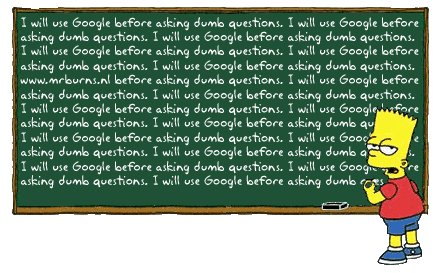
The Tapestry Mailing list is interesting - it seems to have a different level of users. Maybe it's just me, but they seem to be a more enlightened crowd. You could almost say the same for the WebWork mailing lists. If I compare these two lists to the questions on the Struts mailing lists - it seems like there's a bunch of idiots over there (on Struts). Don't these people know how to use Google?! To be fair to Struts, I have a theory.

If WebWork or Tapestry ever becomes as popular as Struts, they'll get their fare share of idiots too.

It's just the nature of mailing lists - it's so much easier to ask your question than to look for the answer. Which reminds me...

Don't ask dumb questions...

Posted in Java at Jan 28 2004, 09:51:15 PM MST 2 Comments