Matt RaibleMatt Raible is a writer with a passion for software. Connect with him on LinkedIn.

The Angular Mini-Book The Angular Mini-Book is a guide to getting started with Angular. You'll learn how to develop a bare-bones application, test it, and deploy it. Then you'll move on to adding Bootstrap, Angular Material, continuous integration, and authentication.

Spring Boot is a popular framework for building REST APIs. You'll learn how to integrate Angular with Spring Boot and use security best practices like HTTPS and a content security policy.

For book updates, follow @angular_book on Twitter.

The JHipster Mini-Book The JHipster Mini-Book is a guide to getting started with hip technologies today: Angular, Bootstrap, and Spring Boot. All of these frameworks are wrapped up in an easy-to-use project called JHipster.

This book shows you how to build an app with JHipster, and guides you through the plethora of tools, techniques and options you can use. Furthermore, it explains the UI and API building blocks so you understand the underpinnings of your great application.

For book updates, follow @jhipster-book on Twitter.

10+ YEARS


Over 10 years ago, I wrote my first blog post. Since then, I've authored books, had kids, traveled the world, found Trish and blogged about it all.

Portland Tech Meetup Tomorrow Night

If you live in Portland, Oregon - or just happen to be in town - you might want to join us for some beers and tech talk tomorrow (Monday) night. Patrick Lightbody, Howard Lewis Ship and myself will be meeting around 6:30 at the Rogue Distillery & Public House (map). With 36 taps and the delicious beer from Rogue Ales, this is sure to be a fun night.

If you're on Facebook, you can let us know you're coming by RSVP'ing to the Event. Otherwise, please leave a comment or just show up.

Posted in Java at Dec 28 2008, 04:18:35 PM MST 3 Comments

AppFuse Light converted to Maven modules, upgraded to Tapestry 5 and Stripes 1.5

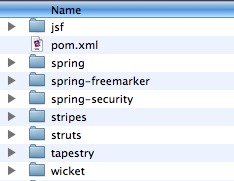
This past week, I stayed up a couple of late nights to do some of the AppFuse Light work I wrote about in October. I converted all web frameworks to Maven modules, as well as made them inherit from the appfuse-web project. Below is what the new module structure looks like:

New AppFuse Light Modules

At this point, the project is ready to import into AppFuse's SVN project. Here's a list of other changes I made:

  • Modules now depend on AppFuse's backend and allow you to use Hibernate, JPA or iBATIS as the persistence framework. Implementations for Spring JDBC, OJB and JDO have been removed.
  • Upgraded to JWebUnit 2.1, which now uses HtmlUnit under the hood and has much better JavaScript support. It also has Selenium support, but I've yet to try it.
  • Ajaxified Body integrated into all frameworks. You can easily turn it off by modifying the global.js file.
  • Prototype and Scriptaculous loaded from Google's Ajax Libraries CDN.
  • Upgraded to Tapestry 5. Mad props to Serge Eby and his tapestry5-appfuse project for showing me how to do this. Serge became a committer on AppFuse recently, so hopefully we'll continue to see great things from the Tapestry 5 support. I really like the clean URLs and minimum configuration required in Tapestry 5. It's testing framework is nice too, but I believe it could be improved.
  • Upgraded to Stripes 1.5. This was easy and painless. I'm definitely a fan of Stripes and look forward to reading the Stripes book on my bookshelf.
  • Dropped support for: Struts 1.x, WebWork, Spring MVC + Velocity.

If you want to try any of these applications, you can create archetypes using the following commands:

svn co https://appfuse-light.dev.java.net/svn/appfuse-light/trunk appfuse-light
cd appfuse-light/preferred-web-framework
mvn archetype:create-from-project
cd target/generated-sources/archetype
mvn install
cd ~/dev
mvn archetype:generate # The new archetype should show up as an option

Next steps include figuring out a way to flatten the inherited dependencies and plugins so archetype:create-from-project can create truly standalone projects. Please let me know if you have any questions.

Posted in Java at Dec 20 2008, 06:42:03 PM MST 9 Comments

Dojo/Comet support in Java Web Frameworks

Dojo Logo This week I'm doing a research project for a client. The main purpose of the project is to find out which Java-based web framework works best with Dojo and Comet. Here's the key requirement from the client:

It's all about Comet, we want Comet everywhere we can put it, but we want to isolate the icky bits of fiddling with pages with JavaScript. We're kind of wed to the Dojo implementation of the client-side bit, so we may as well use more of the Dojo widgets for a richer UI. For us, "works best with" needs to pay a certain amount of consideration to "fits naturally with", if you understand what I mean. I know that any framework that lets you spit out raw HTML will let you hand code in your Dojo / Comet, but that's certain to become very tiresome very quickly.

The candidate frameworks they asked me to look at are Wicket and Tapestry 5. They're willing to upgrade to Struts 2 since they're already using Struts 1. However, they don't feel that action-based frameworks naturally lead to rich UIs, so they'd prefer a component-based framework. They're currently using Seam for an administration-type application and feel it's too heavy for their customer-facing application.

Here's what I've found so far in my research. Please let me know if anything is incorrect.

  • Tapestry 5 doesn't have Dojo or Comet support (Prototype and Scriptaculous are the baked-in Ajax frameworks).
  • Struts 2 has old (version 0.4.3) and somewhat deprecated Dojo support. The developers seem to be in favor of removing it and promoting people hand-code Dojo instead. Struts 2 doesn't have support for Comet.
  • Wicket has support for Dojo 1.1 that includes Comet support. This was written by Stefan Fußenegger and posted to the mailing list last month. I e-mailed Stefan and asked him about documentation. His response: "I lost my ambition to document it properly since I didn't receive any feedback on the mailing list. :)"

At this point, it seems that if the client really wants to use Dojo, they should use Wicket, and possibly pay Stefan to document it properly. However, they're willing to consider other options, as long as they have Comet support.

One option I thought of is to use DWR and its Reverse Ajax/Comet support. Another option would be to add better Dojo support to Tapestry 5. However, I don't think this is possible since the Prototype/Scriptaculous code is generated by the framework and would likely require a changes to switch it to Dojo.

Are there any other Java-based web frameworks that support easily creating Dojo widgets and working with Comet? Keith Donald tweeted that Spring MVC has Dojo support. However, I believe it's only for widgets and it still requires you to write JavaScript. If your framework doesn't have Dojo/Comet support, how hard would it be to add it?

Update: I also posted this question on LinkedIn. Make sure and check my question for additional thoughts from folks.

Posted in Java at Dec 18 2008, 03:58:37 PM MST 19 Comments