
Matt RaibleMatt Raible is a writer with a passion for software. Connect with him on LinkedIn.

The Angular Mini-Book The Angular Mini-Book is a guide to getting started with Angular. You'll learn how to develop a bare-bones application, test it, and deploy it. Then you'll move on to adding Bootstrap, Angular Material, continuous integration, and authentication.

Spring Boot is a popular framework for building REST APIs. You'll learn how to integrate Angular with Spring Boot and use security best practices like HTTPS and a content security policy.

For book updates, follow @angular_book on Twitter.

The JHipster Mini-Book The JHipster Mini-Book is a guide to getting started with hip technologies today: Angular, Bootstrap, and Spring Boot. All of these frameworks are wrapped up in an easy-to-use project called JHipster.

This book shows you how to build an app with JHipster, and guides you through the plethora of tools, techniques and options you can use. Furthermore, it explains the UI and API building blocks so you understand the underpinnings of your great application.

For book updates, follow @jhipster-book on Twitter.

10+ YEARS


Over 10 years ago, I wrote my first blog post. Since then, I've authored books, had kids, traveled the world, found Trish and blogged about it all.

Ajaxified Body: Now with Back Button and Bookmarking Support

I uploaded a new version of Ajaxified Body to its demo site a few minutes ago. Changelog:

Added RSH for history and bookmarking and changed to use Prototype and Scriptaculous from Google's CDN.

I found Really Simple History easy to use but poorly documented. Brad Neuberg's AJAX: How to Handle Bookmarks and Back Buttons article was the one that got me over the learning curve. Hat tip to Ignacio for the RSH suggestion.

Let me know if you see any issues or have suggestions for improvement.

Posted in Java at Oct 07 2008, 12:14:00 AM MDT 4 Comments

Ajaxified Body

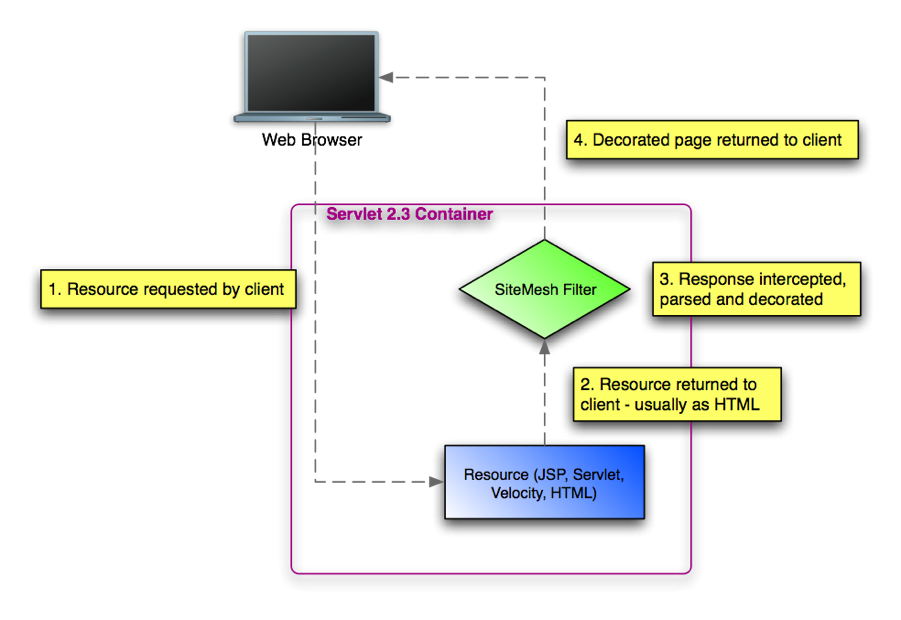
I've often wondered if it was possible to use Ajax to reload the main content of a web application without reloading the header, menu and footer. SiteMesh allows you to move these common elements to a decorator that gets wrapped around each page. Below is a diagram of how SiteMesh works.

SiteMesh

You can read the Introduction to SiteMesh article if you're interested in learning more about SiteMesh's basic features. By default, SiteMesh decorates text/html responses and ignores any other content type (e.g. image/gif). It also contains an <excludes> configuration element that allows you to turn off decoration when a URL matches a certain pattern. For example, the following allows you to disable decoration when "ajax=true" is passed in the URL.

<excludes>
    <pattern>**ajax=true</pattern>
</excludes>

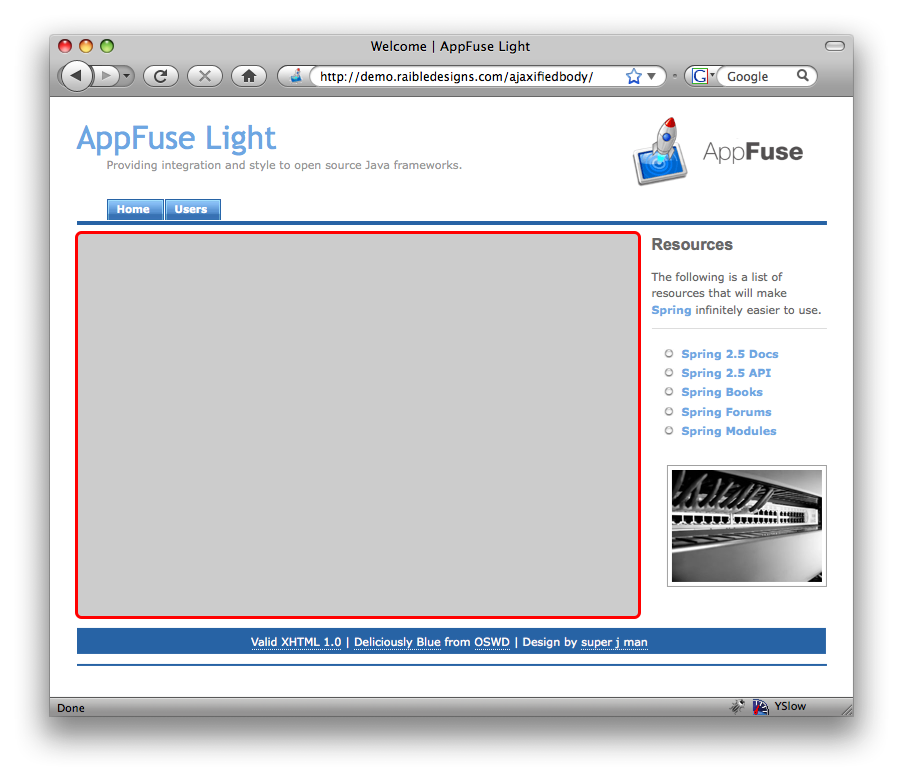
To optimize the loading of an application so the common elements aren't loaded for each page, it should be possible to create an Ajaxified Body where the primary content area (PCA) of the site is loaded via Ajax rather than refreshing the whole page. The header, footer and navigation bar often stays the same from page-to-page, so it doesn't seem to make a whole lot of sense to load them each time the page loads. The image below shows the PCA (of an AppFuse Light application) as a grey square with a red border.

Ajaxified Body - AppFuse Light

Implementing an Ajaxified Body consists of the following steps:

  1. Adding SiteMesh and moving common elements to a decorator.
  2. Remove common elements from each individual page (if you're using includes).
  3. Configure SiteMesh so decoration is disabled when the requested URL contains "ajax=true".
  4. Write JavaScript that modifies all <a href=""> links (and buttons with onclick='location.href') in the PCA to have an onclick handler.
  5. The onclick handler should call a JavaScript function that loads the link's URL + ajax=true using XMLHttpRequest (XHR).
  6. Add XHR success handling to replace the PCA with the loaded content.
  7. Add XHR error handling to go to the URL normally when response.status != 200.
  8. Inspect the response HTML for <title> element and replace document.title if exists.
  9. Inspect the response HTML for <head> element and append to current if exists.
  10. Inspect the response HTML for <script> and <link> elements (JavaScript and CSS) and evaluate them if they exist.

As a proof of concept, I created a prototype using AppFuse Light (Prototype/Scriptaculous for Ajax). You can see a demo at the following URL. You can also download a patch or the source for this project.

http://demo.raibledesigns.com/ajaxifiedbody

Below are a number of things I discovered while writing this prototype:

  • The hardest part of implementing this seems to be coding the exceptions. It's possible you'll have some links with existing onclick handlers and you may have to disable "ajaxifying links" for those links.
  • A progress indicator is important or the page might load so fast that the user doesn't visually detect it changed. This can lead to a worse user experience because they don't see the flash of the blank page they're used to when a page load occurs.
  • While forms can be submitted via Ajax, there's no harm in leaving existing form behavior in place where the full site is reloaded after submitting a form.
  • If a particular page needs to change the common elements (header, menu, footer), it should be possible to do that with JavaScript after the PCA content loads.
  • If the success/error indicator is outside the PCA, it may need to be populated and displayed/hidden with JavaScript after the PCA loads.

I'm sure my implementation can be improved, but I'm also curious to see what you think of this idea. I know it's not revolutionary, but it's something I'm considering adding by default to AppFuse and AppFuse Light. Do any Ajax frameworks do something like this out-of-the-box?

Update: Thanks to everyone for the great feedback - keep it coming. I agree that adding history support is a must. I'll try to do that in the next day or two. This post has also been featured on Javalobby and Ajaxian.

Update 2: Added history support.

Posted in Java at Oct 03 2008, 02:33:09 PM MDT 19 Comments

Oktoberfest: Best. Vacation. Ever.

As mentioned earlier, a good friend (Miller) and I took a vacation to Oktoberfest last week. The flight over was brutal: Denver -> Newark (4 hour layover) -> Paris (2 hour layover) -> Munich. I was pretty disappointed to see "No Service" on my iPhone when we landed in France. This continued in Munich and I quickly decided connectivity wasn't necessary. After a 80 € cab ride from the airport, we arrived at our hotel around 1PM on Monday. We both woke up at 4AM on Sunday to start the journey, so we were pretty beat.

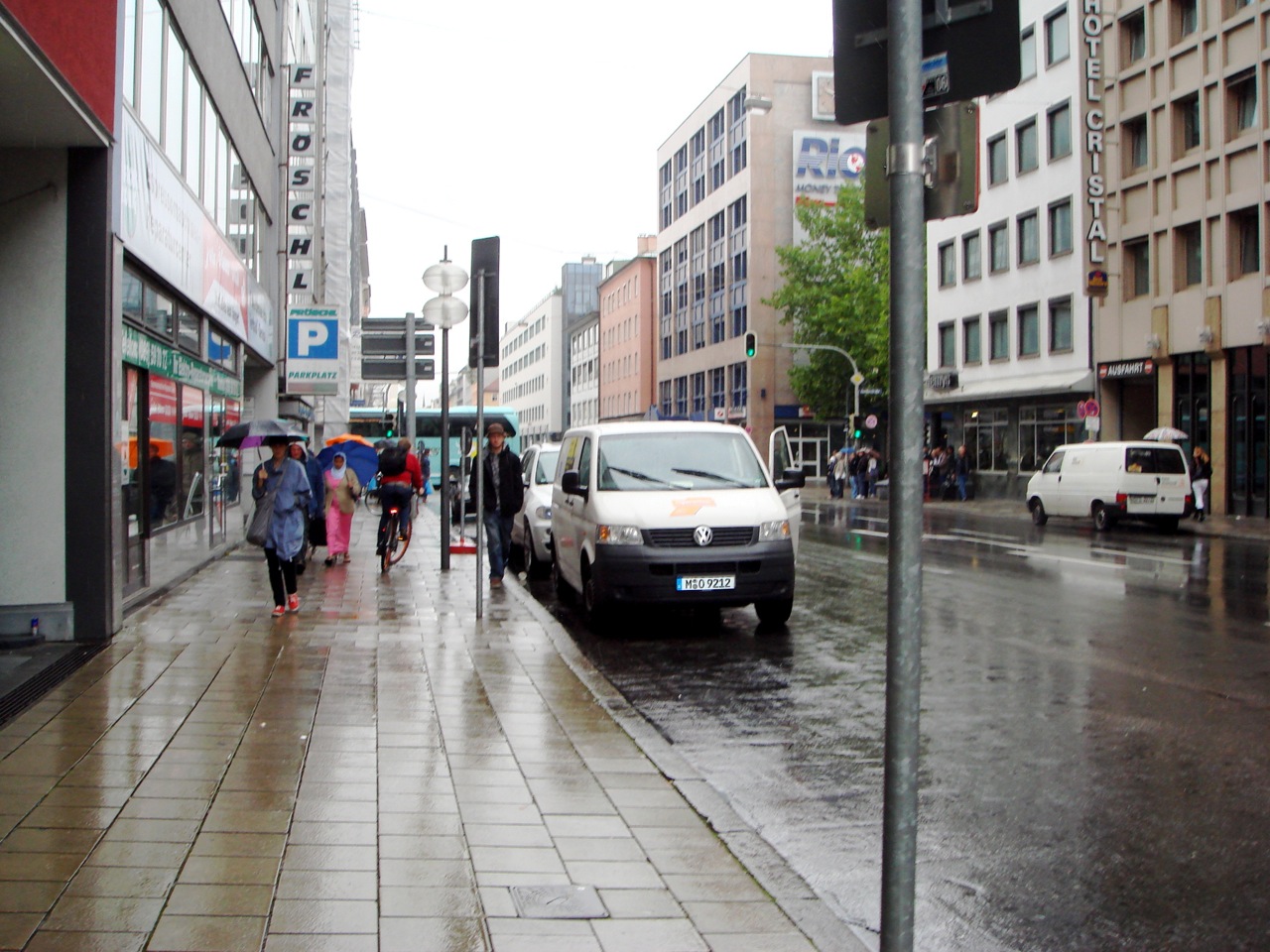
It didn't take us long to decide we had to suck it up and head to "The Tents" at Oktoberfest. We walked the 4 blocks in the rain and quickly ended up in the Armbrustschutzenzelt tent. The crowd was small and we found a table and enjoyed our first Liter.

Weather on Arrival in Munich Day 1 - First Tent

I won't go into details about how much fun we had during the week, except for these simple stats:

  • Made it into The Tents 5 days in a row
  • Mostly slept in until 2 or 4PM each day
  • No Hangovers (for me at least)

I've uploaded most of the pictures I took to an Oktoberfest 2008 set on Flickr. I would like to thank Peter and friends for being fabulous hosts and showing us a great time on Thursday night. Below is a video I took of what the festivities were like (yes, that is Bon Jovi):

If you ever get a chance to attend Oktoberfest, I highly recommend it.

Posted in General at Oct 01 2008, 10:37:49 PM MDT 5 Comments

My Oktoberfest Adventure Begins

A few months ago, a friend called me up and asked if I wanted to go to Oktoberfest. He said he had enough miles to cover both our tickets. I couldn't pass up the opportunity and hence we're leaving at the crack of dawn tomorrow for a week in Munich, Germany. We're not taking laptops and we don't plan on doing a whole lot more than having a great time.

Summerview @ Neuhausen/Munich

If you'd like to see what we're doing on our adventure, you can follow me on Twitter.

Posted in General at Sep 20 2008, 10:19:28 PM MDT 13 Comments

Performance Testing Memcached

Earlier this week, co-workers and I did some performance testing with Memcached. We wanted to see how long it'd take to send different sizes of objects over the wire to Memcached on a remote server.

We setup a simple environment with 2 Mac Pros both running 2 x 2.8 Ghz Quad-Core Intel Xeon processors and 12GB of RAM. We used one machine as a Memcached server and one machine running an application with the addition of a new Servlet Filter. The Servlet Fitler read a size parameter and used it to set the size of the object being written and read from the Memcached server. We used JMeter to put load on the box. The following describes the load and the results.

Write Times
Write tests were performed with a single user executing 1000 sequential remove then writes.

Size in Bytes Time (ms.) Min. Time (ms.) Max. Time (ms.) Total
20000 1.31 0 7 1000
50000 1.834 1 8 1000
100000 2.87 2 9 1000
500000 12.641 9 283 1000

Read Times
Read tests were performed using 50 users with 1 sec. ramp times executing 100 reads each.

Size in Bytes Time (ms.) Min. Time (ms.) Max. Time (ms.) Total
20000 4.8414 1 375 5000
50000 18.343 1 354 5000
100000 46.181 2 415 5000
500000 137.7328 6 953 5000

During our tests, Memcached was started using the following settings:

memcached -d -m 2048 -M -p 10171 -vv

If you've done similar performance testing with Memcached, we'd love to see your results.

Posted in Open Source at Sep 19 2008, 11:29:33 AM MDT 6 Comments

RE: How Open Source is Spring?

Peter Mularien has a very well written post titled How Open Source is Spring?: An Analytical Investigation:

This post is to expand on some of the thoughts I posted on the SpringSource Blog in response to Rod Johnson's excellent description of the SpringSource business model and its commitment to development of open source software.

Now that SpringSource has shown an ability to crank out new product releases on a seemingly weekly basis, I wanted to reflect on where Spring is positioned in the Java open source community, and how open the Spring Core project is to work done by the public.

The hypothesis of my experiment occurred to me when I happened to be reviewing Spring JIRA assignments one day. I was curious whether, following the bug assignments, the majority of development on the "Spring Core" projects (including Spring MVC and what we would consider "classic Spring") is performed solely by SpringSource employees.

Peter's post is near and dear to me because I'm doing a What's coming in Spring 3.0 talk at the Colorado Software Summit in October. The only information I was able to find on Spring 3.0 is from random blog posts and Juergen's presentation. When I give talks about technologies, I prefer to dig in and try them before talking about it. With Spring 3.0's source code nowhere to be found, this is very difficult to do.

I really hope Spring 3.0 becomes available in early October. If it does, I hope to upgrade AppFuse, AppFuse Light and Spring Kickstart. If it doesn't, my talk will most likely be a regurgitation of what Juergen's slides have and that's just not right.

Posted in Java at Sep 19 2008, 09:54:48 AM MDT 14 Comments

Abbie gets her first tooth and The Bus looks great!

Today was quite the day. First of all, Jack and I took Abbie to A Wild Smile to get a couple front teeth yanked. She has her first adult tooth coming in and her baby teeth weren't getting out of the way. Before and after pictures are below:

Abbie has all her baby teeth 2 got yanked

This afternoon, I drove to Colorado Springs to see The Bus and speak at the Colorado Springs Open Source User Group. The Bus looked great. Motorworks Restorations has done a lot of very detailed work (i.e. replacing corners, stretching the frame, replacing window and door drains) in the last couple of months.

We talked for a good hour about the possibilities in wheels, transmission, engine, suspension, gauges and interior. My favorite topics were the air bags, 6-cylinder 911 engine and safari windows. Click here to see the full set of pictures I took. Quote of the night: "It's going to be better than it was when it was brand new."


After leaving the bus, I delivered my Web Frameworks of the Future Presentation to a bunch of guys (and gals) at a nearby library. It was a fun presentation because I got to meet a lot of folks I had name recognition for, but had never met. All in all, a very good day.

Tomorrow marks my last day of work before I head out on a week's vacation in Munich for Oktoberfest. I have a feeling the days are going to get a lot better from here on out. ;-)

Posted in The Bus at Sep 18 2008, 11:49:49 PM MDT 1 Comment

My TripIt Blog Badge

Jared started it. TripIt provides it. Here's mine:

Posted in General at Sep 17 2008, 12:48:52 PM MDT 2 Comments

Upgrading Hibernate to 3.4.0 and AppFuse for Tapestry 5

Last night I spent an hour upgrading AppFuse to Hibernate 3.4.0.GA. I tried the same thing a week ago, but failed miserably. When Hibernate Core Modules (3.3) (a Maven dependency howto) showed up on the Hibernate blog, I was re-inspired. I discovered some interesting things along the way (at least in my setup).

You need to use JBoss's Maven Repository
The latest Hibernate releases aren't in the central Maven repo yet. If they're not in there two weeks after the release, I doubt they'll be there anytime soon. Best to plan on adding http://repository.jboss.com/maven2 as a permanent repository. As a bonus, you can remove http://download.java.net/maven/2 since JTA is in JBoss's repo.

Javassist is not an optional dependency
If I remove the Javassist dependency, here's the error I get:

java.lang.NoClassDefFoundError: javassist/util/proxy/MethodFilter

Seems reasonable right? What if I add in the dependency on Hibernate's cglib instead?

java.lang.NoClassDefFoundError: javassist/util/proxy/MethodFilter

OK, so apparently you can't switch between Javassist and hibernate-cglib-repack as stated in Hibernate's Maven dependency howto. Of course, I do believe their instructions are correct, they just don't work in my setup. Versions I'm using: hibernate-core-3.3.1.GA and hibernate-annotations-3.4.0.GA.

Not including SLF4J is a bad idea
If you don't include a dependency on SLF4J (and you're using Spring), you get a nice cryptic error message.

Caused by: org.springframework.beans.BeanInstantiationException: Could not instantiate bean class 
[org.springframework.orm.hibernate3.annotation.AnnotationSessionFactoryBean]: 
Constructor threw exception; nested exception is java.lang.NoClassDefFoundError
        at org.springframework.beans.BeanUtils.instantiateClass(BeanUtils.java:115)
        at org.springframework.beans.factory.support.SimpleInstantiationStrategy.instantiate(SimpleInstantiationStrategy.java:61)
        at org.springframework.beans.factory.support.AbstractAutowireCapableBeanFactory.instantiateBean(AbstractAutowireCapableBeanFactory.java:877)
        ... 48 more
Caused by: java.lang.NoClassDefFoundError
        at java.lang.Class.forName0(Native Method)
        at java.lang.Class.forName(Class.java:164)
        at org.springframework.orm.hibernate3.LocalSessionFactoryBean.class$(LocalSessionFactoryBean.java:174)
        at org.springframework.orm.hibernate3.LocalSessionFactoryBean.(LocalSessionFactoryBean.java:174)
        at org.springframework.orm.hibernate3.annotation.AnnotationSessionFactoryBean.(AnnotationSessionFactoryBean.java:64)
        at sun.reflect.NativeConstructorAccessorImpl.newInstance0(Native Method)
        at sun.reflect.NativeConstructorAccessorImpl.newInstance(NativeConstructorAccessorImpl.java:39)
        at sun.reflect.DelegatingConstructorAccessorImpl.newInstance(DelegatingConstructorAccessorImpl.java:27)
        at java.lang.reflect.Constructor.newInstance(Constructor.java:494)
        at org.springframework.beans.BeanUtils.instantiateClass(BeanUtils.java:100)

Hibernate's JPA now uses PersistenceException instead of EntityExistsException
In previous releases, Hibernate's ConstraintViolationException was wrapped in a javax.persistence.EntityExistsException. In Hibernate's EntityManager 3.4.0.GA, it's wrapped in a javax.persistence.PersistenceException.

Of course, these errors could be caused by Spring or Maven, but my hunch is they're more related to Hibernate and it's new more modular dependencies. You can view the full changeset for upgrading Hibernate 3.2.6.ga to 3.3.1.GA via FishEye.

Tapestry 5 version of AppFuse
In other AppFuse-related news, Serge Eby has created a Tapestry 5 version of AppFuse. You can see his alpha-level work in Google Code's tapestry5-appfuse project. I haven't had a chance to take a look at Serge's work yet, but I'm eager to do so. Hopefully we can get it back into the main project sooner than later. As far as Wicket and Stripes support, I haven't forgot about those - just having trouble finding the time and motivation to do the work.

Posted in Java at Sep 17 2008, 09:35:45 AM MDT 12 Comments

New Belgium's New Beer: Giddy Up!

I like the name, but the beer itself doesn't sound very good.

Giddy Up!

Ale brewed with Lemon Peel and infused with Espresso. Anyone tried this stuff?

Posted in General at Sep 16 2008, 09:43:48 AM MDT 16 Comments