Matt RaibleMatt Raible is a writer with a passion for software. Connect with him on LinkedIn.

The Angular Mini-Book The Angular Mini-Book is a guide to getting started with Angular. You'll learn how to develop a bare-bones application, test it, and deploy it. Then you'll move on to adding Bootstrap, Angular Material, continuous integration, and authentication.

Spring Boot is a popular framework for building REST APIs. You'll learn how to integrate Angular with Spring Boot and use security best practices like HTTPS and a content security policy.

For book updates, follow @angular_book on Twitter.

The JHipster Mini-Book The JHipster Mini-Book is a guide to getting started with hip technologies today: Angular, Bootstrap, and Spring Boot. All of these frameworks are wrapped up in an easy-to-use project called JHipster.

This book shows you how to build an app with JHipster, and guides you through the plethora of tools, techniques and options you can use. Furthermore, it explains the UI and API building blocks so you understand the underpinnings of your great application.

For book updates, follow @jhipster-book on Twitter.

10+ YEARS


Over 10 years ago, I wrote my first blog post. Since then, I've authored books, had kids, traveled the world, found Trish and blogged about it all.

Reviews: Getting Started with Grails, Rails for Java Developers and Groovy Recipes

Two weeks ago, I mentioned a number of books I was hoping to read to get up to speed on Rails and Grails quickly. Over the last two weeks, I was able to polish off three of these (listed in order of reading):

Below are short reviews of each book.

Getting Started with Grails
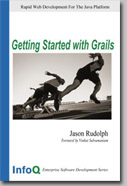
Getting Started with Grails The Good: This is the perfect book to learn the basics of Grails quickly. At 133 pages, I was able to read this entire book in one sitting. The first couple chapters are very introductory, but likely necessary for beginners. The good news is you start writing your first Grails application on page 7 (Chapter 3).

Chapter 4 (Improving the User Experience) is good in that it shows you how to do warning, error and confirmation messages. This is something often overlooked in web frameworks and Rails and its "flash" concept seem to have made it important again. I remember way back in 2003 when I complained about frameworks not allowing messages to live through a redirect - everyone said it was something you didn't need. Now it's a standard part of most web frameworks.

The Bad: Uses Grails 0.3.1. This is understandable since the book was written in 2006 and published in 2007. Also, it doesn't cover testing that much (5 pages). If testing is so easy with Groovy and if Grails has Canoo WebTest support built-in, it should be shown IMO.

Rails for Java Developers
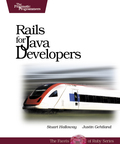
Rails for Java Developers The Good: This was an interesting book for me because it uses AppFuse for many of its Java-based examples. Unfortunately, it uses the Struts 1.x version which is cumbersome and verbose as far as Java web frameworks go. The most impressive part of this book is how Justin and Stu do an excellent job of walking the line and not insulting Java nor developers using it. They provide an easy to understand view of Rails from a Java Developer's perspective. There's detailed chapters on ActiveRecord (as it compares to Hibernate), ActiveController (compared to Struts) and ActiveView (compared to JSP). This book has excellent chapters on Testing, Automating the Development Process and Security.

The Bad: This book was published over a year ago, so it uses an older version of Rails. This means some commands don't work if you're using Rails 2.0. It's also a little light on Ruby, so I didn't feel I learned as much about the language as I was hoping to. That's understandable as it's more of a Rails book than a Ruby book.

Groovy Recipes (Beta from Jan 3, 2008)

Groovy Recipes The Good: I really like the style of this book and that it shows you how to get things done quickly with code samples. It's very no-nonsense in the fact that it contains a lot of code and howtos. I really like Scott's writing style and found this book the easiest to read of the three. This may have something to do with my eagerness to learn Groovy more than anything. The most refreshing part about this book is how up-to-date it is. Because it's a Beta, it seems to contain the most up-to-date information on Groovy and Grails. After reading Getting Started with Grails and working with it for a couple weeks, the first Grails chapter seemed a little basic - but that's likely because I've figured out how to mix all those recipes already. The Grails and Web Services chapter definitely has some interesting content, but I've rarely had a need to implement these recipes in a real-world environment. I'd rather see recipes on testing the UI (with the WebTest plugin) and how to use GWT and Flex with Grails. If SOUIs are the way of the feature, this is a must.

The Bad: Not much information on testing with GroovyTestCase, mock objects or implementing Security. If one of Groovy's sweet spots is testing, why isn't there more coverage on this topic? The Java and Groovy integration chapter is especially good, but there's very limited information on Ant and Maven. It's likely the websites provide sufficient documentation, but the Maven section only fills 5 lines on an otherwise blank page. The biggest problem I have with this book is I really like the recipes writing style and would love to see more tips and tricks. At 250 pages, I was able to finish this book with pleasure in a few days.

What's Next?
Now I'm reading JRuby on Rails (Apress) and Programming Groovy (Pragmatic Programmers). Following that, I'll be perusing dead-tree versions of Struts 2 Web 2.0 Projects (Apress), Prototype and script.aculo.us (Pragmatics) and Laszlo in Action (Manning). If any publishers want to send me books on GWT and Flex, I'd be happy to add them to my list. ;-)

Posted in Java at Feb 09 2008, 11:34:57 AM MST 10 Comments

YUI Grid CSS and Rails Performance

From Stephen O'Grady, I learned a couple interesting tidbits yesterday.

The first is Jeremy Zawodny talking about Yahoo's new Grid Builder in YUI Grid CSS and Grid Builder Kick Ass! The last time I looked at YUI Grid CSS (that's a mouthful) was almost 2 years ago, when it first came out. It's obvious that this library is better supported than Mike Stenhouse's CSS Framework. Maybe it's time to switch in AppFuse? Anyone know of themes available for Grid CSS?

The second item is Charlie Savage's entry titled Must Read Rails Performance Article:

Using a patched version of ruby and ruby-prof, Alex was able to more than double performance (with hints of more to come) and reduced memory consumption by 75%, or 750MB (yes - that is Megabytes). Alex does a wonderful job of documenting his approach with a series of blog posts here and here.

This reminds me of Don Brown's recent work on Maven. This is how open source is supposed to work - instead of complaining about the problems, fix them. In both Rails' and Maven 2's cases - it's somewhat surprising these issues weren't fixed earlier. Kudos to Alex Dymo and Don Brown for stepping up to the plate. Well done gents.

Posted in The Web at Feb 09 2008, 08:14:18 AM MST 2 Comments

It's a Powder Day, but there's no way to get there

It's a sad day in Denver. It's also a "locals' paradise" at the Colorado ski resorts. Most hills received around a foot of fresh powder last night, but there's no way to get there. I-70 is closed at Georgetown (which excludes Keystone, Breckenridge, Vail and Copper). Berthoud Pass (the road to Winter Park) is closed as well. Sniff. :-(

Posted in General at Feb 08 2008, 09:02:48 AM MST 3 Comments

There is no "best" web framework

From Mike Clark's blog, I learned about a number of TED Talks. As a fan of Malcom Gladwell, I was drawn to What we can learn from spaghetti sauce. In this talk, he talks about the research that Howard Moskowitz did for spaghetti sauce and how it changed the food industry forever. Here's a couple of quotes I wrote down:

"When we pursue universal principles in food, we aren't just making an error, we are actually doing ourselves a massive disservice."
...
"The difference between coffee at 60 (% satisfied) and coffee at 78 is the difference between coffee that makes you wince and coffee that makes you deliriously happy."
...
In embracing the diversity of human beings, we will find a sure way to true happiness.

Can this thinking be applied to web frameworks as well? What if it's not about choosing the best framework for your type of application? What if it's all personality related?

» Read more and comment on Javalobby.

Posted in Java at Feb 06 2008, 03:04:24 PM MST

How many years of experience do you really need?

DHH in Years of irrelevance:

Programming platform experience is like knowing your way around the kitchen. Where are the knives, what size plates do we have, and what spices are available. It's very useful for getting things done without having to search high and low for every little thing. But it's also an asset with a cut-off point of diminished returns. Once you have a reasonably good idea where things are, it's no longer the bottleneck in your culinary performance.

Like chefs, like programmers. Peopleware quotes a study that six months seemed to be the cut-off point for programmers. Once they had six months under their belt, the platform knowledge was no longer the bottleneck in their abilities.

That sounds about right to me.

I have to agree. I also think that total years of experience in the software industry plays a huge part in an engineer's knowledge.

The World is your Oyster However, that's not always true either.

I interviewed a PhD this week that had an incredible amount of experience and knowledge, but all his platform knowledge was dated.

Years of Experience in Software + up-to-date platform knowledge = the world is your oyster.

Posted in General at Feb 06 2008, 10:20:45 AM MST 2 Comments

Grails 1.0 and JRuby on Rails on WebSphere

A couple of interesting things happened today that relate to my Grails vs. Rails quest for knowledge.

The first is that Grails 1.0 was released. This was apparently a huge event as it swamped Codehaus' servers for a couple hours. This morning, it was pretty cool to shake Graeme's hand and congratulate him on the release. I also got to meet Jeff Brown for the first time. Who needs to go to a conference when you get to talk to these guys at work? ;-)

Secondly, I found an article by Ryan Shillington that shows how to deploy a Rails application to WebSphere. To me Rails + WebSphere seems like the last thing a Rails advocate would want - but who knows. In my experience, most developers that use WebSphere don't do it by choice.

For companies that have invested a lot of time and money into the JVM as a platform, it seems like Grails is the clear winner over Rails. However, the line gets blurry when you start talking about JRuby. I think JRuby will get there, but I don't believe it's there yet. If you look at the two major JRuby on Rails success stories (from Oracle and Sun), they've had to fix performance issues as part of their projects. With big companies investing in the platform, it's highly likely performance will be fixed in the near future. I believe both the Groovy and JRuby teams have said performance enhancements are their top priority for their next releases.

I think the biggest news related to performance of dynamic languages on the JVM is the new Da Vinci Machine project.

This project will prototype a number of extensions to the JVM, so that it can run non-Java languages efficiently, with a performance level comparable to that of Java itself.

Dynamic languages on the JVM seem to have a very bright future.

I got involved with Struts and Spring just before their 1.0 releases. Is it simply a coincidence that I happened to start looking into Grails right before its 1.0 release?

Posted in Java at Feb 05 2008, 11:32:12 PM MST 1 Comment

Groovy, Rails needs Components, RIA Frameworks compared and faster WebTests

Here's some interesting snippets I found while reading blogs today:

  • Stop writing plain old Java code. Groovy obsoletes plain old Java. We ought to just say "Java 7 = Groovy" and move on. -- Stuart Halloway
  • So far my experience is that I love the Ruby language and don't want to go back to doing Java except when/if I need to to pay the bills. But Rails I'm not as sold on. Mind you I'm not here to bash on Rails, there are some great things there and other people have done a fine job of praising them. But there are some things I definitely miss from Tapestry, and the most significant one is components. -- MysteryCoder
  • If you're looking for maximum control over presentation and the best possible appearance for the finished product, I would say Flex is probably the way to go. If you're a Java developer using Java on the server side, or you just can't stand the thought of having your app run in the Flash player and would prefer JavaScript, GWT is probably going to work out very well for you. Open Laszlo is going to offer a great deal of platform versatility, but at the expense of some polish and features available in the other two frameworks. - Kevin Whinnery in Three RIA Platforms Compared: Adobe Flex, Google Web Toolkit, and OpenLaszlo
  • A new experimental feature of WebTest allows to specify the number of threads that should be used for the tests what can bring enormous speed improvements without modification of the tests. -- Marc Guillemot

To summarize: use Groovy over Java, Rails needs components, Flex is the best RIA framework and WebTest keeps getting better. These aren't my words, but I don't see much fault in them either.

Posted in Java at Feb 05 2008, 12:30:34 AM MST 6 Comments

Powder Day at Steamboat

Photo of the Day @ Steamboat Today is going to be simply awesome:

Snow Report
    * Time: 02/02/08 05:00 am
    * Conditions: Powder
    * Lifts: 16/18
    * Trails: 163/163
    * 24 Hour Snow: 14"
    * 48 Hour Snow: 27"
    * Base: 78"
    * Total: 322"

I'm staying 30 minutes from Kremmling (at "The Farm"), so fresh tracks are an excellent possibility.

Posted in General at Feb 02 2008, 06:21:05 AM MST Add a Comment

How do you get up to speed on Rails and Grails quickly?

What's the best way to learn Rails and Grails and satisfy one of my New Year's Resolutions (read more) at the same time? Books:

Thanks to connections with publishers, I was able to get PDFs of most of these for free. The only ones I paid for were the beta books (Groovy Recipes and Programming Groovy) from the Pragmatic Programmers. I doubt I'll read them all, but I've had fun so far.

I polished off Getting Started with Grails in a few hours. I expect to finish Rails for Java Developers this week. I used to hate reading PDFs, but I've enjoyed reading these books. A 30" monitor might have something to do with it.

After honing my Grails and Rails knowledge, I hope to become a GWT and Flex Ninja. For those GWT and Flex experts out there, what are the best books for those technologies? By "best", I mean the most advanced and up-to-date.

Posted in Java at Jan 31 2008, 11:29:19 AM MST 10 Comments

What a forecast!

Mary Jane - Derailer Run This weekend, I'm planning on heading up to the hills for two fun-filled days of great Colorado skiing. Since it snowed a bit in Denver tonight, I figured I'd check the weather forecast:

Thursday Jan 31, 2008: 3 to 4 inches of accumulation
Friday Feb 01, 2008: 3 to 5 inches of accumulation
Saturday Feb 02, 2008: 3 to 5 inches of accumulation
Sunday Feb 03, 2008: 4 to 7 inches of accumulation

Sweet.

Friday Update: It looks like we'll be skiing at Steamboat tomorrow instead. Checkout their Straight Talk Snow Report from this morning:

Snow Report

    * Time: 02/01/08 05:00 am
    * Conditions: Powder
    * Lifts: 16/18
    * Trails: 163/163
    * 24 Hour Snow: 18"
    * 48 Hour Snow: 22"
    * Base: 77"
    * Total: 308"

Steamboat Straight Talk Snow Report: 2/1/08

Good Morning to you, indeed!

Remember earlier in the week when we had a loud, brash, windy storm 
roll through the mountains and bring us snow? Last night while no one 
was looking, a quiet storm tiptoed in like a whisper, under the cover 
of darkness, and silently dumped a foot and a half of the choicest 
"Champagne Powder" while we all slept. All over town, people woke up, 
looked out their windows, and let out a "Holy Cow"!

I could write this report with fill in the blanks, as in... My first 
run down___________ (insert any trail name) was sweet. I got face 
shots the whole way. Then I skied over to the __________(insert a run) 
trees and the snow was just blowing over my head.

I think you get the picture. The whole mountain is in epic condition.

On one chair ride, my chair mate said, "You know it's a good day, when 
you hear Monkey noises coming from the forest." Everywhere folks were 
hootin' and hollerin'.

Weekend warriors, don't despair, there is plenty powder left to be 
skied tomorrow.

Have fun. Be safe. Look out for your buddy. Peace.

Straight Talker
Kat Murphy
Grinning like a Chimp
Telemark Skier

:-D

Posted in General at Jan 30 2008, 10:24:21 PM MST 3 Comments