
Matt RaibleMatt Raible is a writer with a passion for software. Connect with him on LinkedIn.

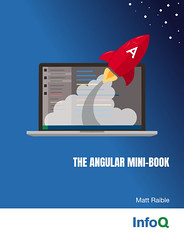
The Angular Mini-Book The Angular Mini-Book is a guide to getting started with Angular. You'll learn how to develop a bare-bones application, test it, and deploy it. Then you'll move on to adding Bootstrap, Angular Material, continuous integration, and authentication.

Spring Boot is a popular framework for building REST APIs. You'll learn how to integrate Angular with Spring Boot and use security best practices like HTTPS and a content security policy.

For book updates, follow @angular_book on Twitter.

The JHipster Mini-Book The JHipster Mini-Book is a guide to getting started with hip technologies today: Angular, Bootstrap, and Spring Boot. All of these frameworks are wrapped up in an easy-to-use project called JHipster.

This book shows you how to build an app with JHipster, and guides you through the plethora of tools, techniques and options you can use. Furthermore, it explains the UI and API building blocks so you understand the underpinnings of your great application.

For book updates, follow @jhipster-book on Twitter.

10+ YEARS


Over 10 years ago, I wrote my first blog post. Since then, I've authored books, had kids, traveled the world, found Trish and blogged about it all.

AppFuse 3.5 Released!

The AppFuse Team is pleased to announce the release of AppFuse 3.5. This release contains a number of improvements.

  • XML reduced by 8x in projects generated with AppFuse
  • CRUD generation support for Wicket, as well as AppFuse Light archetypes (Spring Security, Spring FreeMarker and Stripes)
  • Upgraded Tapestry to 5.4
  • Integrated Spring IO Platform for dependency management
  • Refactored unit tests to use JUnit 4
  • Renamed maven-warpath-plugin to warpath-maven-plugin
  • Upgraded to jWebUnit 3 for AppFuse Light integration tests
  • Updated all AppFuse Light modules to be up-to-date

For more details on specific changes see the release notes.

What is AppFuse?
AppFuse is a full-stack framework for building web applications on the JVM. It was originally developed to eliminate the ramp-up time when building new web applications. Over the years, it has matured into a very testable and secure system for creating Java-based webapps.

Demos for this release can be viewed at http://demo.appfuse.org. Please see the QuickStart Guide to get started with this release.

If you have questions about AppFuse, please read the FAQ or join the user mailing list. If you find any issues, please report them on the users mailing list. You can also post them to Stack Overflow with the "appfuse" tag.

Thanks to everyone for their help contributing patches, writing documentation and participating on the mailing lists.

We greatly appreciate the help from our sponsors, particularly Atlassian, Contegix, and JetBrains. Atlassian and Contegix are especially awesome: Atlassian has donated licenses to all its products and Contegix has donated an entire server to the AppFuse project.

Posted in Java at Feb 20 2015, 09:08:53 AM MST Add a Comment

Converting an Application to JHipster

I've been intrigued by JHipster ever since I first tried it last September. I'd worked with AngularJS and Spring Boot quite a bit, and I liked the idea that someone had combined them, adding some nifty features along the way. When I spoke about AngularJS earlier this month, I included a few slides on JHipster near the end of the presentation.

This week, I received an email from someone who attended that presentation.

Hey Matt,
We met a few weeks back when you presented at DOSUG. You were talking about JHipster which I had been eyeing for a few months and wanted your quick .02 cents.

I have built a pretty heavy application over the last 6 months that is using mostly the same tech as JHipster.

  • Java
  • Spring
  • JPA
  • AngularJS
  • Compass
  • Grunt

It's ridiculously close for most of the tech stack. So, I was debating rolling it over into a JHipster app to make it a more familiar stack for folks. My concern is that it I will spend months trying to shoehorn it in for not much ROI. Any thoughts on going down this path? What are the biggest issues you've seen in using JHipster? It seems pretty straightforward except for the entity generators. I'm concerned they are totally different than what I am using.

The main difference in what I'm doing compared to JHipster is my almost complete use of groovy instead of old school Java in the app. I would have to be forced into going back to regular java beans... Thoughts?

I replied with the following advice:

JHipster is great for starting a project, but I don't know that it buys you much value after the first few months. I would stick with your current setup and consider JHipster for your next project. I've only prototyped with it, I haven't created any client apps or put anything in production. I have with Spring Boot and AngularJS though, so I like that JHipster combines them for me.

JHipster doesn't generate Scala or Groovy code, but you could still use them in a project as long as you had Maven/Gradle configured properly.

You might try generating a new app with JHipster and examine how they're doing this. At the very least, it can be a good learning tool, even if you're not using it directly.

Java Hipsters: Do you agree with this advice? Have you tried migrating an existing app to JHipster? Are any of you using Scala or Groovy in your JHipster projects?

Posted in Java at Feb 12 2015, 09:28:59 AM MST 4 Comments