Matt RaibleMatt Raible is a writer with a passion for software. Connect with him on LinkedIn.

The Angular Mini-Book The Angular Mini-Book is a guide to getting started with Angular. You'll learn how to develop a bare-bones application, test it, and deploy it. Then you'll move on to adding Bootstrap, Angular Material, continuous integration, and authentication.

Spring Boot is a popular framework for building REST APIs. You'll learn how to integrate Angular with Spring Boot and use security best practices like HTTPS and a content security policy.

For book updates, follow @angular_book on Twitter.

The JHipster Mini-Book The JHipster Mini-Book is a guide to getting started with hip technologies today: Angular, Bootstrap, and Spring Boot. All of these frameworks are wrapped up in an easy-to-use project called JHipster.

This book shows you how to build an app with JHipster, and guides you through the plethora of tools, techniques and options you can use. Furthermore, it explains the UI and API building blocks so you understand the underpinnings of your great application.

For book updates, follow @jhipster-book on Twitter.

10+ YEARS


Over 10 years ago, I wrote my first blog post. Since then, I've authored books, had kids, traveled the world, found Trish and blogged about it all.
You searched this site for "jsf". 312 entries found.

You can also try this same search on Google.

What's the best Java Hosting Solution?

A friend recently asked me who I'd recommend for a Java hosting provider. Since I get asked this question every-so-often, it seemed appropriate to post my answer here.

  1. KGB Internet - I use KGB for this site. I have my own JVM and have full control over what I want to install. I can control Tomcat versions and upgrade as needed. I don't know if I'd recommend him for a business site as he can take up to 12 hours to respond to requests.
  2. Kattare - These guys will give you your own Tomcat instance and seem to have reasonable prices. They do seem to take quite some time to respond to requests (24-48 hours). I have a free instance that I use for a non-profit, so that could be the reason.
  3. Contegix - These guys are far-and-away the best company for Java-based hosting. They're not cheap though. However, they have the best customer service in the business - often responding to e-mails in less than a minute.

Do you agree with these recommendations? If not, who do you recommend for Java hosting and why?

Posted in Java at Feb 07 2009, 10:21:28 AM MST 38 Comments

Choosing an Ajax Framework

This past week, my colleagues and I have been researching Ajax Frameworks. We're working on a project that's following SOFEA-style architecture principles and we want the best framework for our needs. I'm writing this post to see 1) if you, the community, agree with our selection process and 2) to learn about your experiences with the frameworks we're evaluating. Below is the process we're following to make our choice.

  1. Choose a short list of frameworks to prototype with.
  2. Create an application prototype with each framework.
  3. Document findings and create a matrix with important criteria.
  4. Create presentation to summarize document.
  5. Deliver document, presentation (with demos) and recommendation.

For #1, we chose Ext JS, Dojo, YUI and GWT because we feel these Ajax libraries offer the most UI widgets. We also considered Prototype/Scriptaculous, jQuery and MooTools, but decided against them because of their lack of UI widgets.

For #2, we time-boxed ourselves to 3 days of development. In addition to basic functionality, we added several features (i.e. edit in place, drag and drop, calendar widgets, transitions, charts, grid) that might be used in the production application. We all were able to complete most of the functionality of the application. Of course, there's still some code cleanup as well as styling to make each app look good for the demo. The nice thing about doing this is we're able to look at each others code and see how the same thing is done in each framework. None of us are experts in any of the frameworks, so it's possible we could do things better. However, I think it's good we all started somewhat green because it shows what's possible for someone relatively new to the frameworks.

For #3, we're creating a document with the following outline:

Introduction

Ajax Framework Candidates
(intro and explanation)

  Project Information
  (history)
  (license / cost)
  (number of committers)
  (support options)
  (mailing list traffic (nov/dec 2008))

Matrix and Notes

Conclusion

For the Matrix referenced in the outline above, we're using a table with weights and ranks:

Weight Criteria Dojo YUI GWT Ext JS Notes
# Important Criteria for Customer 0..1 0..1 0..1 0..1 Notes about rankings

Our strategy for filling in this matrix:

  • Customer adjusts the weight for each criteria (removing/adding as needed) so all weights add up to 1.
  • We rank each framework with 0, .5 or 1 where 0 = doesn't satisfy criteria, .5 = partially satisfies, 1 = satisfies.

The list of criteria provided to us by our client is as follows (in no particular order).

  • Quality of Documentation/Tutorials/Self Help
  • Browser support (most important browsers/versions based on web stats)
  • Testability (esp. Selenium compatibility)
  • Licensing
  • Project health/adoption
  • Performance
  • Scalability
  • Flexibility/extensibility
  • Productivity (app dev, web dev)
  • Richness of widget/component library
  • Charting capability
  • Ability to create new widgets
  • Match to existing Java team skill-set
  • Ease of deployment (on Ops, QA, Users)
  • Degree of risk generally
  • Ability to integrate with existing site (which includes Prototype)
  • Easy to style with CSS
  • Validation (esp. marking form elements invalid)
  • Component Theme-ing/Decoration
  • CDN Availability (i.e. Google's Ajax Libraries API or Ext CDN)

What do you think? How could this process be improved? Of course, if you have framework answers (0, .5 or 1) for our matrix, we'd love to hear your opinions.

Posted in Java at Jan 08 2009, 09:36:22 PM MST 39 Comments

Dojo/Comet support in Java Web Frameworks

Dojo Logo This week I'm doing a research project for a client. The main purpose of the project is to find out which Java-based web framework works best with Dojo and Comet. Here's the key requirement from the client:

It's all about Comet, we want Comet everywhere we can put it, but we want to isolate the icky bits of fiddling with pages with JavaScript. We're kind of wed to the Dojo implementation of the client-side bit, so we may as well use more of the Dojo widgets for a richer UI. For us, "works best with" needs to pay a certain amount of consideration to "fits naturally with", if you understand what I mean. I know that any framework that lets you spit out raw HTML will let you hand code in your Dojo / Comet, but that's certain to become very tiresome very quickly.

The candidate frameworks they asked me to look at are Wicket and Tapestry 5. They're willing to upgrade to Struts 2 since they're already using Struts 1. However, they don't feel that action-based frameworks naturally lead to rich UIs, so they'd prefer a component-based framework. They're currently using Seam for an administration-type application and feel it's too heavy for their customer-facing application.

Here's what I've found so far in my research. Please let me know if anything is incorrect.

  • Tapestry 5 doesn't have Dojo or Comet support (Prototype and Scriptaculous are the baked-in Ajax frameworks).
  • Struts 2 has old (version 0.4.3) and somewhat deprecated Dojo support. The developers seem to be in favor of removing it and promoting people hand-code Dojo instead. Struts 2 doesn't have support for Comet.
  • Wicket has support for Dojo 1.1 that includes Comet support. This was written by Stefan Fußenegger and posted to the mailing list last month. I e-mailed Stefan and asked him about documentation. His response: "I lost my ambition to document it properly since I didn't receive any feedback on the mailing list. :)"

At this point, it seems that if the client really wants to use Dojo, they should use Wicket, and possibly pay Stefan to document it properly. However, they're willing to consider other options, as long as they have Comet support.

One option I thought of is to use DWR and its Reverse Ajax/Comet support. Another option would be to add better Dojo support to Tapestry 5. However, I don't think this is possible since the Prototype/Scriptaculous code is generated by the framework and would likely require a changes to switch it to Dojo.

Are there any other Java-based web frameworks that support easily creating Dojo widgets and working with Comet? Keith Donald tweeted that Spring MVC has Dojo support. However, I believe it's only for widgets and it still requires you to write JavaScript. If your framework doesn't have Dojo/Comet support, how hard would it be to add it?

Update: I also posted this question on LinkedIn. Make sure and check my question for additional thoughts from folks.

Posted in Java at Dec 18 2008, 03:58:37 PM MST 19 Comments

RESTful Web Applications with Subbu Allamaraju

Subbu works at Yahoo! developing standards, patterns and practices for HTTP web languages. In the past, he was a web service and Java developer. He was also a standards contributor at BEA and an author of books on Java EE. His current passion is HTTP and REST. Subbu confesses that he's not a web developer, has no interest in the internals of programming models used for web frameworks and he's only interested in the visible aspects of the architecture.

"The Web is Mostly Restful"

Being RESTful in an abstract sense means:

  • Resources are named by URIs
  • Resources have representations (Atom, HTML, JSON, XML)
  • Resources contain contextual links to allow navigation of state
  • There's a Uniform Interface

In the web today, some resources and URIs are personalized, but most are not. Some depend on sessions, but most do not. The consequence of a personalized UI with a non-unique URI is you cannot rely on browser caching.

The web is full of different representations (HTML, XML, JS, PDF, CSS, Flash). The problem with HTML is you can't tell links that you want a particular representation based of a link. The links are hard-coded to be a particular content-type. However, some media types on responses are ignored. This is often a problem with browsers and whether the user has plugins installed.

The Uniform Interface for the web is HTML and primarily links and forms (GET and POST). There's still some misconceptions (e.g. POST is secure). However, it's not about security, it's about idempotency and safety. You need to make sure you only use POST when you're changing data. POSTs are not repeatable. GET URIs are not always refreshable, which is quite unfortunate. Users shouldn't have to fight the back button.

Caching is a fundamental aspect of the web. Even in a personalized site, most of the content can be cached. The web is read-only for the most part. However, many enterprise web applications don't take advantage of caching. This is fine when there's not that many users, but it's bad when you want to scale to thousands of users. There's several frameworks that use cache-busting and prefer backend caching over HTTP caching. These frameworks are not using the web like they should.

Backend caching (e.g. Memcached) uses a non-uniform interface and you need to explicitly program to it. Frontend/HTTP caching has a uniform interface that's pluggable. Backend caching is generally more expensive to develop and deploy. There are cases where data should be cached on the backend, but you shouldn't focus all on backend caching w/o doing some frontend caching.

With Ajax, you get more opportunities to be RESTful. XMLHttpRequest is another HTTP client that can be programmed to. It has full support for the uniform interface, which allows content negotiation, optimistic concurrency and caching. Cross-domain hacks can be done with <script> and <iframe> to tunnel requests over GET. The W3C has been working for the last two years on how to do cross-domain Ajax w/o using hacks. The problem with current cross-domain implementations is they often use GET for everything, which isn't very RESTful. Subbu recommends using a proxy on the same domain if you do need to talk to other domains. This will allow your Ajax code to remain RESTful.

Web Frameworks
Web development is hard because of all the moving pieces that exist. Because of this, many web frameworks have been created to solve the various problems. In 1997, there were servlets. They provided basic plumbing and closely reflected HTTP/1.1. Servlets provided a poor programming model, but it allowed a lot of frameworks to be built on top of it. We don't use servlets to write applications, only to write application frameworks. The second era came about in 2001 when Action-oriented frameworks became popular. In 2004, JSF and friends came to play. JSF is a component-based framework with known limitations (complex, slow, uses POST for almost everything, Ajax is difficult). These limitations have resulted in a number of third-party patches being developed to solve these issues.

JSF was designed to use the request to create a component tree that maintains state. Unfortunately, the state is not something the developer has control over. It's not the state of the application, it's the state of the components. The client's knowledge of the state is mentioned with a cookie and the server keeps the state in the session. The problem with JSF is you don't have a choice of state in your application - you can't write stateless applications like you can with servlets.

JSF uses overloaded URIs for its resources. When you have one URI with multiple representations, there's no way to tell how a representation was chosen. JSF's compromise is to allow client-side state saving. However, they do this by putting hidden field in the form and requiring POST for navigation.

JSF vs. REST
Basically, these two are at opposite extremes. JSF is focused heavily on a UI component model. The people that developed it misinterpreted how the web works and made some fundamental questionable choices. You can patch it, but you can not fix it.

Web 2.0 Frameworks
GWT is a cross-compilation based framework. You write Java to generate JavaScript (b/c everyone hates writing JavaScript). It mashes client and server code into a single source. These layers communicate using GWT-RPC. Typical RPC concerns do not apply since code generation handles coupling and the client is downloaded from the same application. GWT-PRC does POSTs to the server and uses HTTP like a transport layer. To be fair, GWT does allow you to use a RequestBuilder to use the web like it should be used. This class allows more control over HTTP requests, it supports GET and POST and it allows so-called RESTful layers (GWT-REST and GET-Restlet). GWT is focused heavily on ease-of-use, which is good. It's modeled after RPC and breaks the uniform interface and focuses on backend caching. Unlike JSF, GWT is fixable, but the community tends to use RPC instead of RequestBuilder.

SOFEA has a central promise of SOA. Business logic is a reusable service that changes less often. The presentation application calls those services and changes more often. The nice thing about this type of architecture is it allows a separation of concerns and loose coupling. However, it doesn't embrace REST like it should. Appcelerator is an implementation of SOFEA that has a Ruby on Rails-like usability. However, it uses a SOAP/HTTP style with messaging and POSTs to a single URI. Appcelerator is interesting, but it introduces a different style of coupling. It breaks URI opacity and client deals with POX instead of links.

Conclusion
Don't fight the architecture of the web. Innovate and enhance instead of breaking. If nothing else, break judiciously. As developers, we should demand more from our frameworks and make sure they use the web and HTTP like it should be used.

Posted in Java at Oct 24 2008, 09:52:02 AM MDT 16 Comments

Xebia RIA Framework Contest

Last year, I blogged about the Xebia Web Framework Contest where Struts 2, GWT, Wicket and MyFaces (JSF) were all used to develop the same applications. It seems they've done it again this year, comparing RIA frameworks (English translation) this time.

Five teams were formed, five frameworks have been selected:

  • Flex 3 Flex 3
  • Silverlight 2.0 beta 2 Silverlight 2.0 beta 2
  • Google GWT 1.5 Google GWT 1.5
  • Echo3 Echo3
  • JavaFX Preview SDK JavaFX SDK Preview

The number of teams is limited, the list of frameworks is also selected, and we have therefore necessarily set aside some frameworks that would have certainly had their place in the contest. Examples Ext JS, Yahoo! UI, Curl, XUL, ZK or OpenLaszlo. If you have experience on one of these frameworks, feel free to share in the comments on this article! [Read More »]

The winner? Flex - which doesn't surprise me a whole lot.

After this day, the Flex team, has clearly demarcated from its competitors. After two sprints of development and ownership, it could devote the third and final sprint to get rich quick and easy application, focusing only on the features and user experience. It is thanks to the wealth of high-level components, the wealth of documentation available and a maturity framework that the team has made the Flex application's most successful.

Good stuff - thanks Xebia!

Posted in Java at Oct 07 2008, 08:06:48 AM MDT 1 Comment

Ajaxified Body

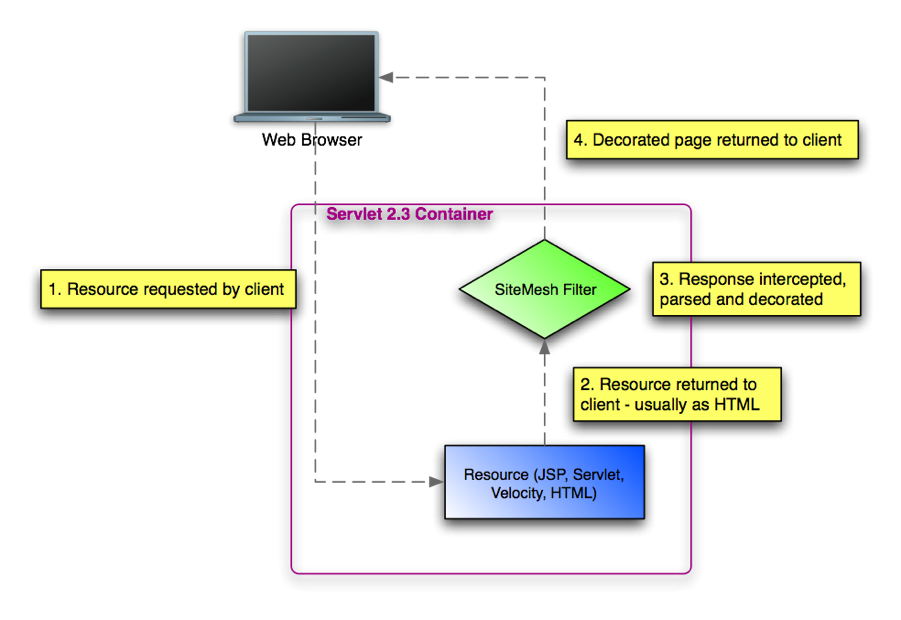
I've often wondered if it was possible to use Ajax to reload the main content of a web application without reloading the header, menu and footer. SiteMesh allows you to move these common elements to a decorator that gets wrapped around each page. Below is a diagram of how SiteMesh works.

SiteMesh

You can read the Introduction to SiteMesh article if you're interested in learning more about SiteMesh's basic features. By default, SiteMesh decorates text/html responses and ignores any other content type (e.g. image/gif). It also contains an <excludes> configuration element that allows you to turn off decoration when a URL matches a certain pattern. For example, the following allows you to disable decoration when "ajax=true" is passed in the URL.

<excludes>
    <pattern>**ajax=true</pattern>
</excludes>

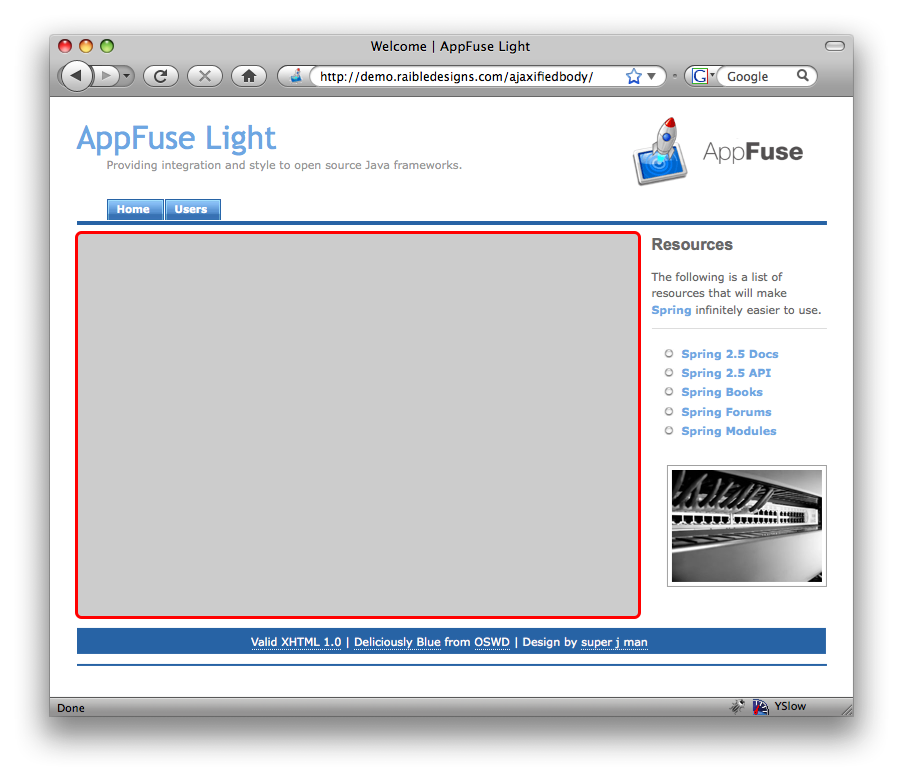
To optimize the loading of an application so the common elements aren't loaded for each page, it should be possible to create an Ajaxified Body where the primary content area (PCA) of the site is loaded via Ajax rather than refreshing the whole page. The header, footer and navigation bar often stays the same from page-to-page, so it doesn't seem to make a whole lot of sense to load them each time the page loads. The image below shows the PCA (of an AppFuse Light application) as a grey square with a red border.

Ajaxified Body - AppFuse Light

Implementing an Ajaxified Body consists of the following steps:

  1. Adding SiteMesh and moving common elements to a decorator.
  2. Remove common elements from each individual page (if you're using includes).
  3. Configure SiteMesh so decoration is disabled when the requested URL contains "ajax=true".
  4. Write JavaScript that modifies all <a href=""> links (and buttons with onclick='location.href') in the PCA to have an onclick handler.
  5. The onclick handler should call a JavaScript function that loads the link's URL + ajax=true using XMLHttpRequest (XHR).
  6. Add XHR success handling to replace the PCA with the loaded content.
  7. Add XHR error handling to go to the URL normally when response.status != 200.
  8. Inspect the response HTML for <title> element and replace document.title if exists.
  9. Inspect the response HTML for <head> element and append to current if exists.
  10. Inspect the response HTML for <script> and <link> elements (JavaScript and CSS) and evaluate them if they exist.

As a proof of concept, I created a prototype using AppFuse Light (Prototype/Scriptaculous for Ajax). You can see a demo at the following URL. You can also download a patch or the source for this project.

http://demo.raibledesigns.com/ajaxifiedbody

Below are a number of things I discovered while writing this prototype:

  • The hardest part of implementing this seems to be coding the exceptions. It's possible you'll have some links with existing onclick handlers and you may have to disable "ajaxifying links" for those links.
  • A progress indicator is important or the page might load so fast that the user doesn't visually detect it changed. This can lead to a worse user experience because they don't see the flash of the blank page they're used to when a page load occurs.
  • While forms can be submitted via Ajax, there's no harm in leaving existing form behavior in place where the full site is reloaded after submitting a form.
  • If a particular page needs to change the common elements (header, menu, footer), it should be possible to do that with JavaScript after the PCA content loads.
  • If the success/error indicator is outside the PCA, it may need to be populated and displayed/hidden with JavaScript after the PCA loads.

I'm sure my implementation can be improved, but I'm also curious to see what you think of this idea. I know it's not revolutionary, but it's something I'm considering adding by default to AppFuse and AppFuse Light. Do any Ajax frameworks do something like this out-of-the-box?

Update: Thanks to everyone for the great feedback - keep it coming. I agree that adding history support is a must. I'll try to do that in the next day or two. This post has also been featured on Javalobby and Ajaxian.

Update 2: Added history support.

Posted in Java at Oct 03 2008, 02:33:09 PM MDT 19 Comments

What's wrong with JSF

The developers of Seam have come up with a list of major issues with JSF. I'm assuming many of these issues are fixed by Seam, but it's interesting to note how they've somewhat admitted that JSF has many flaws. Note that there's a lot of references to Struts and WebWork.

Hopefully many of these will be fixed in JSF 2. If REST support is an important feature for web frameworks, it'll be be interesting to see how the component frameworks handle it. It'd be great if they provided native support. Oh wait, then they'd be action-based frameworks. ;-)

Posted in Java at Aug 25 2008, 06:53:31 PM MDT 5 Comments

GWT and REST

I've posted two message to the GWT Google Group in the last couple of days. However, new member messages are moderated and neither has shown up yet. I'm reposting my questions here in hopes of getting some answers.

Is there a way to easily use a REST backend with GWT? I tried GWT-REST. It works, but it seems to be centered towards Rails (I'm using Grails) and it suffers from the SOP issue.

JSONRequest looks promising for cross-domain support, but I can't get it to work either. The provided examples work, but not my simple hello world that returns:

{"response":"Hello World!"}

Also, the example implementation only has GET support, not PUT, DELETE or POST. I can post my REST backend on the public internet if anyone is interested in seeing the issues I'm having.

Thanks in advance for any advice.

Posted in Java at Jul 21 2008, 10:31:58 AM MDT 14 Comments

RE: Which is the Hottest Java Web Framework?

The "Break it Down" Blog has a lengthy post on Which is the Hottest Java Web Framework? Or Maybe Not Java? Comparing Java Web Frameworks is hard because so many people are passionate about the framework they know best. Add a couple more like Flex and Ruby on Rails and its downright difficult. Nevertheless, this post is good in that it contains a lot of pretty trend graphs and it looks like the author has done some good research. It's likely the folks that will scream foul are the ones that did poor in the comparison (Tapestry and Stripes, I'm talking about you).

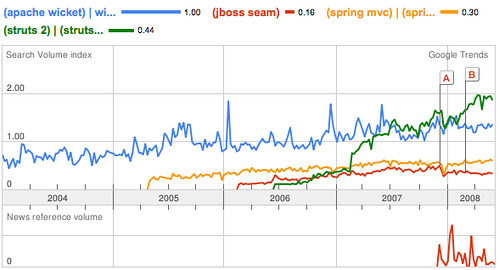
Surprising among the top Java Web Frameworks is the rise of Struts 2:

Google Trends Graph

To quote:

Which is much more interesting I think is how Wicket adoption has stayed almost flat while Struts 2 adoption has spiked. Spring MVC/WebFlow seems to be going no where fast and racing JBoss Seam there.

The popularity of Struts 2 really caught me off guard with it being quite a bit different from Struts 1, I figured it got thrown into the "just another web framework" category, but I guess there is something in a name and it's doing quite well.

Regardless of what you think of the post and trends, you have to appreciate the amount of time the author put into it.

Posted in Java at Jun 10 2008, 10:39:08 PM MDT 14 Comments

Should we change AppFuse to be Struts 2-specific?

Dusty recently posted an interesting idea to the AppFuse developers mailing list:

After thinking/coding/reading for a while I think the more interesting task is: Retool AppFuse to be one or more Struts2 plugins based on various higher level app patterns. (AppFuse Facebook, AppFuse Employee DB, AppFuse Blog, AppFuse Basic LDAP, AppFuse Basic Crowd).

This all comes from the fact, that I have been wanting to refactor the AppFuse web layer for Struts. One of the interesting aspects of AppFuse is that it works pretty much the same across all its web frameworks. It does so with some lowest common denominator abstractions that can be ported and look and work the same across frameworks. I have picked my tool(s): Struts 2 and Ruby On Rails when I want to pretend I am young again. I know Spring MVC, JSF, etc. but I have no desire to build significant apps on those platforms. It's not because they suck and Struts2 rules, it is because I know Struts 2 the best, I am most efficient there and it provides everything I need to build great webapps (Let's not devolve to a framework debate). So, I would rather have a more Struts 2-specific web stack, that really leverages conventions born and raised there. The nice thing about the Struts 2 web stack is that it is complemented nicely by AppFuse's data/service layer, since unlike Grails or Rails, Struts 2 has no data or service layer. [Read More »]

Seems like a good idea to me. What do you think?

Someday I'd like to come up with a "compatibility test" that allows others to improve upon the ideas in AppFuse and develop their stacks independently. A suite of Selenium tests that require extensionless URLs might be a good start.

Posted in Java at May 29 2008, 08:29:44 AM MDT 11 Comments