Matt RaibleMatt Raible is a writer with a passion for software. Connect with him on LinkedIn.

The Angular Mini-Book The Angular Mini-Book is a guide to getting started with Angular. You'll learn how to develop a bare-bones application, test it, and deploy it. Then you'll move on to adding Bootstrap, Angular Material, continuous integration, and authentication.

Spring Boot is a popular framework for building REST APIs. You'll learn how to integrate Angular with Spring Boot and use security best practices like HTTPS and a content security policy.

For book updates, follow @angular_book on Twitter.

The JHipster Mini-Book The JHipster Mini-Book is a guide to getting started with hip technologies today: Angular, Bootstrap, and Spring Boot. All of these frameworks are wrapped up in an easy-to-use project called JHipster.

This book shows you how to build an app with JHipster, and guides you through the plethora of tools, techniques and options you can use. Furthermore, it explains the UI and API building blocks so you understand the underpinnings of your great application.

For book updates, follow @jhipster-book on Twitter.

10+ YEARS


Over 10 years ago, I wrote my first blog post. Since then, I've authored books, had kids, traveled the world, found Trish and blogged about it all.
You searched this site for "struts". 659 entries found.

You can also try this same search on Google.

Maven 2 Archetypes get a much needed improvement

Yesterday, a new version of the Maven Archetype Plugin was released. This release incorporates many of the improvements that were developed in a different project - code named "Archetype NG". The two major improvements are 1) you only have to use "mvn archetype:create" now and 2) you can create archetypes from existing projects.

I haven't tried #2, but #1 seems to work pretty well (especially since AppFuse archetypes are the first 9 ;-)).

[Read More]

Posted in Java at Feb 09 2008, 03:20:00 PM MST 15 Comments

Reviews: Getting Started with Grails, Rails for Java Developers and Groovy Recipes

Two weeks ago, I mentioned a number of books I was hoping to read to get up to speed on Rails and Grails quickly. Over the last two weeks, I was able to polish off three of these (listed in order of reading):

Below are short reviews of each book.

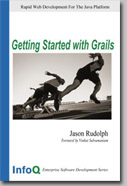
Getting Started with Grails
Getting Started with Grails The Good: This is the perfect book to learn the basics of Grails quickly. At 133 pages, I was able to read this entire book in one sitting. The first couple chapters are very introductory, but likely necessary for beginners. The good news is you start writing your first Grails application on page 7 (Chapter 3).

Chapter 4 (Improving the User Experience) is good in that it shows you how to do warning, error and confirmation messages. This is something often overlooked in web frameworks and Rails and its "flash" concept seem to have made it important again. I remember way back in 2003 when I complained about frameworks not allowing messages to live through a redirect - everyone said it was something you didn't need. Now it's a standard part of most web frameworks.

The Bad: Uses Grails 0.3.1. This is understandable since the book was written in 2006 and published in 2007. Also, it doesn't cover testing that much (5 pages). If testing is so easy with Groovy and if Grails has Canoo WebTest support built-in, it should be shown IMO.

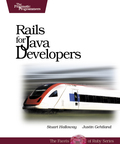
Rails for Java Developers
Rails for Java Developers The Good: This was an interesting book for me because it uses AppFuse for many of its Java-based examples. Unfortunately, it uses the Struts 1.x version which is cumbersome and verbose as far as Java web frameworks go. The most impressive part of this book is how Justin and Stu do an excellent job of walking the line and not insulting Java nor developers using it. They provide an easy to understand view of Rails from a Java Developer's perspective. There's detailed chapters on ActiveRecord (as it compares to Hibernate), ActiveController (compared to Struts) and ActiveView (compared to JSP). This book has excellent chapters on Testing, Automating the Development Process and Security.

The Bad: This book was published over a year ago, so it uses an older version of Rails. This means some commands don't work if you're using Rails 2.0. It's also a little light on Ruby, so I didn't feel I learned as much about the language as I was hoping to. That's understandable as it's more of a Rails book than a Ruby book.

Groovy Recipes (Beta from Jan 3, 2008)
Groovy Recipes The Good: I really like the style of this book and that it shows you how to get things done quickly with code samples. It's very no-nonsense in the fact that it contains a lot of code and howtos. I really like Scott's writing style and found this book the easiest to read of the three. This may have something to do with my eagerness to learn Groovy more than anything. The most refreshing part about this book is how up-to-date it is. Because it's a Beta, it seems to contain the most up-to-date information on Groovy and Grails. After reading Getting Started with Grails and working with it for a couple weeks, the first Grails chapter seemed a little basic - but that's likely because I've figured out how to mix all those recipes already. The Grails and Web Services chapter definitely has some interesting content, but I've rarely had a need to implement these recipes in a real-world environment. I'd rather see recipes on testing the UI (with the WebTest plugin) and how to use GWT and Flex with Grails. If SOUIs are the way of the feature, this is a must.

The Bad: Not much information on testing with GroovyTestCase, mock objects or implementing Security. If one of Groovy's sweet spots is testing, why isn't there more coverage on this topic? The Java and Groovy integration chapter is especially good, but there's very limited information on Ant and Maven. It's likely the websites provide sufficient documentation, but the Maven section only fills 5 lines on an otherwise blank page. The biggest problem I have with this book is I really like the recipes writing style and would love to see more tips and tricks. At 250 pages, I was able to finish this book with pleasure in a few days.

What's Next?
Now I'm reading JRuby on Rails (Apress) and Programming Groovy (Pragmatic Programmers). Following that, I'll be perusing dead-tree versions of Struts 2 Web 2.0 Projects (Apress), Prototype and script.aculo.us (Pragmatics) and Laszlo in Action (Manning). If any publishers want to send me books on GWT and Flex, I'd be happy to add them to my list. ;-)

Posted in Java at Feb 09 2008, 11:34:57 AM MST 10 Comments

Grails 1.0 and JRuby on Rails on WebSphere

A couple of interesting things happened today that relate to my Grails vs. Rails quest for knowledge.

The first is that Grails 1.0 was released. This was apparently a huge event as it swamped Codehaus' servers for a couple hours. This morning, it was pretty cool to shake Graeme's hand and congratulate him on the release. I also got to meet Jeff Brown for the first time. Who needs to go to a conference when you get to talk to these guys at work? ;-)

Secondly, I found an article by Ryan Shillington that shows how to deploy a Rails application to WebSphere. To me Rails + WebSphere seems like the last thing a Rails advocate would want - but who knows. In my experience, most developers that use WebSphere don't do it by choice.

For companies that have invested a lot of time and money into the JVM as a platform, it seems like Grails is the clear winner over Rails. However, the line gets blurry when you start talking about JRuby. I think JRuby will get there, but I don't believe it's there yet. If you look at the two major JRuby on Rails success stories (from Oracle and Sun), they've had to fix performance issues as part of their projects. With big companies investing in the platform, it's highly likely performance will be fixed in the near future. I believe both the Groovy and JRuby teams have said performance enhancements are their top priority for their next releases.

I think the biggest news related to performance of dynamic languages on the JVM is the new Da Vinci Machine project.

This project will prototype a number of extensions to the JVM, so that it can run non-Java languages efficiently, with a performance level comparable to that of Java itself.

Dynamic languages on the JVM seem to have a very bright future.

I got involved with Struts and Spring just before their 1.0 releases. Is it simply a coincidence that I happened to start looking into Grails right before its 1.0 release?

Posted in Java at Feb 05 2008, 11:32:12 PM MST 1 Comment

Is there room for both Rails and Grails in a company?

For the last week, I've been knee deep learning more about Rails and Grails. The reason is because I think developers (and companies) are going to have a hard time deciding which framework is best for them. The real question is: do they both do the same thing or are their different applications for each? Is "Grails vs. JRuby on Rails" a "Struts 2 vs. Spring MVC vs. Stripes" argument - where they're all so similar it probably doesn't really matter which one you choose?

Of course, the Stripes folks will object, but I really don't think it's that much better than Spring MVC 2.5 or Struts 2.1. Sorry guys. ;-)

If it is a Spring MVC vs. Struts 2 type of argument, then it seems to make sense for a company to standardize on one -- don't you agree? Does it make sense to allow both frameworks in a company if they're so similar?

Google has had much success in restricting its allowed programming languages to C++, Java, Python, and JavaScript. Shouldn't other companies do something similar? It seems like a good idea to restrict allowed web frameworks to a few as well. For companies with successful Java infrastructures, it seems logic to allow one Java-based web framework and Rails or Grails for getting things done as fast as possible.

Here's the sticking point: Ask any Rails developers and they'll say Rails wins hands down. Ask any Grails developers and they'll say Grails is the easy choice because it builds on top of Java's strong open source projects. Blah, blah, blah - where's the objective voice that's identified the "sweet spot" for each?

The Relevance guys, particularly Stuart Halloway, has a post about How to pick a platform. The logic in this post seems to imply that both frameworks do solve the same problem - just in different ways. Stu seems to recommend Rails for most applications, because Ruby is a better language. He says Grails might win if you have "an established team of Spring ninjas".

I know Stu and believe he does know his stuff (in both Java and Ruby). So is this the definitive guide on which framework to choose? If you have a staff full of Java developers, they should start learning/using Rails rather than doing the easier transition to Groovy, which they pretty much already know?

I don't know what the answer is, but that's what everyone seems to be saying. The problems is, the authorities on this matter (Rails vs. Grails) are often "head honchos" in companies that have a vested interest in seeing their respective framework/platform succeed. Since the Relevance team employs some Grails developers, it seems they're less biased. But who knows.

Is Rails really head and shoulders better than Grails? I don't think so, but I've only been programming with both for a week.

Posted in Java at Jan 30 2008, 11:48:14 AM MST 11 Comments

Don Brown Makes Maven 2 Not Suck

Don Brown spent some time over the weekend Making Maven 2 not suck:

While there are a few (very important, I might add) things Maven 2 gets right, there are a bunch that just suck, yet I use it at my day job (Atlassian) and in Open Source work, so in true Open Source tradition, rather than continue bitching, I'm doing something about it. I'm embarking on a quest to fix all the bits of Maven 2 that really annoy me and waste my time. I hope to get most, if not all, of the changes back into the codebase, but my personal deliverable is a build of Maven 2 that doesn't suck.

On his blog, Don lists a number of improvements he hopes to make. This weekend, he implemented the first three, which concentrates on speeding up remote repository access and downloading of artifacts.

First up, tasks #1-3. I implemented these changes in a bored Sunday afternoon and saw a example build (Struts 2 core) go from 3 minutes, 26 seconds to 2 minutes even, so a little over 40% performance improvement.

Interested, I decided to try Don's improvements on AppFuse. Since it fetches seemingly hundreds of artifacts from Maven's central repository, it seemed like a good testing ground. With a clean repository (rm -r ~/.m2/repository), a 8 MB/sec internet connection and "mvn -Dmaven.test.skip", I achieved the following results with the stock version of Maven 2.0.8:

[INFO] Total time: 7 minutes 40 seconds
[INFO] Finished at: Mon Jan 28 09:02:11 MST 2008
[INFO] Final Memory: 55M/508M

With Don's improved uber-jar, I received the following results:

[INFO] Total time: 5 minutes 17 seconds
[INFO] Finished at: Mon Jan 28 09:10:56 MST 2008
[INFO] Final Memory: 56M/508M

460 vs. 317 seconds = a 31.1% improvement -- Nice work Don!

When he implements #4 (Should support artifacts checked into the SCM in the lib/ directory so no external repository needed), I'll be a much happier Maven consumer. I've always wanted the ability to bundle all of AppFuse's dependencies for offline use like we did in 1.9.x.

Don - I'll buy you numerous beverages in Vegas if you add the ability to run a Maven command to put all a project's dependencies in its lib directory too. ;-)

Posted in Java at Jan 28 2008, 09:28:09 AM MST 7 Comments

All Java web frameworks should support hot deploy of a single class

In Anyone else using Groovy?, Tim Fennell (inventor of Stripes) raves at how much he likes Groovy now that it supports Java 5 features. He writes that Groovy might offer a solution to make development with Stripes faster:

The other thing I've been wondering about is that if there were enough demand for it we could try adding "improved" groovy support. E.g. throw your groovy actions under WEB-INF and we'll use groovy's built in stuff to do auto-reloading etc.

Gregg Bolinger responds with an excellent idea:

It would be really cool if Stripes could automatically discover and load changes to action beans (including new ones) without the entire app restarting, regardless of what the action bean is written in. But I realize that is a pretty tall order. :)

I agree that it might be a tall order, but I don't think it's impossible. In fact, I think all Java-based web frameworks should support hot deploy of a single class. We shouldn't have to buy JavaRebel to do this. It should be mandatory.

When an application reaches a certain size, the startup time can get pretty lengthy. This is lost development time. Furthermore, if any part of the development cycle takes longer than 15 seconds, there's a good chance developers will do something else (check their e-mail, move onto another task, etc.). Multi-tasking may be a good skill to have, but it's a horrible way to be productive.

Of the frameworks I'm familiar with, only Tapestry 5 and Seam support reloading single classes without restarting the whole application. Why can't the other frameworks "borrow" Tapestry 5's code? Maybe someone should just buy ZeroTurnaround and give away JavaRebel for free.

If I had one wish for 2008, it would be for all Java web frameworks to support this feature. Pretty Please?

Posted in Java at Jan 24 2008, 03:11:18 PM MST 21 Comments

A Positive Wicket Experience

Julian Sinai recently released the first version of his company's product based on Wicket. In A Year of Wicket, he describes the experience (emphasis mine).

I've been working with Wicket for almost a year. We've just released our first product that uses Wicket for the user interface, and so it seems like a good time to take stock. Unfortunately, it's not a public site, it's an installable enterprise product, so I can't show it to you. If you don't want to read further, here's the executive summary: Wicket rocks!

I was hired as the GUI Architect for this project. I came to it with many years of GUI experience, mostly using Swing, but without a lot of web development experience.

Because of my Java and Swing background, I was drawn to Wicket. It maps fairly closely to the Swing model of development. So does GWT, but when I evaluated it, it seemed so different from other J2EE frameworks that I felt it was a step too far. No HTML, and no WAR files, for example. This made my colleagues nervous, who were used to Struts and PHP. Me too, as a matter of fact.

I had done some pretty serious prototyping for another project with Tapestry, and there were certain things I liked, like runtime bytecode generation. But the learning curve was pretty steep. At one point I needed to create a custom component, and to do so I needed to learn about engine services and other arcane things that I felt made the process too hard. By contrast, custom components are Wicket's bread and butter, and they are very easy to build.

I also took a close look at JSF. It seemed overly complex to me, and not much of a departure from the Struts era. It came across as a technology designed by committee, with the combination of several complementary libraries required to get the job done, and there are still too many configuration files.

So we decided to use Wicket.

...

One of Wicket's advantages is the strict separation of design from behavior, that is, HTML from code. While we did not have a web designer on the team who built the HTML (the developers did this), and therefore didn't get any mileage from the separation in that sense, we definitely gained from having all the behavior in Java code, because it gave us all the power of refactoring, compile-time error checking, and maximum reusability. [Read More]

I really like how Julian talks about reasons they didn't choose other frameworks. Beyond that, I think it's important to note that Wicket was a perfect fit for someone with heavy Java and Swing experience. I still think Wicket is a little verbose for Web developers that program in Java (me), but it's unlikely there's very many of those. Building a form in Java seems so much more cumbersome than building it with HTML - but that's probably just me.

Posted in Java at Jan 18 2008, 12:37:18 PM MST 7 Comments

FreeMarker vs. JSP 2

I've been doing quite a bit of prototyping with Spring MVC and Struts 2 with both JSP and FreeMarker in the last few months. I'm trying to migrate a proprietary servlet-based framework with a proprietary JSP compiler to something that's open source. There's a couple of important features that the proprietary view framework has:

  1. It's expression language allows methods to be called with arguments.
  2. Templates can be loaded from a JAR on a remote server.
  3. XML in variables is escaped by default.

For #1, I've found this to be impossible with JSP EL or JSTL. I've created JSP functions that allow argument passing, but they don't allow overloading of functions. FreeMarker solves #1.

For #2, JSPs again fail because the templates have to be on the file system or in a WAR. FreeMarker solves this problem as well.

For #3, neither JSP or FreeMarker solve this problem. I realize it can be fixed in FreeMarker by hacking the code - I've done the same with Tomcat and solved it for JSP as well.

So based on the requirements in this project, FreeMarker is the clear winner. Here's some problems that I see with using it:

  • No XML escaping of expressions by default
  • No compile-time checking of expressions
  • IDE support is limited to Eclipse (meaning very little in the way of code-completion)

FreeMarker users - are there other problems you've experienced when using FreeMarker in your applications?

Posted in Java at Jan 17 2008, 12:37:12 PM MST 12 Comments

Java Web Framework Smackdown at TSSJS in Vegas

This year's TSSJS is starting to look like an excellent conference. I'm particularly excited to be moderating the following Expert Panel.

Java Web Framework Smackdown: Struts 2, Spring MVC, Grails, Seam/JSF and Wicket
The leading advocates of today's popular Web frameworks will duel under the Vegas Lights. Come and learn when to use your favorite framework and to see if it can live up to its hype.

We're talking about productivity, scalability and maintainability of Java-based Web applications. The emerging trend is that simplicity is better and productivity matters. Furthermore, if maintainability is the most costly part of any application -- how do these frameworks perform?

Attend if you're a Java Web developer, or if you simply like good entertainment. A working knowledge of the popular Java Web framework options will make this session more fun. If you haven't worked with any framework, come and learn who has the best spokesman.

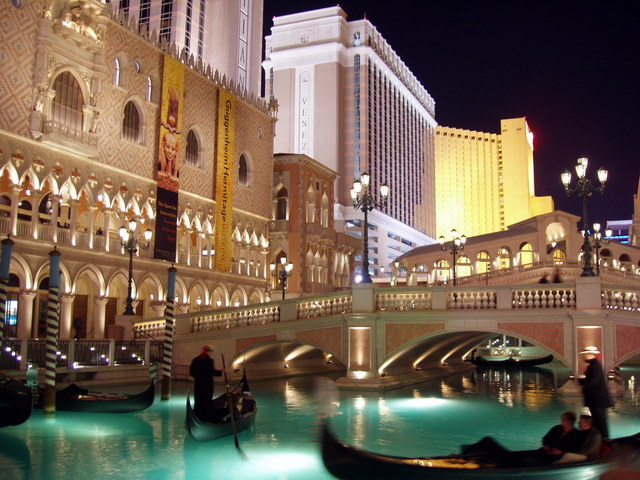
The Venetian I plan on bringing the boxing bell from OSCON 2005 to make this session one of the best in the show. I'll be coming up with a list of questions for these experts in the next couple of months. In the meantime, if you have any suggestions, please let me know.

With a venue like The Venetian, why wouldn't you go? ;-)

Posted in Java at Jan 11 2008, 12:06:24 PM MST 19 Comments

REST and Seam Talks at Denver's JUG

After a long hiatus, I decided to attend the Denver JUG meeting this evening. Tonight there's a couple of interesting talks:

I'll do my best to live-blog these sessions, so hopefully you can read along and learn everything I do.

Give It a REST by Brian Sletten
This talk isn't an implementation talk, it's more of a motivational talk. Brian is trying to answer the question "Why do we care?". We care because we have a lot of WS-Dissatisfaction. "Conventional" Web Services are often:

  • too difficult for non-trivial tasks (real complexity)
  • too complex for trivial tasks (artificial complexity)

RPC-based Web Services are mythically interoperable and time/process coupled in painful ways. SOAP has largely become popular because of marketing dollars behind in. REST is more like the "hippy" way that has grass-roots support with no corporate sponsor.

What makes SOAP difficult? It's remote procedure calls and its tunneled using existing application protocols (HTTP). Furthermore, there are no nouns (mappings to business terms), only handlers. There are no semantics, only handlers. When you tie yourself to a contract/WSDL, you can have anything back that you want - so as long as its simple XML. This isn't entirely true because a lot of things can be shoved into XML (Word documents that are Base64 encoded).

The main problem with SOAP is it solves a problem that most people don't have. It solves an edge case, rather than the main problem.

Many people say "SOAP is secure and REST isn't".

Why do people believe this? It's because of the long list of SOAP-related security acronyms: XML Encryption, XML Signature, XKMS, SAML, XACML, WS-Security, WS-Trust, XrML. Even if you're using these in your system, there's no proof that your implementation is secure. REST is what we all use on the web with online shopping, etc. We don't seem to have a problem with the security we use everyday on the web, do we?

SAO is an architectural style promoting loose coupling among software participants. Sompanies have rigid definitions of what constitutes a SOA. Many believe that SOAP is an essential piece, but it's not. SOAP 1.2 and Doc Lit are improvements, but are they necessary? Interestingly, 85% of Amazon's users chose REST over SOAP when given the choice.

What is REST? The acronym stands for REpresentational State Transfer. It's an architectural style based on certain constraints designed to elicit properties of scalability and extensibility. It's an idealized notion of how the early web should work and helped drive the way it eventually did work. It's more than just URLs!

Resource-Oriented Computing focuses on information spaces, not code or objects. It focuses on logical connections and reduces complexity by separating actions from nouns. In the history of the web, we started with URLs that pointed to documents. Eventually, these documents became dynamic and were generated on-the-fly.

URLs are locations on the web that are horrible names because they change so much. URIs are good names that have no way of being resolved. Fundamentally, REST is a separation of the parts of the system: Nouns, Verbs and Representation. A Resource (in a REST architecture) can be a file, a service or a concept. It can also have different representations. Resources are named with Resource Identifiers. It's simply the means of naming a resource. It's a standard syntax that allows various schemes. Often known as URIs (or IRIs). It's orthogonal to satisfying the reference and it's one of the missing pieces of "normal" web services.

Examples of Representation include 1) a particular dereferencing of a Resource Identifier to a Resource at a particular time, 2) a byte-stream tagged with metadata or 3) it could change based on request or processing/display capabilities of the client (Firefox vs. WAP).

REST's verbs are design decisions to minimize the the complexity of implementing a system. GET retrieves a resource and always returns the exact same result. It doesn't change anything in the backend system. Because of this, it allows for easier layering of your system - particularly when you introduce caching for GETs. POST is used to create (or update) a Resource. It does not require a "known URI" and it supports the append operation. PUT creates (or updates) a Resource, but requires a "known URI" and also supports an overwrite operation. Lastly, there is DELETE, which removes a Resource. This is not supported in modern browsers. Just because browsers don't support them doesn't mean you can't implement them in your applications.

REST's concepts were developed by Roy Fielding in his thesis. He was trying to create a system that had the following architectural properties: performance, scalability, generality, simplicity and modifiability. REST allows us to create true client-server applications. To satisfy scalability requirements, REST is stateless. All parameters travel with the request and no session information is maintained on the server. This improves scalability through load-balancing and allows visibility of intermediary processors.

One of the first things that becomes a bottleneck in enterprise systems is the database. This works fine if you like paying Oracle. By using REST and HTTP concepts, it's easy to take advantage of a cache. This allows replication of an external data set where it's too large to copy locally. REST allows you to create Layered Systems that allow you to have managed dependencies between layers. Having a RESTful architecture allows you to swap out the backend without changing the front-end and vise-versa.

Now Brian is going to do some demos using NetKernel. He recommends using HTML documents to describe services. The beauty of developing a RESTful system is there's nothing preventing you from appending ?wsdl to your URLs to return SOAP.

Invoking functionality using web-friendly techniques is a very nice way to build web applications.

What is controversial in REST? When you are not dereferencing you should not look at the contents of the URI string to gain other information.. However, if you structure your URLs in your application in a hierarchical manner, people will be able to use URIs in this way.

What isn't controversial? No one believes you should rely on sessions or other state at the application level. They also believe using nouns, not verbs is an excellent idea.


Seam by Norman Richards
Seam isn't just a web framework, it's an integration technology for building applications for the web. It's a technology that takes your persistence and web technologies and unifies them so you have a simpler view of your system.

First of all, what is Seam?

  • It's a unified component and event model - you access all your components the same way
  • It has a declarative state with a rich context model
  • It provides deep integration with minimal glue code
  • It minimizes configuration, prefers annotations to XML
  • It allows a freedom of architectures and technologies
  • It also allows testing of components in context

With Seam, you have a number of technology choices to make. The first is which business component model you want to use (EJB 3 vs. POJO). You might choose EJB 3 if you want more clustering capabilities. For persistence, you can use Hibernate or any JPA implementation. Norman recommends using JPA if possible. You also have a choice of languages: Java or Groovy (and possibly Scala in the future). Seam gives you a choice of web frameworks. All the examples today will use JSF, but there's also support for GWT and 2.1 will have support for Wicket. Also, there's some non-committers developing support for Flex. Norman believes component-based web frameworks are the best way to develop web applications. While I hear this from a lot of folks component-based framework authors, it seems ironic that the "best" way to develop webapps is not the most popular way (PHP, Struts, Rails).

I think it's ironic that there's a REST (no state) and a Seam (it's all about state) talk in the same night. I'm tempted to ask why a stateful architecture is better than a REST one, but I'm not really that interested in the answer. I think your architecture should be determined by the needs of your application, rather than choosing the architecture and then implementing an application with it.

In addition to choices, Seam gives you a number of tools: CRUD generation, Eclipse and NetBeans support and full IDE support in JBoss Tools / JBoss Developer Studio.

Now Norman is doing a demo - starting by creating a new Seam Web Project in Eclipse. He mentions that he's skipped a number of steps: downloading and installing Seam, downloading and installing JBoss and configuring your Seam installation and database in Eclipse. He has two projects in Eclipse - apparently the New Project wizard creates two - one for the application and one for testing. It's strange that the tests don't go in the actual project. The directory structure has src/action and src/model for your Seam components. After doing some simple CRUD, Norman starts JBoss and looks at the master/detail screens it generates.

To make a Java class a Seam component, you usually only have to add a @Name annotation to the class. While trying to show us how the Authenticator/login works, Norman tried to open components.xml. Unfortunately, this crashed Eclipse and 30 seconds later - following a bevy of "file does not exist" errors, we're back in action. To inject dependencies in a Seam environment, you use the @In annotation. In the example class, here's what the code looks like:

try {
  currentUser = (Person) entityManager.createQuery("select p from Person p where" + 
       " p.email = #{identity.username} and p.password=#{identity.password}").getSingleResult();
} catch (NoSuchEntityException e) {
  currentUser = null;
}

This example appears to encourage title coupling with the data layer, rather than loose coupling (i.e. a DAO layer). I'm sure Seam doesn't prevent you from developing a more loosely coupled application.

Bug Alert: The <h:messages> tag looks like it always has an <li> - even when there's only one message. Struts 2 has the same issue with its <s:errors> tag. It's disappointing that so many Java framework developers don't have more attention to HTML details.

Probably the coolest part of Norman's demo is how Eclipse auto-synchronizes with JBoss so he never has to start/stop anything when he changes Facelets pages or Java classes. Of course, hot deploy should be possible with any web application if you're using Eclipse Web Tools effectively.

I do believe all-in-one starter frameworks like Seam, Rails, Grails and AppFuse are excellent. However, I also believe they're solving a problem that only 10% of companies have. Most companies don't have the ability to start applications from scratch - unless they're a startup. Most companies have an existing infrastructure in place for the backend and they simply need a better web framework to slap a pretty face on it. I don't know the best solution for this, but it seems like a logical choice to RESTify the backend (possibly with a web framework) and then use a modern web framework for the front-end. IMHO, the best web frameworks for a RESTified backend are Flex, GWT and Appcelerator. If nothing else, these appear to be the most hyped for 2008.

Many of the enhancements that Seam has added to the Java web programming model are being pushed back into the Web Beans JSR. With Seam, injection is bi-directional (input and output), is continuous during application invocation and dis-injected after action is done. The whole purpose of this is to let Seam handle the state of your application. By not worrying about storing/maintaining state, you as a developer can concentrate on business logic more and get your applications done faster.

At this point, Norman started talking about Seam's events and how you can use them. Unfortunately, my battery ran out and I drifted off to do some other stuff. I'm sure Seam's Event Model is pretty cool, I just missed it.

Posted in Java at Jan 09 2008, 08:59:45 PM MST 5 Comments