
Matt RaibleMatt Raible is a writer with a passion for software. Connect with him on LinkedIn.

The Angular Mini-Book The Angular Mini-Book is a guide to getting started with Angular. You'll learn how to develop a bare-bones application, test it, and deploy it. Then you'll move on to adding Bootstrap, Angular Material, continuous integration, and authentication.

Spring Boot is a popular framework for building REST APIs. You'll learn how to integrate Angular with Spring Boot and use security best practices like HTTPS and a content security policy.

For book updates, follow @angular_book on Twitter.

The JHipster Mini-Book The JHipster Mini-Book is a guide to getting started with hip technologies today: Angular, Bootstrap, and Spring Boot. All of these frameworks are wrapped up in an easy-to-use project called JHipster.

This book shows you how to build an app with JHipster, and guides you through the plethora of tools, techniques and options you can use. Furthermore, it explains the UI and API building blocks so you understand the underpinnings of your great application.

For book updates, follow @jhipster-book on Twitter.

10+ YEARS


Over 10 years ago, I wrote my first blog post. Since then, I've authored books, had kids, traveled the world, found Trish and blogged about it all.
You searched this site for "free sex movies for men non blog". 1,227 entries found.

You can also try this same search on Google.

Building a website with an Open Source CMS

I think the open source community has done an excellent job of figuring out how to create frameworks for developing web applications. But what about websites. You know, the web presence that every company wants - for minimal cost. For most companies, it's nothing more than 5-10 pages that tells a bit about the company, show some management folks and tells you how to get to their offices.

I've developed many websites over the years, many that were static, but more that were dynamic. The unfortunate thing about all of them is they required someone technical to update them. Often, the client had to contact me if they wanted anything new on the site. I've often thought there was a better solution - and I think I'm at a point where I know what customers want, and I know how to provide it. The solution is a Content Management Solution (CMS). One of the biggest problems with static websites is they're not dynamic enough. A CMS can alleviate this problem by reducing the bottleneck that a traditional "webmaster" creates.

In my mind, there are a couple of things that make a good CMS: 1) it's open source (to minimize costs to the client) and 2) it's easy to customize. On the customization front, my demands are a bit more rigorous - mainly because I know what many folks want in a website. Here are my main criteria for a good open source CMS - when it's used to power a regular ol' client-updateable website:

  • Design customization: I should be able to customize all the (X)HTML that's generated using one or two files (like SiteMesh allows). It should be possible to change the look and feel of *everything* by modifying some CSS. It should also be possible to use Mike Stenhouse's CSS Framework to simplify layout choices for clients. Ideally, a web designer or regular ol' HTML person could do the customization.
  • Static-looking URLs: The site should look like a static site. The URLs should be all lowercase and end with .html. It should be possible to modify all the URLs to look as if all pages are static. Apache's mod_rewrite and the URL Rewrite Filter are great tools for making this happen, but it'd be nice if the administration of the application allowed for setting these rules.
  • It shouldn't look like a CMS: No login links, no registration links, etc.
  • Ability to easily add dynamic content: It should be easy to add dynamic content - such as RSS Feed headlines to pages.
  • Menu Customization: In the application, it should be possible to create menus (both main and local navigation) and configure a page to highlight a menu when a particular page is shown.
  • Versioning of pages: In case someone messes something up, it should be easy enough to revert back to a previous version.
  • Easy to use: It should be possible to train a marketing person (with little technical knowledge) how to use the system in 10-15 minutes.

For technical companies (such as Virtuas), there are a few additional requirements I'd like to see:

  • Articles with syntax highlighting: It should be easy to publish articles with code that's colorized. The Java2HtmlPlugin for JSPWiki is a good example of this. I currently don't know of any for XHTML, XML or scripting languages like Ruby or Python.
  • File Upload: For uploading white papers and other technical publications.

So I've started looking at open source CMS's that fill my requirements. Last weekend, I wrote a solution that fills all of these requirements using SiteMesh, JSPWiki, CSS Framework, Acegi Security and the URL Rewrite Filter. It only took me about 6 hours to complete, but after completing it - I started wondering if I really wanted to start another open source project and maintain it. The answer is no, I don't want to create something new - I want to use something that's already out there. However, since I do have something that satisfies all my requirements, I will use it if I can't tweak an existing OS CMS enough.

Here are a list of CMS's that I'll be looking at in the next week or so. If you're associated with any of these projects, please leave a comment and let me know how many of my requirements you satisfy.

I'm a bit hesitant on Daisy b/c it requires XSLT knowledge for design customization. Magnolia has long URLs and doesn't appear like a static site - and the PHP ones often have .php in their URLs. It should be an interesting investigation to see if these (seemingly) heavyweight solutions can solve a few simple requirements.

Posted in Open Source at Sep 12 2005, 11:48:14 AM MDT 49 Comments

Stripes

Greg Hinkle writes about a new JDK 5-only Java web framework called Stripes.

Stripes is a presentation framework for building web applications using the latest Java technologies. The main driver behind Stripes is that web application development in Java is just too much work! It seems like every existing framework requires gobs of configuration. Struts is pretty feature-light and has some serious architectural issues. Others, like WebWork 2 and Spring-MVC are much better, but still require a lot of configuration, and seem to require you to learn a whole new language just to get started.

I dig the fact that someone is trying to create a web framework that requires less configuration. It's also very cool that they've released it as 1.0 (rather than 0.1 as many OS projects do) and it also seems to be well documented. Unfortunately, it doesn't look like there's any support for Spring or dependency injection.

Personally, I don't mind the configuration required by WebWork or Spring MVC - but then again, I use AppFuse and tend to generate most of the configuration code using AppGen. Even so, it would be nice to get away from the configuration requirement. Hopefully more framework authors will find ways to reduce or even eliminate the XML hell we have in Java web frameworks. Kudos to the Tapestry developers for doing this in their 4.0 release.

I like the convention over configuration that Rails uses. It's this same mantra that I've been trying to develop AppFuse with for the past few years. The problem with Java web frameworks is developers want configuration choices - even if they never bother to use them.

Posted in Java at Sep 06 2005, 09:56:41 PM MDT 6 Comments

PowerBook Dent Redux

Continuing my PowerBook Dent story from last week...

I continued to work with my iPod as a hard drive on Wednesday and Thursday of last week, and took my laptop into the Apple Store on Thursday evening. The guys at the Genius Bar said that neither Apple Care nor a warranty covered accidental damage, and that it would be very expensive if I sent it in. Their suggestion was to take my dented, no-hard-drive-finding PowerBook to The Mac Outlet for a new case. They said if I got a new bottom case, I could bring it back and say "the hard drive can't be found" and Apple Care would likely fix it for free.

On Saturday, I took my machine into The Mac Outlet. They estimated $550 for a new bottom case, and suggested the cheaper new hard drive route for around $250. I agreed with the cheaper route, but told them I was very keen on trying to recover the existing hard drive. Yesterday, they called me at 5:30 and said "You're on of the lucky ones." The whole problem was due to a loose cable - plugging it back in fixed all the issues. Yeeee haawww, my laptop is as good as new!

Now it's time to buy some DVDs, do some backup, and buy one of those "spongy wetsuit material" type cases. ;-)

Posted in Mac OS X at Aug 31 2005, 10:36:13 AM MDT 1 Comment

Happy Birthday Jack!

Happy Birthday Jack!! It's hard to believe it's been a whole year since Jack was born. He's quite a guy to hang out with now - he's walking, laughing and smiling like you wouldn't believe. He always wakes up with a smile on his face too - quite the opposite of his big sister. ;-)

I'd post a recent picture, but I killed my PowerBook last week, where all our pictures are stored. In the meantime, here's a video of him walking from last week.

Posted in General at Aug 28 2005, 02:53:45 PM MDT 3 Comments

[ANN] AppFuse 1.8.2 Released

This release is mostly a bug fix release with no new features. It also includes upgrades to Acegi Security and the Spring Framework. Thanks to all the sponsors who have contributed products and free hosting to the AppFuse project.

To see how AppFuse works, please see the following demos:

Comments and issues can be sent to the mailing list or posted to the AppFuse Issue Tracker.

P.S. I have the Acegi integration done for Remember Me and SSL Switching in another project, so that support should be in CVS sometime next week. Thanks to Justin Spears for his help on this issue.

Posted in Java at Aug 27 2005, 06:42:06 PM MDT 12 Comments

Using CruiseControl with Subversion

This morning, I had the pleasure of setting up an AppFuse-based project to run under CruiseControl. Normally, this is very easy to do because I have the CruiseControl setup files and instructions. However, this project uses Subversion instead of CVS. Luckily, Subversion is easy to use and I was able to modify things to work quite easily. Below are the steps you can take to modify your AppFuse project to run under CruiseControl and Subversion.

  • Download svant and extract it to your work directory.
  • In build.xml, change your "cvs" target to "svn" and change the tasks appropriately.

        <path id="svn.classpath">
            <fileset dir="svnant-1.0.0-rc1/lib" includes="*.jar"/>
        </path>
            
        <taskdef resource="svntask.properties" classpathref="svn.classpath"/>
        
        <target name="svn">
            <delete dir="checkout/appfuse"/>
            <svn>
                <checkout url="https://svn.java.net/svn/appfuse/trunk" 
                    revision="HEAD" destPath="checkout/appfuse" />
            </svn>
        </target>
    
  • Modify the "test" target in build.xml to depend on "svn".
  • In config.xml, change the <modificationset> to be <svn LocalWorkingCopy="/home/cc/work/checkout/appfuse"/> instead of the <cvs> equivalent.

The instructions have been documented on the wiki and checked into AppFuse's CVS.

Posted in Java at Aug 24 2005, 10:24:26 AM MDT 4 Comments

Wicket is the most widely used Java Web Framework

According to this post, Wicket is the most widely used Java web framework. While I believe his statements are true, IMO it's only true in the context of this guy's post. My guess is that most of the folks that read his post were Wicket users, or somehow the Wicket Team got wind of this and told users to e-mail this guy. The main reason I don't believe that Wicket is the most popular is because it's so new. I do think it's an up and coming framework that may become the most popular, but I don't think it's there yet.

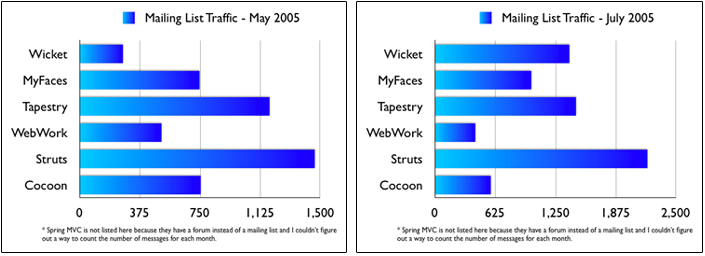
So, to answer this question, I believe that claiming Wicket to be the most widely is Just Good Guerilla PR. To put some numbers behind that, here's some graphs showing mailing list traffic for the various Java web frameworks.

Web Framework Mailing List Traffic - May/July 2005

Granted, these are just indicators of the number of users - but I believe they are a good indicator. One interesting note about these stats is that Wicket's mailing list traffic has increased significantly in the past few months. Ironically, here's what one of the Wicket developers had to say about this statistic about a month ago:

... who says having a lists that has a lot of traffic is a good thing? It might just as well be an indication of a too-hard-to-understand framework having insufficient documention.

In the past couple of months, I've spoke in front of 25+ Java developers on 4 different occasions to talk about web frameworks. I've asked those developers which frameworks they've used, or plan on using. Struts is still the most widely used, with WebWork and Tapestry the least used. Surprisingly, JSF seemed to be getting no traction among the the audiences I spoke to. Even more surprising (to me at least) was that the most popular web framework continues to be the in-house framework. The overwhelming majority of the developers I've talked to aren't even using open-source web frameworks.

Posted in Java at Aug 18 2005, 12:13:11 PM MDT 2 Comments

Integrating Lucene with Hibernate

The code_poet has an interesting post on using a Hibernate interceptor to index objects for Lucene searching. I've been thinking about integrating Lucene into AppFuse (or at least providing a tutorial) for quite some time. Hopefully this post will serve as a starting point when I do. I wonder how much the Lucene code can be simplified by the Spring support in the Spring Modules project?

Posted in Java at Aug 17 2005, 10:19:09 PM MDT 17 Comments

Roller 2.0 looks good!

Dave has posted some screenshots of Roller 2.0. I have to say, the new UI is a big improvement, both with colors and fonts. I hope to try 2.0 out today and hopefully get it installed at Virtuas in the next week or two. I can't wait until this release is installed on JRoller - it'll be very cool when many people can participate in a SourceBeat blog. Nice work Dave!

FWIW, I plan on hanging out in #appfuse and #roller on irc.freenode.net this week. Stop by and say hi if you have questions about either project.

Posted in Roller at Aug 16 2005, 09:32:11 AM MDT Add a Comment

Failed upgrade to Struts 1.2.7

Yesterday I made an attempt to upgrade AppFuse to use Struts 1.2.7 instead of 1.2.4. Everything seemed to go smoothly until I started running my Canoo WebTests with JavaScript enabled. It turns out there's a major bug (IMO) in Struts 1.2.7 where the JavaScript rendered by Commons Validator can't handle the Struts' <form> tag in XHTML mode. I tried a nightly build (20050809), but it's not fixed there either, so I backed out the upgrade.

The interesting thing about Struts 1.2.7 is SpikeSource has certified this release. Are they not testing JavaScript as part of their certification test?

Another thing I attempted to upgrade yesterday was Canoo WebTest from build574 to build976. No dice - mainly because of issues with Prototype (I think). The worst part is everything works fine in a browser. Even worse is I still have a problem with build574, but it doesn't cause the tests to fail. Times like this make me wish Selenium was more polished and ready to use. I talked with some ThoughtWorkers last week and they said the Java driver is ready for a 1.0 release, but one of the committers wanted to make sure all language drivers were ready first (at least that's what I remember).

Posted in Java at Aug 10 2005, 11:17:35 AM MDT 9 Comments