
Matt RaibleMatt Raible is a writer with a passion for software. Connect with him on LinkedIn.

The Angular Mini-Book The Angular Mini-Book is a guide to getting started with Angular. You'll learn how to develop a bare-bones application, test it, and deploy it. Then you'll move on to adding Bootstrap, Angular Material, continuous integration, and authentication.

Spring Boot is a popular framework for building REST APIs. You'll learn how to integrate Angular with Spring Boot and use security best practices like HTTPS and a content security policy.

For book updates, follow @angular_book on Twitter.

The JHipster Mini-Book The JHipster Mini-Book is a guide to getting started with hip technologies today: Angular, Bootstrap, and Spring Boot. All of these frameworks are wrapped up in an easy-to-use project called JHipster.

This book shows you how to build an app with JHipster, and guides you through the plethora of tools, techniques and options you can use. Furthermore, it explains the UI and API building blocks so you understand the underpinnings of your great application.

For book updates, follow @jhipster-book on Twitter.

10+ YEARS


Over 10 years ago, I wrote my first blog post. Since then, I've authored books, had kids, traveled the world, found Trish and blogged about it all.
You searched this site for "play". 220 entries found.

You can also try this same search on Google.

[DJUG] Testing and Handling Exceptions in the Web Tier

I'm attending Denver's JUG tonight, where Scott Davis is talking about Unit Testing the Web Tier. His opening slide says he's going to cover HttpUnit, Canoo WebTest and JMeter. I'm most interested in the JMeter stuff as I've been meaning to integrate it into AppFuse. I've used HttpUnit and it's a little verbose for me. I prefer using Canoo WebTest or jWebUnit over HttpUnit. On my current project, we're considering using jWebUnit or HttpUnit to act as a browser when interacting with a 3rd-party system.

All of these tools run functional tests - which are much different from unit tests. Unit tests usually tests the bricks, whereas functional tests test the building. For unit and functional tests to be truly effective, they must be:

  • Scriptable
  • Repeatable
  • Automated
  • Darn close to 100% coverage

The tools Scott is talking about tonight have passed his basic tests:

  • Can I learn it in 10 minutes?
  • Does it play nicely with my existing test environment?
  • Does it play nicely with my existing production environment?

I didn't take any notes about HttpUnit or Canoo WebTest because I didn't really learn anything new. Scott did do a nice job in his HttpUnit examples - he made it look a lot simpler than I've previously seen. I've used it HttpUnit before and it seems a bit verbose. I've always used jWebUnit, which simplifies HttpUnit's API.

JMeter allows you to do the same thing as HttpUnit and Canoo WebTest. It's a standalone GUI, for the complete non-programmer. It does not plug into Ant/JUnit and is mostly used for load testing. I thought it was exclusively used for load testing - and I think it has an Ant task. I could be wrong.

<sidenote>Scott uses Smultron for XML editing on his Mac.</sidenote>

The basic building block of JMeter is a "Thread Group". The Thread Group allows you to control the number of users/threads that run a particular test. You can test gets, posts, change the protocol and even upload files. For load testing, make sure and check "Retrieve all Embedded objects in HTML files". You have to view the "result windows" to view that your tests actually ran - there's no "green bar" feature.

I think JMeter has improved a lot since I last looked at it. Scott's overview and demonstration make it look very straight forward and easy to use. One guy asked if it's possible to see a a global view of all tests run. Scott thinks it's possible by adding a Listener to the Thread Group and creating a graph (one of the options). Scott is now showing a lot of the options in JMeter - there's a ton! It's almost overwhelming.

Next up is "Exceptional" Web Apps by Stephen A. Stelting, a senior Instructor and Author from Sun. His latest book is "Robust Java". Stephen has spent the last year and 1/2 figuring out how to make Java fail.

Objectives:

  • Describe the types of errors that occur in the web
  • Explain how exceptions and errors can be handled
  • Describe the web container response to exceptions
  • Present best practices to address web tier exceptions
  • Show how web frameworks handle exceptions

Payoff: As a result of this talk, you'll have a better understanding of how to use exceptions in Servlets and JSPs, improving the robustness of your webapps.

I'm a little skeptical at this point. I think most folks don't do exception handling in their webapps. I hope Stephen has some good tips and tricks for those of us who are familiar with handling exceptions. I wonder how he feels about Spring and its runtime exceptions?

There are two types of exceptions in the web tier: HTTP Errors and Java Exceptions. Standard HTTP Errors are handled by the web server. You can also send your own HTTP errors by calling HttpServletResponse.sendError(). If you're using response.sendError(), make sure and call it before you commit the output. The web.xml file allows you to specify errors and exceptions with the <error-page> element.

Servlets and Filters have similar exception behavior. Both declare exceptions in both of their lifecycle methods: init and service (doFilter for Filters). Developers throw exceptions in lifecycle methods to "tell" the container about problems.

  • javax.servlet.ServletException
  • javax.servlet.UnavailableException
  • java.io.IOException

Stephen is now describing the init() method and the exceptions it can throw. Yawn. I think most Java web developers use frameworks these days. Because of this, most developers probably don't use these methods because they don't write plain ol' servlets. One thing I didn't know is that UnavailableException takes a time parameter - if you throw an UnavailableException with this parameter, the container will retry after the specified amount of time.

Result of Exceptions in init(): The destroy() method is never called, since the initialization did not complete. Client calls during component unavailability render a 500 error.

I stopped taking notes at this point because my laptop battery was dying. I didn't really learn much in the rest of the presentation. While I can appreciate Stephen's enthusiasm, it was obvious that he was an instructor and not an in-the-trenches developer. He explained a lot of what and didn't have any code to show how to do stuff. There wasn't a single demo in the entire presentation.

Most of the exception handling stuff Stephen talked about for the rest of the session was common sense (IMO). It also centered around the Servlet and JSP API, which most folks probably don't mess with. The Struts and JSF coverage at the end was cool. If nothing else, it was to nice to hear a Sun employee confirm that JSF is quite deficient in its hooks to allow easy framework-configurable exception handling.

Now that I'm working at home, and working/interacting with friends all day - it seems that the DJUG meetings aren't as exciting. They used to be fun because I could get out of the house and have a few beers with friends. Maybe it was the lack of learning anything new tonight.

Posted in Java at Jan 12 2005, 11:30:50 PM MST 3 Comments

Friday Afternoon Humor

This is some funny stuff. I can't believe it actually aired on television. Maybe it didn't, but it's funny anyway.

Posted in General at Nov 05 2004, 12:28:54 PM MST 4 Comments

AppFuse a top 10 java.net project?

AppFuse I don't know if it's really a top 10 project, but it gets lots of hits, accesses and mail traffic. Nice! I'm willing to bet it's the cool logo that's the source of its popularity. ;-)

BTW, I'm giving a talk on AppFuse at Denver's No Fluff Just Stuff in two weeks. If I can finish up the "appgen" tool by then, the talk could be a lot more fun as the demo would be short and sweet. I doubt it'll happen though. I'm knee deep in creating a version of AppFuse Light that showcases how to use Spring with Hibernate and your choice of web framework: Struts, Spring, WebWork, Tapestry or JSF. I hope to release it sometime this weekend or early next week. Next week (and likely the week after), I have to write Chapter 10 of Spring Live. That leaves almost no time for creating the next cool tool. Who knows though - it might be easier than I think - especially since Lance submitted a good start.

Posted in Java at Oct 29 2004, 09:49:17 PM MDT 2 Comments

Rails - the MVC Framework for Ruby

When I first saw the quick setup for Rails video, I dismissed it as a something simple that wasn't that cool. Thanks to Dion's post, I decided to watch it again. Then I realized why it looked so simple the first time - the video kept looping and all I saw was the Apache setup part - I didn't see the whole video. After watching the video this morning, it's enough to make me want to become a Ruby developer and use Rails to develop my next webapp. Then again, Ruby probably doesn't pay the bills nearly as well. The upside is it looks like it would actually run fast on OS X instead of the dog-slow Ant/Tomcat/Eclipse/IDEA combination.

Hopefully I'll get to learn more about Rails at Denver's upcoming No Fluff Just Stuff. It looks like Dave has added it to his repertoire. I wonder if Rails has support for using the Copeland IoC container?

Posted in Java at Oct 25 2004, 03:19:00 PM MDT 9 Comments

Comparing Web Frameworks: Presentation Outline

My Comparing Web Frameworks outline is due to the ApacheCon Planners today. I spent a couple of hours putting it together this morning and I'm mostly done. In reality, I know that I won't cover the things that everyone wants to know. In an ideal world, I could simply target the presentation towards people like me: they know Struts but want to learn more about the other frameworks. Before diving in, they want to know some things to watch out for.

The problem with doing that is writing for people like me sometimes backfires. I'd like to make it an advanced presentation, but I'm not an authority on all 5 frameworks - so that seems a bit far fetched. However, if I could add Tapestry and JSF support to AppFuse in the next two weeks - I'd have a lot more experience to refer to. But that ain't gonna happen - the first update chapter for Spring Live is due next week. OK, enough rambling - here's the slide titles I've come up with. So far, it's 22 slides and shouldn't grow any since it's supposed to be finalized when I submit it.

  • Who is Matt Raible? My background, open source involvement, etc. Trying to give myself some credibility. ;-)
  • Framework Experience: Long time Struts user, used Spring since end of last year, developed apps with other three this summer. AppFuse supports Struts, Spring MVC and WebWork; Tapestry and JSF coming before end of year.
  • Meet the Candidates
    • Struts: Pros and Cons. Pretty much a standard, lots of examples, HTML tag library kicks ass. ActionForms kinda suck, can't unit test (only StrutsTestCase integration tests), Mailing list is swamped.
    • Spring MVC: Nice lifecyle (for overriding binding, validation, etc.) integrates with many view options seamlessly, IoC for easy testability. Not widely used, requires lots of code in JSPs, almost too flexible (no parent controller for SimpleFormController and Controller).
    • WebWork: Simple architecture, tag library easy to customize, interceptors are pretty slick. Documentation only recently written, few examples, client-side validation needs work.
    • Tapestry: Very productive once you learn it, templates are HTML (great for designers), healthy project. Documentation very conceptual, rather than pragmatic (lots of "read the book"). Steep learning curve, few examples. Impossible to test - page classes are abstract.
    • JSF: J2EE standard (lots of demand and jobs), fast and easy to develop with, rich navigation framework. Tag soup for JSPs, a bit immature (doesn't come with everything), no single source for implementation.
  • Controllers and Views: Show controllers for all 5 frameworks and template page (JSP/HTML) for forms. Give URL to download sample apps.
  • List Screens: How easy is it to integrate a sortable/pageable list of data? Struts, Spring and WebWork can use tag libraries like the display tag, value list or data grid. Tapesty has contrib:Table. JSF has dataTable component that requires custom logic for sorting (let me know if this has changed).
  • Bookmarking and URLs: Struts, Spring and WebWork give you full URL control. Tapestry has ugly URLs. JSF does a POST for everything. Conclusion: first 3 play nicely with container-managed authentication. Tapestry doesn't (although there's a patch for pretty URLs). JSF is not friendly to bookmarking.
  • Validation: Struts and Spring MVC can use Commons Validation - a mature solution. I've heard it's architecture is ugly, but who cares - it works! WebWork uses OGNL which allows powerful expressions. Client-side support is new and maturing. Tapestry has robust validation w/ good messages out-of-the-box. JSF has ugly default error messages, but is the easiest to configure.
  • Testability: Struts you can use StrutsTestCase, which requires web.xml and struts-config.xml. WebWork and Spring allow easy testing with Mocks. Spring has a spring-mock.jar that can be used for mocking the Servlet API with any framework (it's not Spring-specific). Tapestry is impossible to test because page classes are abstract. The argument I've hard is "you don't need to test them b/c they're so simple." JSF page classes can be easily tested and actually look a lot like WebWork Actions (except they don't extend anything).
  • Success Messages: The easiest way to solve the duplicate-post problem is to redirect after doing a POST. Struts is the only framework that allows for success messages to live through a redirect. It's fairly easy to get i18n messages in a Struts Action. Spring has nothing "built-in" for success messages. Long classnames / method arguments make it kinda clunky to get messages. WebWork has the cleanest way to get messages using a simple "getText()" method. Both require a custom solution to make your messages live through a redirect. Tapestry requires you to throw an exception to redirect and it still doesn't redirect (I haven't solved the duplicate post problem with Tapestry). JSF requires lots of code to get a ResourceBundle, but you could use Spring's IoC to inject a "messageSource" bean, making it a lot easier. JSF requires a custom solution for messages to live past a redirect.
  • Spring Integration: Supported by all, sample apps have examples (quick slide).
  • Internationalization: JSTL's <fmt:message> tag makes it easy in all JSP-supporting frameworks. Too bad there's not a standard for getting bundles in controllers and setting messages. Struts, Spring and JSF encourage you to use one ResourceBundle for all messages while WebWork and Tapestry encourage separate files for each page/action. This strategy is probably better for large teams.
  • Page Decoration: I used to be a huge advocate of Tiles (using it since August 2001). SiteMesh is much easier to setup and use. Tiles can be used in Struts, Spring MVC and JSF. SiteMesh can be used with all 5 frameworks. In fact, the sample app uses the same SiteMesh setup for all w/o changing a thing. SiteMesh requires no maintenance, Tiles requires you add entries to tiles-config.xml whenever you add a new page.
  • Tools: Struts has lots of tools available for it and even frameworks built on top of it (i.e. Beehive's NetUI/PageFlow). Spring has Spring IDE which is really just an XML tool for validating your bean and their relationships. WebWork has none (that've been released), but it is on the roadmap. Tapestry has Spindle, which is great for code-level programmers. It doesn't do drag-n-drop, but it does validate relationships between files. JSF has lots - but all of them cost money and tend to hook into proprietary app servers.
  • Business/Marketing: Struts has lots of jobs and is well-known in the industry. A lot of enterprise applications are based on it. Spring is getting more press, but mostly because of the framework's other features. Knowing the rest of Spring is more valuable than Spring MVC. WebWork is gaining ground, but it's still virtually unheard of on job boards. If you do get gigs using WebWork, it's likely word-of-mouth and you'll probably be working with some pretty smart people. Often used with Spring and Hibernate. Tapestry needs more marketing - no one has heard of it, hence no jobs exist for it. JSF is quickly becoming the most popular. Want to stay employed? Learn JSF. The best reason: so you can back up your arguments on why you do/don't like it.

    Dice Job Count: Struts (1006), Spring (15 - not a very good name for searching, used "spring framework"), WebWork (14), Tapestry (9), JSF (147).

  • My Opinion: You have to come to the conference for that ;-). Slides should be posted following my presentation.
  • Resources: Link and such for downloads, frameworks and tools mentioned.

Comments, suggestions, like it/hate it? Let me know. I expect to send this in in a few hours - so you'd better be quick!

Posted in Java at Oct 15 2004, 12:02:03 PM MDT 22 Comments

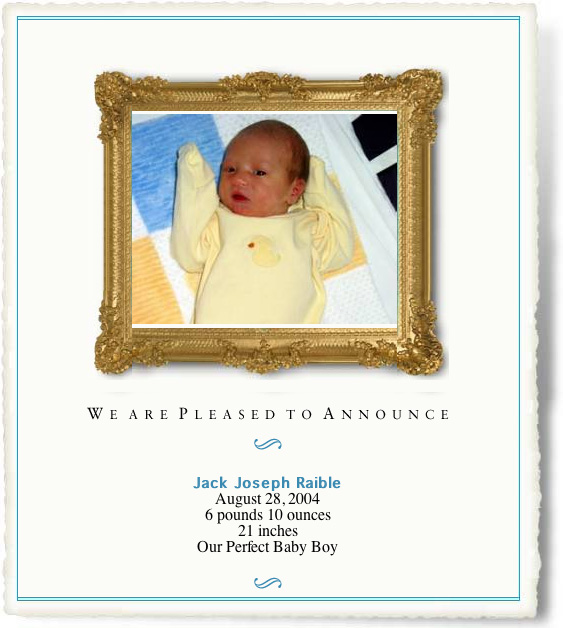
Our Little Boy has Arrived!

Jacks's Birth Announcement

We've all make it home safe and sound. This birth was pretty easy compared to Abbie's. We left for the hospital at 8:15 pm and Jack was born shortly after midnight. Julie was a champ - two pushes and he was out! Julie's mom and sister flew in so we've been having a great time with all the family around. Life is great in Denver right now.

The whole family
The Whole Family

Posted in General at Aug 29 2004, 05:11:58 PM MDT 46 Comments

Just take her with you

Abbie's a Hiker! With my hectic schedule lately, it's been tough to get a workout in and not piss off Julie or Abbie. When I'm done working, Abbie wants to play like a crazy lady. I don't blame her - we have a lot of fun together. If I finish the day and walk into the living room to tell them I'm heading out to get some exercise, both of them get mad. Julie because I've been working all day and she wants a break; Abbie because she's ready for some fun.

About 2 weeks ago, we were all a little huffy at each other as I wanted to head out for a run before DJUG. Julie was trying to convince me to skip it so I could spend some time with Abbie. Abbie saw I was leaving - put on her shoes and ran to the door to go with me. Everyone was tense and Julie says "Just take her with you!" I laugh b/c our stroller isn't a jogging stroller, but then I realize it wasn't a bad idea.

Abbie usually can't sit still in the stroller for more than a few minutes, so even though I thought it would be a disaster, I took her anyway. I jogged and pushed her around our local park - and to my amazement - she loved it. She didn't want to get out once - she just giggled and laughed and pointed out all the dogs and airplanes. Since then, we've gone a couple times.

Getting bold with this new "take her with you" mantra, yesterday I took Abbie on a hike. Rather than a simple walk around the lake, I wanted to take her on a real hike. So we trekked on out to the foothills, strapped her in the backpack and headed up Mt. Falcon. This is a beautiful trail that I used to mountain bike a fair amount. I expected an hour trip, but it ended up being an hour and 40 minutes. How did Abbie do? She loved it. Sure we had to stop a few times, and of course she didn't want to get in the backpack after doing so, but I had lots of joose and gummy bears, so she was happy. It was something I'll remember for the rest of my life - especially the last 20 minutes where she made me sing to her the whole time. A true father-daughter experience - I'm looking forward to many more. I can't wait until Raible #2 arrives, I'm taking a month off and hope to enjoy a lot more days like yesterday.

Posted in General at Aug 22 2004, 05:57:30 PM MDT 9 Comments

My JSF Experience

Of all the MVC Frameworks I've developed with in the last few weeks (Struts, Spring MVC, WebWork and Tapestry) - JSF was by far the worst. And it's not the implementations that are the problem, it's the spec itself (as far as I can tell). Plain and simple, it does not simplify web development.

I spent 3 days developing a simple JSF app - most of it which I had done in the first day. The last 2 days have been spent migrating to MyFaces and trying to find clean ways to do things. My perspective on JSF after this experience? Run away. Run far, far away. All of the above mentioned frameworks are MUCH superior to this technology. Let's get on with the things I learned.

  • MyFaces handles duplicate posts nicely. If you hit "reload" on your browser after saving a record, you get presented with an empty form rather than a duplicate record. I believe I got a duplicate record with Sun's RI.
  • The ability to specify an "action" attribute on a button (or a link) and them map that action to a page (in faces-config.xml) is pretty cool.
  • Every button or link clicked results in a form post. That's just wrong - why can't I have true links like the web is supposed to? So much for bookmarks.
  • Saving state on the client results in enormously long URLs and/or hidden fields.
  • JSF support is fairly non-existent. Unlike the other MVC frameworks, the MyFaces mailing list has hardly any traffic and the Sun forums aren't much better.
  • The MyFaces website seems to be down whenever I want to look something up on it, like right now.
  • I did find some CRUD examples, like this this one, but was disappointed to find that i18n is not considered for setting success messages. I ended up using the solution described in this post. 6 lines of code to set a success message - you've got to be kidding me! Most frameworks have a simple 1-2 liner.
  • Waiting for JSPs to compile the first time has surprisingly become painful after using Tapestry, Velocity and FreeMarker for the last 2 weeks.
  • Integration with Spring is fairly easy (code is in CVS), but MyFaces spits out an error when it shouldn't be.
  • Validation messages are ugly. For instance, when a required field isn't filled in, I get: "lastName": Value is required. I was able to override the default messages, but I was never able to use the label of the field (vs. the field's id).
  • The <h:messages> tag is practically worthless. Sure it's great for displaying messages (error and success), but that's about it. It has a "layout" attribute that doesn't even work in Sun's RI, and in MyFaces it just wraps a <span> with a <ul><li> or a <table>. Both of these layouts are useless b/c you can't set a css class on them. I ended up using "table" and having to set a generic CSS rule (width: 100%) in order to get the message/error bar to show across the top of my page. This tag also doesn't allow you to escape HTML.
  • The <h:dataTable> component is nothing like the displaytag. MyFaces claims to have a pageable/sortable component, but it requires custom logic/methods in your managed-bean. Yuck. I ended up using <h:dataTable>, which has neither sorting or paging. This is only because I couldn't get an <h:commandLink> working inside a displaytag column.
  • JSF-created apps are pretty much untestable. Managed-beans are testable, but the UI seems really difficult with jWebUnit and Canoo's WebTest. IMO, it should be possible to specify a URL to edit a record (i.e. editUser.html?id=2). With JSF and my master/detail app, the link to edit actually sets about 5 hidden form fields with JavaScript and then submits the form. I could probably figure the URL out, but it'd be ugly. Also, the MyFaces <h:dataTable> will not render an "id" attribute if you specify one. This is needed to verify tables and their data with jWebUnit.
  • When using "ant reload" to reload my application (using Tomcat's Ant Tasks), I kept encountering a ThreadDeath error. This seems to be specific to MyFaces as I never saw it with other frameworks or Sun's RI.

Like Tapestry, I felt like I was banging my head against the wall a fair amount. However, with Tapestry (and all the other frameworks), I was able to get exactly the behavior I wanted w/o too much work. I could produce clean and user-friendly error messages - (Tapestry already had clean required messages built in). I was able to write a jUnitWebTest to test all CRUD activities. With JSF, I was able to test one thing - adding a new record. I couldn't edit it b/c the JavaScript support (which I tend to not use) puked every time it encountered a JSF-generated JavaScript function.

My opinion after all of this? If you know Struts, Spring MVC and WebWork are fairly easy to learn. WebWork is simpler and elegant, but Spring MVC supports more view options out-of-the-box. Tapestry is cool, but you'll have to invest a lot of time into learning it and you'll probably get caught up in its cult and forever be claiming "Tapestry Rocks!" which can get annoying to your fellow developers. ;-) Finally, I can confirm that SiteMesh rocks - it worked for all the frameworks I used and I never had to change a single line of code.

Whatever you do, don't use JSF. Not yet anyway.

Posted in Java at Aug 06 2004, 04:53:22 PM MDT 76 Comments

August is gonna be a rough one

I've got a lot on my plate for August. Probably too much, but I'm going to make a run at it anyway. In addition to my 40-hour per-week contract, I'm going to try and finish off 1.0 of Spring Live and release the next version of AppFuse. Julie and I were talking last week and I estimated that I'd need about 100 hours outside of "work" to accomplish both of these tasks. That's 65 hour weeks, or 12.5 hour days. Yech...

I'm off to a bad start today since I was twidding with my monitor most of the day and only billed 4 hours to my client. Tonight I got a couple hours in on AppFuse, but only minor bug fixes - no major features. It's gonna be rough - if I seem short or don't post much you'll know why. If I did it right, I'd get up at 4 every day and be I'd have my time in + exercise by 6 p.m. every night.

We'll see how it goes - the baby is due September 3rd (a.k.a. Labor Day Weekend) and I'd like to be done with Spring Live 1.0 and AppFuse 1.6 before the little guy/girl comes out. I told Julie if she had it two weeks late it would work out awful nice for me! ;-)

Posted in General at Aug 02 2004, 10:45:24 PM MDT 6 Comments

Off to OSCON

I'm off to OSCON - plane leaves in 2 hours - sheite - I'd better get going!! My dad is picking Bruce and I up from the airport this morning and then we're going to proceed to enjoy a good Oregon Micro Brewery and head for a hike in Silver Falls State Park. Conference starts tomorrow - should be a fun trip!

Posted in General at Jul 27 2004, 06:20:03 AM MDT 4 Comments