Matt RaibleMatt Raible is a writer with a passion for software. Connect with him on LinkedIn.

The Angular Mini-Book The Angular Mini-Book is a guide to getting started with Angular. You'll learn how to develop a bare-bones application, test it, and deploy it. Then you'll move on to adding Bootstrap, Angular Material, continuous integration, and authentication.

Spring Boot is a popular framework for building REST APIs. You'll learn how to integrate Angular with Spring Boot and use security best practices like HTTPS and a content security policy.

For book updates, follow @angular_book on Twitter.

The JHipster Mini-Book The JHipster Mini-Book is a guide to getting started with hip technologies today: Angular, Bootstrap, and Spring Boot. All of these frameworks are wrapped up in an easy-to-use project called JHipster.

This book shows you how to build an app with JHipster, and guides you through the plethora of tools, techniques and options you can use. Furthermore, it explains the UI and API building blocks so you understand the underpinnings of your great application.

For book updates, follow @jhipster-book on Twitter.

10+ YEARS


Over 10 years ago, I wrote my first blog post. Since then, I've authored books, had kids, traveled the world, found Trish and blogged about it all.
You searched this site for "free sex movies for men non blog". 1,227 entries found.

You can also try this same search on Google.

Are you doing client-side validation in your JSF applications?

Are you doing client-side validation in your JSF application? I am in Equinox and AppFuse, but it seems somewhat primitive. I'm using David Geary's corejsf-validator.jar from his Core JSF book. It hooks into Commons Validator, and while it does work - it has some issues. First of all, if you have it in your classpath when testing, it screws up Ant-style path matching in Spring (applicationContext*.xml doesn't work). Secondly, it puts all the JavaScript validation functions right in your page, rather than in an external file that can be cached by your browser.

In reality, I believe that JSF should include client-side validation as part of the spec. After all, all of the other popular Java web frameworks support it. Then again, Rails is growing in popularity and AFAIK, it doesn't support it. In addition, the popular Java webapps I've seen (JIRA, Confluence, Jive Forums) don't use it either. I'm not trying to advocate that we should all be using client-side validation in our apps, I'm merely saying it should be an option in the standard web framework for Java.

The only public (and open source) option I've found is the Commons Validator support in Shale. Will this work in a MyFaces application w/o Shale? Are there other client-validation frameworks for JSF I don't know about? Or is the best option "don't use client-side validation with JSF?"

Posted in Java at Nov 24 2005, 09:02:39 AM MST 6 Comments

Clustering OSCache

For the past few days, I've been tuning and configuring OSCache in a clustered (WebLogic) environment. While setting it up was fairly easy, there was some fundamental concepts that took me a bit to figure out.

First of all, I chose to use JavaGroups instead of JMS. The primary reason behind this was it was easier to configure, but I also discovered that if you use JMS - you have to have a unique "cache.cluster.jms.node.name" property in your oscache.properties file on each server. This means to use OSCache with JMS, you have to build two different EARs. At least that's my impression. If you've figured out a better way to do this, please let me know.

In the application I'm working on, there are 4 different caches: one for Hibernate, and several other ones we've created with OSCache and Spring. For the past week, I developed a feature where we cache a user's account information across the cluster. The feature is more like an HttpSession than a cache b/c it's designed to replicate an authentication token (similar to a session id) across all the master servers.

After much head pounding, I discovered that OSCache doesn't update other nodes in a cluster for inserts and updates. It only broadcasts flushes. After understanding how OSCache works, it was much easier for me to code the solution (sans OSCache). If you'd like to see OSCache support replicating a cache across a cluster, vote for CACHE-96.

Posted in Java at Nov 23 2005, 01:05:44 PM MST 9 Comments

Lots of Java activity in San Francisco

The last 24 hours here in San Francisco have been quite interesting. Yesterday, I had lunch with a group of AppFuse users. They work for a company a few blocks from my training class. Chipotle was on the way, so I grabbed a burrito on my route and had a great time talking with them about the various open source tools that AppFuse uses, as well as what's on the roadmap. Thanks for the cookies John!

After class yesterday, I had a Guinness with an AppFuse user that recently put a high-volume site into production. He said it's held up surprisingly well and AppFuse greatly simplified his ability to deliver the project on time. In fact, most of the features the client wanted were already built-in.

Last night was another hotbed for Java talk - from web frameworks to TSSS in Vegas. Matt Filios and I had dinner and drinks with Mike "wanna play poker" Cannon-Brookes, Crazy Bob, Patrick Linskey, Geoff Hendrey (I hope I got the name right) and a number of other guys whose names escape me. It was Mike's birthday, so I left early to avoid the chaos that Crazy Bob and Mike always seem to stir up.

To top it all off, this morning I ran into a couple of folks that read this blog. I was getting breakfast at a local bagel shop - when a guy came up to me and asked "Is your name Matt"? I answered yes, and we talked briefly about my trip out here. It was kinda wierd being recognized, but kinda cool at the same time. It was good to meet you Nadeem.

I'm heading home from this wonderfully warm place tonight, but I'm sure I'll be back in the near future.

Posted in Java at Nov 18 2005, 12:00:57 PM MST 5 Comments

RE: Is Ajax gonna kill the web frameworks?

James is asking "Is Ajax gonna kill the web frameworks?" From my personal experience, I can definitely say that Ajax is going to give web frameworks a run for their money. However, I doubt it's going to completely replace web frameworks. There's many companies out there that aren't willing to commit to developing a JavaScript-only UI - not even Google. GMail has a non-javascript version that's used when you disable JavaScript in your browser.

That being said, I'd much rather work on a project that embraces and uses Ajax over a web framework. However, even if you decide to use Ajax, doesn't the same framework proliferation problem still exist? DWR, Scriptaculous, Prototype, AjaxTags, AjaxAnywhere, Rico, Dojo, JSON-RPC - which Ajax frameworks are the best ones to use? If one of these projects joins Apache, will it become the de-facto Ajax framework like Struts did? ;-)

Posted in Java at Nov 16 2005, 11:16:57 AM MST 8 Comments

Effective Presentations

At Virtuas today, we had a workshop from Joel Hochberger of Effective Presentations. This was a very valuable training course that I learned a lot from. We started out by doing short presentations that were videotaped and criticized by other folks in the class. It was interesting to see myself speaking on video because I did a lot of "umms" and "ya knows" that weren't noticed by me or the audience.

After learning to pause more, quit shifting and have better eye contact - we moved on to learning how to better organize our presentations. Joel gave us some great tips that I should be able to really benefit from. The main gist was that you can easily create better presentations by simply thinking from the listeners perspective. What is the main benefit the listener derives from your idea?

The other two things that really stuck with me were: 1) ask for action from your listener (what they must do to achieve the benefits of your idea) and 2) summarize your presentation following audience questions. If you get a chance to attend one of Joel's workshops, I'd definitely recommend it.

Posted in General at Nov 08 2005, 09:49:03 PM MST 5 Comments

Editing Java webapps instead of edit/deploy/reload

For the last few years, I've always done Java webapp development the hard way. Yeah, I'm the guy that makes Dion cringe (although I'm pretty sure he's not referring directly to me). I edit a class/jsp/xml file and run "ant deploy reload". Then I wait a few seconds for my context to reload in Tomcat. Luckily, I do mostly test-first development, so it's rare that I have to open my browser to test stuff. However, with the power of CSS and Ajax, manual testing in a browser is becoming more and more useful (although Selenium may solve that).

I've long resisted the power of the IDE, b/c I've always trusted Ant and felt confortable with the command line. However, I'm ready for a change. I'm ready to start developing Equinox and AppFuse-based applications using the edit/save/auto-reload cycle. So how do I get started? Where's the instructions for setting up my IDEs to work this way?

I prefer to use Eclipse and IDEA for development - so I'll likely try to get this working in both. If I get it working, I'll make sure and provide good documentation so others can do the same. I'm also willing to make any changes in project structure to make this happen; modifying build.xml (or pom.xml) to accomodate shouldn't be too difficult.

Posted in Java at Nov 07 2005, 09:16:03 AM MST 23 Comments

Simon begins "The Journey"

It's pretty cool to see that Simon is going to begin a quest to find the best web framework to fit his needs.

Struts, WebWork, Stripes, Spring MVC, Wicket, Tapestry, JSF, etc, or even rolling your own. With so many J2EE web application frameworks to choose from, how do you decide which one to use? Several articles (e.g. JavaServer Faces vs Tapestry) and presentations (e.g. Comparing Web Frameworks) already exist, but they generally concentrate on a small subset of the available frameworks.

This can be a daunting task, but it sounds like he's got a good plan:

Clearly this is a massive task so, to reduce the scope, I'm going to focus on what it takes to build a read only web application. If I were to hazard a guess, I'd say that the 80-20 rule applies. 80% of a web application is read only and 20% is interactive (e.g. HTML forms, AJAX, etc). Of course, this is changing with technologies like AJAX, but we're still on the upward curve. Traditionally, that 20% is the most complex and is an area where many web application frameworks claim their unique selling points. For this reason, I may iterate over the evaluation process to take into account how the frameworks help web developers build interactive webapps. For now, I'm going to look at whether the frameworks make doing the 80% easy.

Notice that Simon has added a couple frameworks that I haven't worked with: Stripes and Wicket. It should be interesting to see his findings. Not every framework is designed to do the same thing, so it'll be cool to find out which one Simon thinks is the best for read-only applications.

Posted in Java at Nov 02 2005, 03:18:32 PM MST 3 Comments

[CSS] The Zen of Open (Observations of a New Bear) by Simon Phipps

Simon used to work for IBM, on a video conferencing product. In 1994, Simon would fly all over the world to tell everyone about it. The last 10 years have brought many changes. When Simon used to travel in 1994, he needed cash and travellers checks, airline tickets, telephone kiosks and sent mail through the regular ol' postal system. Fast forward to 2004, and we have ATM cards and a "global identity card" (a Visa card), e-tickets, GSM mobile phones and e-mail. We're now in the participation age.

If we were massively connected:

Security would no longer concern only boundaries. Before the participation age, security was a matter of "how do I keep you out". Now it's "who are you can you prove that". It's all about digital identity now.

Software would have nowhere and everyone to run. Service orientation is how software is build today. Simon believes it'll happen through REST-based services, rather than by employing web services.

Software pricing should not track ephemera [definition]. We're now switching to value-based pricing.

Markets would become conversations (from The Cluetrain Manifesto). This idea led Simon to start blogs.sun.com.

Closed-room development would be insufficient. The old way was lock smart people in a room and slide pizza under the door - and then charge others admission fees to watch them work. Software that's developed out in the open gets better and better b/c you can get all the experts working on it. This is called Open Source. The initial objective of Open Source was to undermine companies like Microsoft and Sun - but now it's the best way to write software in a connected society.

Open Source in a Nutshell: a community of developers, sharing a code commons, create "wealth" from the commons, enriching the commons in the process. The "craft guilds" have been rediscovered in a sense. Open source is not communism, but more like Connected Capitalism.

There are a number of different open source licenses:

  • Class A: "Unrestricted", create any work, no restrictions on licensing. BSD-style license, with the gold standard being the Apache License.
  • Class B: "File-based", files derived from commons must use license B, files added may use any license. Mozilla-style, CDDL v1.
  • Class C: "Project-based", all files in project must use license C if any files use commons files, GPL.

According to Simon, the best license is the one that gives the most freedom to the most people. Class A licenses promote freedom to innovate, but do not protect the commons. Class C licenses promote constant growth of the commons but limit the freedom of the developer to use their own innovation however they want. Class B licenses balance both freedoms protecting and enriching the commons but leaving innovators free to use their work in any commons.

The overlooked corners of open source: it's not licenses, there's no more limelight needed for those. However, there is a problem now - and that's license proliferation. There's too many licenses, we need fewer so it's easier to choose. We need better motivational models: how do we leave room for the motivations of diverse contributors?

The overlooked corner of open source is Governance. Apache is a good example of how Governance should be done. Bad governance is the primary vector for disease in open source. If the only way to contribute back is to go through one company that chooses committers, the project is likely doomed.

Software Patents happen, get over it. "Parallel Filing" means Corporations own patents on pretty much anything they touch. If you don't, your competitor will. The nature of US law means all must play. Using patents defensively is a routine element of corporation-to-corporation interaction. Software patents are a zone on the continuum - even their detractors have to deal with them. Until world trade is reformed, software patents happen.

So how do you protect yourself?

  • Patent Grants: Research specific patents and give a broad usage grant to open source use.
  • Compulsory licensing: Blanket grant of patents, restricted to licensed code. This is the strategy that Sun has used with OpenSolaris.
  • Non-Assert Covenants: Covenant not to assert rights against bona fides community.

Simon believes all 3 approaches are needed to protect ourselves from software patents. He believes that #2 and #3 should be mandatory for standards bodies and open source projects.

Summary: The next phase of F/L/OSS is upon us. The Virtuous Cycle of open source needs a health check. We need to reduce license proliferation by dealing with its causes. We need to leave room for the motivations of all contributors. Don't sacrifice the freedom of developers for an ideology. Governance best practice needs an advocate.

F/L/OSS Alone is not enough for freedom - we need standards. Open standards set end users free to choose. Development and deployment are not the same thing. Standard Formats + Open Source = Freedom.

Software Patents demand multiple defenses. We need to lobby the governing bodies of our countries and put a stop to patents.

Posted in Java at Oct 27 2005, 10:19:04 AM MDT 2 Comments

The best part about the Colorado Software Summit

The best part about the Colorado Software Summit has been the fact that I can travel home at night. Keystone is beautiful, the conference is well organized - but hopping in my car and sleeping in my own bed last night was awesome. This morning, I'll be heading to breakfast with the family, taking Abbie to school and then driving back up for some dynamite sessions this afternoon.

Tom Bender is speaking at 1:00 on "Mule - A Detailed Look at an Enterprise Service Bus", followed by Bruce's "Apache Geronimo Architecture and Community". I'm staying with both of these guys in a nice condo on the lake (across from the conference center) so it should be fun to hear them speak. I'll do my best to blog both sessions.

Posted in Java at Oct 26 2005, 06:09:23 AM MDT Add a Comment

Spring MVC the most popular web framework among AppFuse users

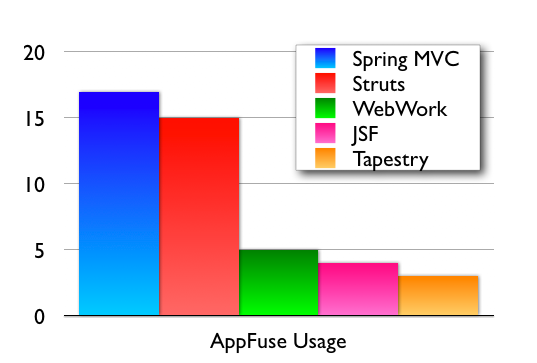
At the beginning of October, I did an informal poll on the AppFuse mailing list to see which web framework users were developing their applications with. Surprisingly, Spring came out on top, and the component frameworks (JSF and Tapestry) are the least used. I find this interesting b/c AppFuse lowers the barriers and reduces the learning curve for all of these frameworks.

Poll Results

If you're an AppFuse user and didn't respond on the mailing list, please leave a comment with the web framework you're using.

On a related note, I noticed that java.net added RSS Feeds for mailing lists today. This means if you have an RSS Reader, you can subscribe to the AppFuse user mailing list.

Heh, I just subscribed and there's no messages in the feed. Maybe this feature needs a little more work.

Posted in Java at Oct 25 2005, 10:29:40 AM MDT 30 Comments