Beautiful
This has to be cutest picture I've ever captured. It's hard to believe she's going to be 5 next month.

Posted in General
at Oct 21 2007, 12:18:25 PM MDT
 The Angular Mini-Book is a
guide to getting started with Angular. You'll learn how to develop a bare-bones application, test it, and
deploy it. Then you'll move on to adding Bootstrap, Angular Material, continuous integration, and authentication.
The Angular Mini-Book is a
guide to getting started with Angular. You'll learn how to develop a bare-bones application, test it, and
deploy it. Then you'll move on to adding Bootstrap, Angular Material, continuous integration, and authentication.
Spring Boot is a popular framework for building REST APIs. You'll learn how to integrate Angular with Spring Boot and use security best practices like HTTPS and a content security policy.
For book updates, follow @angular_book on Twitter.
 The JHipster Mini-Book is a
guide to getting started with hip technologies today: Angular, Bootstrap, and Spring
Boot. All of these frameworks are wrapped up in an easy-to-use project called JHipster.
The JHipster Mini-Book is a
guide to getting started with hip technologies today: Angular, Bootstrap, and Spring
Boot. All of these frameworks are wrapped up in an easy-to-use project called JHipster.
This book shows you how to build an app with JHipster, and guides you through the plethora of tools, techniques and options you can use. Furthermore, it explains the UI and API building blocks so you understand the underpinnings of your great application.
For book updates, follow @jhipster-book on Twitter.
This has to be cutest picture I've ever captured. It's hard to believe she's going to be 5 next month.
It usually snows in September in Denver. This year, it waited until today. It was awesome to wake up this morning and see the white stuff coming down. Bring on Ski Season - I'm ready!

Bill mentions that A-Basin is open. If you're going to this year's Colorado Software Summit (starts today), you may want to bring your skis. Then again, who wants to ski greens? 
 Today marks the beginning of a long-awaited trip to the East Coast. Way back in March, I negotiated a deal with a company in Danbury, CT to teach my Open Source Java Jewels training course. I was supposed to deliver it in May, but that got changed because of their 45-day Vendor Approval Process. It was rescheduled for August. August came and it got moved again because so many people were on vacation. It was rescheduled for October and I'll be delivering it next week.
I'm teaching 2 courses: one for 16 managers Monday - Tuesday and one for 21 developers Wednesday - Friday. Yeah, I know that's way too many students, but I think I can handle it. I warned the company it wasn't a good idea to have that many students, but they wanted to pack them all in anyway. Oh well.
The best part about this trip is I'm doing something I've wanted to do for a long time. I'm taking the kids with me! The rest of my family is coming too - my parents will be on our 2nd flight today and my sister flies in Monday. My dad grew up in Beacon, NY - only 45 minutes from Danbury. Since his brother and sister still live there (as well as many cousins) it should be a fun week of family and crazy kids in a hotel room. With any luck, we'll get to see some fall colors and create some great memories.
If you live in the Bay Area and you're interested in talking with the inventors of Maven and/or XWiki, you should checkout the XWiki + Maven meetup at Terracotta's HQ. Java Open Source gurus Vincent Massol and Jason van Zyl will be there - sounds like a fun event!
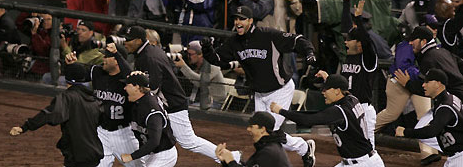
The past week has been an incredible time to live in Denver. It all started last Monday when I went to the Rockies vs. Padres Wildcard Game. It was a beautiful night, we had club-level seats and the Rockies beat the Padres in a 13-inning, 5-hour marathon. It was the best baseball game I've ever seen in my life.
Fast forward to last weekend. The kids and I rented a condo in Winter Park with some friends. It was an awesome 5-bedroom place with a great view of the ski resort, a nice hot tub and an ideal location to watch Saturday night's sweep of the Phillies.

After a hike in the warm mountain air on Saturday, I received a phone call from a friend saying he couldn't make it to the Broncos game on Sunday and asked if I wanted his tickets. I leaped at the opportunity and sped down the mountain on Sunday to go to the game. While the Broncos game was pretty bad, it was still fun going to the stadium and watching them play.
The fun hasn't stopped yet either - I (somehow) got free VIP tickets to a Nuggets pre-season game tomorrow night and this weekend is the Great American Beer Festival. Unfortunately, I'm out of town for all the Arizona games, but I should be in town for the World Series.
Are you coming to the Colorado Software Summit this year? I'm excited to go because I wrote new presentations and I think they'll be a lot of fun to deliver. Also, as I've said before, I really enjoy this conference because it's so relaxing. It's a full-week long, which is a tough commitment, but I like to think of it as a vacation. You do have to deliver your talks 3 times each, so you still have to work every day, but there's also a great opportunity to learn from other speakers. And you don't feel rushed since each talk is given 3 times. This means you can treat some days like real vacation days where you only work a couple hours and others you can pack it in and get a brain full of stuff.
Here's my Choosing a JVM Web Framework abstract?
One of the most difficult things to do (in Java web development) today is to pick which web framework to use when developing an application. A few years ago, there were over 50 Java web frameworks available, most of them open source. Since then, the number hasn't gone down, but the quality of choices has certainly improved. Should you use the standard JSF, or something like Tapestry or Wicket? What about Struts' successor ? is Struts 2 better than Spring MVC or Stripes? And what about the slick-looking applications that Flex and OpenLaszlo can create? Should you use Rails on GlassFish or Grails with Groovy? Is ZK really the next best thing? Where does RIFE fit into all of this? The choice hasn't gotten easier over the years.
This session is a discussion about choosing the best tool for the job. Not only will various frameworks and their features be discussed, but so will important factors for choosing a web framework. Is ease of development more important, or future maintenance? Is the project community an important factor? All of these questions will be discussed and answers will be provided. If you are about to choose a web framework, or if you have an opinion about a web framework, this session is for you.
I think it's important to note that this talk is going to be a discussion. I don't plan on offering my opinions as much as I plan on extracting them from others. This talk probably wouldn't work with the Norway crowd (they don't like to participate much), but I think it'll work with the Colorado folks.
If you're attending ApacheCon this year, which talk would you rather attend - Comparing or Choosing? Or maybe "choosing" would fit in better as a BOF?
Rod Johnson in Replies to Nonsense about Open Source says that Interface21 is the only legitimate company that can offer support for Spring.
...at least that's my interpretation...
Ben Speakmon (of SourceLabs) responds with Nonsense about Interface21.
Both articles are good reads. However, I think Ben has a good point:
One final point for Rod: why did you open source Spring at all? If you're so convinced that no one else can offer credible support for it, why not just make it proprietary?
Is Interface21 becoming the JBoss from two years ago? Will they one day make it difficult for companies to provide services around Spring like JBoss has? Fleury and Johnson will say that "professional open source" is the only way to have a truly successful project. While it may be working well for them, I tend to like DHH's stance on Rails a bit more:
I believe a Rails Inc consisting of a large group of core committers would have an unfair advantage in the training and consulting space - easily siphoning off all the best juice and leaving little for anything else. There are plenty of examples in our industry of that happening around open source tools.
It's much more satisfying to see a broader pool of companies all competing on a level playing field.
Disclaimer: In the past, I've provided training and consulting around Spring - in addition to writing a book about it. Interface21 has never done anything to discourage people from using my services. At least they haven't done anything that I know of.
In Switched, Dave says:
Now that Glassfish V2 is out I'm switching from Tomcat to Glassfish for all of my development. It's more than fast enough. With Glassfish on my MacBook Pro, Roller restart time is about 8 seconds compared to 16 with Tomcat. And the quality is high; the admin console, the asadmin command-line utility and the docs are all excellent. The dog food is surprisingly tasty ;-)
I did some brief and very non-scientific performance comparisons myself:
Startup Time with no applications deployed:
Startup Time with AppFuse 2.0 (Struts + Hibernate version) as a WAR
Environment:
Since this was a very non-scientific experiment, it's possible the last two are actually the same. It's strange that Dave is seeing Roller startup twice as fast on GlassFish. Maybe they've done some Roller deployment optimization?
I realize startup times aren't that important. However, as Dave mentions, they (and context reloading) can be extremely important when developing.
Update: I got to thinking that Dave is probably referring to context reloading. Here's a comparison of how long it takes for both servers to pick up a new WAR (and start the application) when it's dropped into their autodeploy directories.
The strange thing about Tomcat is it takes 6-8 seconds to recognize a new WAR has been deployed. Does Tomcat have a polling increment that can be increased during development?
Regardless, it's impressive that the GlassFish guys have made things that much faster for developers. Nice work folks!
These days, I try to use mvn jetty:run on projects. Then I don't have to worry about deploying, just save and wait for the reload. Time to wait for AppFuse 2.0 to reload using the Maven Jetty Plugin (version 6.1.5)? 7 seconds. Of course, it'd be nice if I could somehow get this down to 1 or 2 seconds.
Maybe Dave should use the Maven integration for Roller to decrease his reload times. ;-)
I posted the following to the Tomcat Developers mailing list. Unfortunately, it didn't get any responses, which means (to me) that no one cares about this feature. I guess the good thing is they didn't veto it.
Hello all,
I'm working for a client that's using a proprietary Servlet/JSP-based framework that runs on Tomcat. They have their own custom JSP compiler and they're looking to move to a standard JSP compiler. One of the things their compiler supports is automatic escaping of XML in expressions. For example, ${foo} would be escaped so <body> -> <body>. JSP EL does not do this. It *doesn't* escape by default and instead requires you to wrap your expressions with <c:out/> if you want escaping.
I'd like to ask what developers think about adding a flag (similar to trimSpaces in conf/web.xml) that allows users to change the escaping behavior from false to true?
I think this is a good option to have as it allows security-conscious organizations to paranoid and escape all content by default.
Thanks,
Matt
Related: http://raibledesigns.com/rd/entry/java_web_frameworks_and_xss
What do you think? Is there anything wrong with adding this (optional) feature to Tomcat? Enhancing security is a good thing - right?
Update: I've entered an enhancement request for this feature and attached a patch.