
Matt RaibleMatt Raible is a writer with a passion for software. Connect with him on LinkedIn.

The Angular Mini-Book The Angular Mini-Book is a guide to getting started with Angular. You'll learn how to develop a bare-bones application, test it, and deploy it. Then you'll move on to adding Bootstrap, Angular Material, continuous integration, and authentication.

Spring Boot is a popular framework for building REST APIs. You'll learn how to integrate Angular with Spring Boot and use security best practices like HTTPS and a content security policy.

For book updates, follow @angular_book on Twitter.

The JHipster Mini-Book The JHipster Mini-Book is a guide to getting started with hip technologies today: Angular, Bootstrap, and Spring Boot. All of these frameworks are wrapped up in an easy-to-use project called JHipster.

This book shows you how to build an app with JHipster, and guides you through the plethora of tools, techniques and options you can use. Furthermore, it explains the UI and API building blocks so you understand the underpinnings of your great application.

For book updates, follow @jhipster-book on Twitter.

10+ YEARS


Over 10 years ago, I wrote my first blog post. Since then, I've authored books, had kids, traveled the world, found Trish and blogged about it all.
You searched this site for "free sex movies for men non blog". 1,227 entries found.

You can also try this same search on Google.

RE: Which is the Hottest Java Web Framework?

The "Break it Down" Blog has a lengthy post on Which is the Hottest Java Web Framework? Or Maybe Not Java? Comparing Java Web Frameworks is hard because so many people are passionate about the framework they know best. Add a couple more like Flex and Ruby on Rails and its downright difficult. Nevertheless, this post is good in that it contains a lot of pretty trend graphs and it looks like the author has done some good research. It's likely the folks that will scream foul are the ones that did poor in the comparison (Tapestry and Stripes, I'm talking about you).

Surprising among the top Java Web Frameworks is the rise of Struts 2:
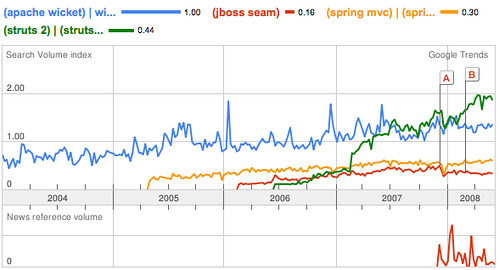
Google Trends Graph

To quote:

Which is much more interesting I think is how Wicket adoption has stayed almost flat while Struts 2 adoption has spiked. Spring MVC/WebFlow seems to be going no where fast and racing JBoss Seam there.

The popularity of Struts 2 really caught me off guard with it being quite a bit different from Struts 1, I figured it got thrown into the "just another web framework" category, but I guess there is something in a name and it's doing quite well.

Regardless of what you think of the post and trends, you have to appreciate the amount of time the author put into it.

Posted in Java at Jun 10 2008, 10:39:08 PM MDT 14 Comments

What's a good RIA to develop in 20 hours?

OSCON 2008 In less than two months, I'm making my annual trek to Portland, Oregon to speak at OSCON. To prepare for my talk, I'd like to develop the same application with two different combinations: Flex + Rails and GWT + Grails.

As luck would have it, I'm having a hard time coming up with a good application to write. I'd like to time-box it so I only spend 10 hours on the backend (for each) and 10 hours on the front-end, for a total of 40 hours for both applications.

Can you think of any good applications that would warrant a rich front-end and wouldn't take too long to create? I'd like to put both applications in production and generate enough traffic to be faced with scalability issues.

Over the next several weeks, I hope to start creating the applications and blog about what I've learned along the way. At some point, I hope to post an outline and a rough draft. With your help, I believe this can be an excellent presentation. If the presentation and applications are as good as I hope they'll be, it's likely I'll open source them for everyone to use.

Thanks in advance for any advice.

Update: Thanks for all the great feedback. I've posted a survey to narrow the choices.

Posted in Java at Jun 09 2008, 09:56:30 PM MDT 21 Comments

New Mac Pro

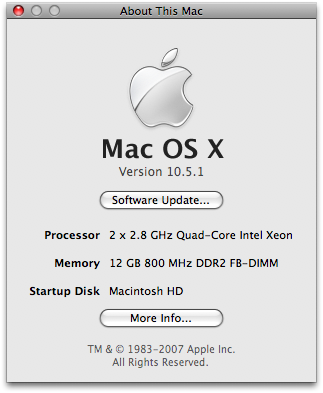
It sure is cool when dreams come true. Look what arrived at the Denver office today. :-)

New Mac Pro

Update: Believe it or not, I rebooted my MacBook Pro the same minute I plugged in my Mac Pro. Upon reboot, the MBP choked and I've been looking at a gray screen with a spinning icon for most of the day. I'm soooo glad I have Time Machine. Let's hope I can do a restore on the MBP tomorrow.

Update 2: I was able to successfully build the Mac Pro from my latest MacBook Pro backup on Time Machine. Sweet! Let's see how this works:

$ echo $JAVA_OPTS
-Xms512M -Xmx4096M -XX:PermSize=384m -XX:MaxPermSize=512m -Djava.awt.headless=true -XX:+CMSClassUnloadingEnabled -XX:+CMSPermGenSweepingEnabled -XX:+UseConcMarkSweepGC -server

Posted in Mac OS X at Jun 05 2008, 11:21:17 AM MDT 13 Comments

2008: The Year of Beer

Beer In a few weeks, I'm heading to the American Craft Beer Festival in Boston. In July, I'll be attending the Oregon Brewers Festival in Portland (followed by a night at McMenamins Kennedy School). A friend and I just booked flights for Oktoberfest in Munich. A couple weeks after Oktoberfest, I'll be attending the Great American Beer Festival in Denver.

Homer would be proud.

Posted in General at Jun 04 2008, 02:58:37 PM MDT 15 Comments

Why no more than 500 connections?

I recently updated my status on LinkedIn to read:

Matt is determined not to have 500+ connections. Will start removing connections soon.

A couple of days later, I received the following message from a connection:

I noticed the other day you mentioned that you are determined to not have over 500 LinkedIn connections. I'm wondering what the reason is? Not just because LinkedIn shows 500+ after that, is it? As you work for LinkedIn, I assume there's some other reason. I'm interested to know what it is...

I joined LinkedIn May 27, 2003, 22 days after it initially launched. For the first few years, I accepted invitations when I received them. Some folks I knew, some I didn't. When I started consulting for LinkedIn last summer, I had somewhere between 200 and 300 connections. Most of them were people who had contacted me, not folks I had contacted.

One day, I used the import webmail contacts feature to pull in my contacts from Gmail. My number of connections quickly jumped by 100 and it's increased quite a bit since then (mostly due to co-workers from LinkedIn). Of the almost 500 connections I have, I believe there's a good 100-200 of them that are folks I don't know, have never had contact with, and will likely never benefit from being "connected" with.

I guess the main reason I'm planning on trimming my connections is to make my network higher quality. I admit I'm somewhat motivated by the 500+ icon, but it's also a genuine feeling that there's quite a few folks I won't benefit from being connected to. I'm not a LION after all. I believe my LinkedIn network should resemble my real-world network.

What's your opinion? Should I have folks in my network that know me, but I don't know them?

Posted in The Web at Jun 01 2008, 06:40:59 PM MDT 17 Comments

Should we change AppFuse to be Struts 2-specific?

Dusty recently posted an interesting idea to the AppFuse developers mailing list:

After thinking/coding/reading for a while I think the more interesting task is: Retool AppFuse to be one or more Struts2 plugins based on various higher level app patterns. (AppFuse Facebook, AppFuse Employee DB, AppFuse Blog, AppFuse Basic LDAP, AppFuse Basic Crowd).

This all comes from the fact, that I have been wanting to refactor the AppFuse web layer for Struts. One of the interesting aspects of AppFuse is that it works pretty much the same across all its web frameworks. It does so with some lowest common denominator abstractions that can be ported and look and work the same across frameworks. I have picked my tool(s): Struts 2 and Ruby On Rails when I want to pretend I am young again. I know Spring MVC, JSF, etc. but I have no desire to build significant apps on those platforms. It's not because they suck and Struts2 rules, it is because I know Struts 2 the best, I am most efficient there and it provides everything I need to build great webapps (Let's not devolve to a framework debate). So, I would rather have a more Struts 2-specific web stack, that really leverages conventions born and raised there. The nice thing about the Struts 2 web stack is that it is complemented nicely by AppFuse's data/service layer, since unlike Grails or Rails, Struts 2 has no data or service layer. [Read More »]

Seems like a good idea to me. What do you think?

Someday I'd like to come up with a "compatibility test" that allows others to improve upon the ideas in AppFuse and develop their stacks independently. A suite of Selenium tests that require extensionless URLs might be a good start.

Posted in Java at May 29 2008, 08:29:44 AM MDT 11 Comments

AppFuse + DisplayTag: External Sorting and Paging Example

Chris Barham has posted an excellent example of how to do external sorting and paging to the AppFuse mailing list:

I've put together a new AppFuse project which demonstrates how to enhance the List screens. DisplayTag as provided has issues with large datasets, (it retrieves all the records every time), and sorting via column headings does not work for the entire dataset, only those on screen at the time.

I've built a project which addresses these issues, using Hibernate Criteria and extensions to DisplayTags PaginatedList interface which gets DisplayTag to hand off all requests for sorting and paging to the new implementation of PaginatedList.

The Google Code project is checked in to: http://code.google.com/p/pagingappfuse/ feel free to check out the code and comment. (instructions here: http://code.google.com/p/pagingappfuse/source/checkout)

There are instructions regarding the steps taken on the project wiki page here: http://code.google.com/p/pagingappfuse/wiki/PagingSorting

Cheers,
Chris

Nice work - thanks Chris!

Posted in Java at May 17 2008, 08:19:55 AM MDT 6 Comments

Spring MVC vs. JSF and The State of Spring Web

Alternative Adult has only posted a couple times in 2008, but his entries have peaked my interest.

Spring MVC or JSF+?
My business unit is trying to standardize if we can on a single Java-based Web framework going forward to simplify the Web development process, especially as individual developers move from one division to another, or centralized support groups need to maintain multiple applications from multiple divisions.

At the enterprise level within my company, the architecture group says that they will provide support for either Spring MVC or JSF+ (where the + represents the accompanying technologies you would use to provide a more maintainable application and a more rich user experience, e.g. Facelets, Richfaces, etc.).

Now my business unit is trying to decide which of these two frameworks, Spring MVC or JSF+, is the most appropriate to standardize upon for our development community. [Read More]

...and...

State of Spring Web
For those that are interested, the following is a summary of the notes I captured from a conversation with SpringSource on the state of Spring Web. [Read More]

Good stuff Michael - keep it coming.

Posted in Java at May 16 2008, 06:17:52 PM MDT 6 Comments

Extensionless URLs with Java Web Frameworks

Last week, I had a go of making a Spring MVC application use extensionless URLs. I did some googling, found some tips on the Spring Forums and believe I arrived at a solid solution. Using the UrlRewriteFilter (version 3), I was able to create a rule that looks for any URLs without an extension. If it finds one, it appends the extension and forwards to the controllers. This rule is as follows (where *.html is my servlet-mapping for DispatcherServlet in web.xml):

  <rule>
    <from>^([^?]*)/([^?/\.]+)(\?.*)?$</from>
    <to last="true">$1/$2.html$3</to>
  </rule>

As long as I hand-write all my URLs without an extension (<a href="home"> vs. <a href="home.html">), this seems to work. To combat developers that use "home.html", one solution is to require all links to be wrapped with <c:url value="url"/> (or some other macro that call response.encodeURL()). If you can convince everyone to do this, you can write an outbound-rule that strips the .html extension from URLs.

  <outbound-rule>
    <from>^(.*)\.html(\?.*)?$</from>
    <to last="false">$1$2</to>
  </outbound-rule>

In an ideal world, it'd be possible to modify the <a> tag at the very core of the view framework you're using to automatically encode the URL of any "href" attributes. I don't think this is possible with JSP, FreeMarker, Facelets or any other Java Web Framework templates (i.e. Tapestry or Wicket). If it is, please let me know.

Below is my final urlrewrite.xml with these rules, as well as my "welcome-file" rule at the top.

<?xml version="1.0" encoding="utf-8"?>
<!DOCENGINE urlrewrite PUBLIC "-//tuckey.org//DTD UrlRewrite 3.0//EN"
  "http://tuckey.org/res/dtds/urlrewrite3.0.dtd">

<urlrewrite>
  <rule>
    <from>/$</from>
    <to type="forward">home</to>
  </rule>

  <rule>
    <from>^([^?]*)/([^?/\.]+)(\?.*)?$</from>
    <to last="true">$1/$2.html$3</to>
  </rule>

  <outbound-rule>
    <from>^(.*)\.html(\?.*)?$</from>
    <to last="false">$1$2</to>
  </outbound-rule>

</urlrewrite>

If you have other solutions for extensionless URLs with Java web frameworks, I'd love to hear about them. With any luck, 2008 will be the year we drop extensions (and path-mappings) from our URLs. The stat packages might not like it, but I do.

Posted in Java at May 13 2008, 09:50:51 PM MDT 18 Comments

JavaOne Parties Update

In an effort to keep one of the top spots for "javaone parties", here's the updated list for JavaOne parties this week:

Thanks to Atlassian for the free beer last night at Thirsty Bear. I'll likely be at Thirsty Bear tonight, followed by Zebulon. Let the networking begin!

Related: JavaOne: Where are the good parties at?

Posted in Java at May 06 2008, 12:20:28 PM MDT 1 Comment