Matt RaibleMatt Raible is a writer with a passion for software. Connect with him on LinkedIn.

The Angular Mini-Book The Angular Mini-Book is a guide to getting started with Angular. You'll learn how to develop a bare-bones application, test it, and deploy it. Then you'll move on to adding Bootstrap, Angular Material, continuous integration, and authentication.

Spring Boot is a popular framework for building REST APIs. You'll learn how to integrate Angular with Spring Boot and use security best practices like HTTPS and a content security policy.

For book updates, follow @angular_book on Twitter.

The JHipster Mini-Book The JHipster Mini-Book is a guide to getting started with hip technologies today: Angular, Bootstrap, and Spring Boot. All of these frameworks are wrapped up in an easy-to-use project called JHipster.

This book shows you how to build an app with JHipster, and guides you through the plethora of tools, techniques and options you can use. Furthermore, it explains the UI and API building blocks so you understand the underpinnings of your great application.

For book updates, follow @jhipster-book on Twitter.

10+ YEARS


Over 10 years ago, I wrote my first blog post. Since then, I've authored books, had kids, traveled the world, found Trish and blogged about it all.
You searched this site for "jsf". 312 entries found.

You can also try this same search on Google.

AppFuse, Reduced

In November, I had some time off between clients. To occupy my time, I exercised my body and brain a bit. I spent a couple hours a day exercising and a few hours a day working on AppFuse. AppFuse isn't used to start projects nearly as much as it once was. This makes sense since there's been a ton of innovation on the JVM and there's lots of get-started-quickly frameworks now. Among my favorites are Spring Boot, JHipster, Grails and Play.

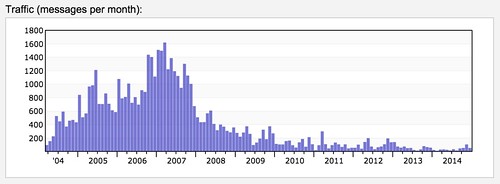
You can see that AppFuse's community activity has decreased quite a bit over the years by looking at its mailing list traffic.

AppFuse Mailing List Traffic, December 2014

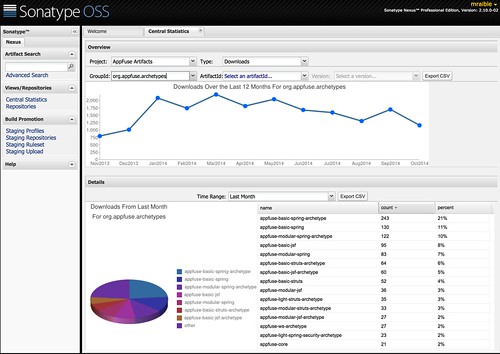
Even though there's not a lot of users talking on the mailing list, it still seems to get quite a few downloads from Maven Central.

AppFuse Maven Central Stats, November 2014

I think the biggest value that AppFuse provides now is a learning tool for those who work on it. Also, it's a good place to show other developers how they can evolve with open source frameworks (e.g. Spring, Hibernate, JSF, Tapestry, Struts) over several years. Showing how we migrated to Spring MVC Test, for example, might be useful. The upcoming move to Spring Data instead of our Generic DAO solution might be interesting as well.

Regardless of whether AppFuse is used a lot or not, it should be easy to maintain. Over the several weeks, I made some opinionated changes and achieved some pretty good progress on simplifying things and making the project easier to maintain. The previous structure has a lot of duplicate versions, properties and plugin configurations between different projects. I was able to leverage Maven's inheritance model to make a number of improvements:

[Read More]

Posted in Java at Dec 16 2014, 06:03:31 AM MST 6 Comments

Comparing JVM Web Frameworks at vJUG

A couple months ago, I was invited to speak at Virtual JUG - an online-only Java User Group organized by the ZeroTurnaround folks. They chose my Comparing JVM Web Frameworks presentation and we agreed I'd speak yesterday morning. They used a combination of Google Hangouts, live streaming on YouTube and IRC to facilitate the meeting. It all went pretty smoothly and produced a comfortable speaking environment. To practice for vJUG, I delivered the same talk on Tuesday night at the Denver Open Source Users Group.

The last time I delivered this talk was at Devoxx France in March 2013. I didn't change any of the format this time, keeping with referencing the Paradox of Choice and encouraging people to define constraints to help them make their decision. I did add a few new slides regarding RebelLabs' Curious Coder’s Java Web Frameworks Comparison: Spring MVC, Grails, Vaadin, GWT, Wicket, Play, Struts and JSF and The 2014 Decision Maker’s Guide to Java Web Frameworks.

I also updated all the pretty graphs (which may or may not have any significance) with the latest stats from Dice.com, LinkedIn, StackOverflow and respective mailing lists. Significant changes I found compared to one year ago:

[Read More]

Posted in Java at Feb 06 2014, 10:54:17 AM MST 6 Comments

AppFuse 3.0 Released!

The AppFuse Team is pleased to announce the release of AppFuse 3.0. This release is AppFuse's first release as a 10-year old and includes a whole slew of improvements.

  • Java 7 and Maven 3 are now minimal requirements
  • Replaced MyFaces and Tomahawk with PrimeFaces for JSF
    • Removed SiteMesh in favor of JSF's built-in layout support
  • Added Wicket support
  • Migrated from jMock to Mockito for tests
  • Integrated wro4j and WebJars
  • Migrated to Bootstrap 3 and defaulted to Bootswatch's Spacelab theme

In addition, this release includes upgrades to all dependencies to bring them up-to-date with their latest releases. Most notable are Spring 4, Spring Security 3.2 and Bootstrap 3. For more details on specific changes see the release notes.

What is AppFuse?
AppFuse is a full-stack framework for building web applications on the JVM. It was originally developed to eliminate the ramp-up time when building new web applications. Over the years, it has matured into a very testable and secure system for creating Java-based webapps.

Demos for this release can be viewed at http://demo.appfuse.org. Please see the QuickStart Guide to get started with this release.

If you have questions about AppFuse, please read the FAQ or join the user mailing list. If you find any issues, please report them on the users mailing list. You can also post them to Stack Overflow with the "appfuse" tag.

Thanks to everyone for their help contributing patches, writing documentation and participating on the mailing lists.

We greatly appreciate the help from our sponsors, particularly Atlassian, Contegix, and JetBrains. Atlassian and Contegix are especially awesome: Atlassian has donated licenses to all its products and Contegix has donated an entire server to the AppFuse project.

Posted in Java at Dec 23 2013, 02:31:15 PM MST 1 Comment

Happy 10 Year AppFuse!

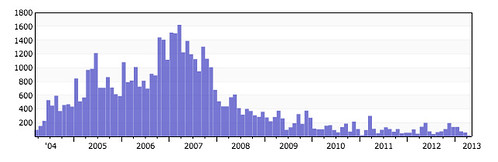
10 years ago yesterday, I released the first version of AppFuse. It started with XDoclet generating ActionForms from POJOs and became very popular for Struts developers that wanted to use Hibernate. The project's popularity peaked in 2006, as you can see from the mailing list traffic below.

AppFuse Mailing List Traffic

It's possible the decrease in traffic is because we re-wrote everything to be based on Maven. It's also possible it was because of more attractive full-stack frameworks like Grails and Rails. However, the real reason is likely that I stopped working on it all the time due to getting a divorce becoming an awesome dad.

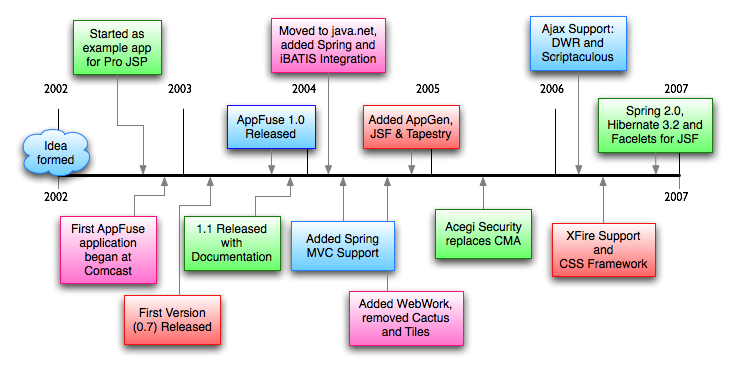
Below is a timeline of how the project evolved over its first 4 years.

AppFuse History: 2003 - 2007

AppFuse has been a great project for me to work on and it's been a large source of my knowledge about Java, Web Frameworks, Spring, Hibernate - as well as build systems like Ant and Maven. We started with CVS, moved to SVN and now we're on GitHub. We've experienced migrating from Tapestry 4 to Tapestry 5 (thanks Serge Eby!), upgrading to JSF 2 and enjoyed the backwards compatibility of Spring and Struts 2 throughout the years. We've also added REST support, a Web Services archetype and kept up with the latest Spring and Hibernate releases.

AppFuse History: 2007 - 2013

Last year, we added Bootstrap and jQuery as foundational front-end frameworks. For our next release, we're switching to PrimeFaces, adding Wicket and changing from jMock to Mockito. Most of these changes are already in source control, we just need to polish them up a bit and add AMP support. I hope to release 3.0 before the bus is done. ;)

Thanks to all the enthusiastic users of and contributors to AppFuse over the years. It's been a great ride!

Posted in Java at Apr 05 2013, 08:56:45 AM MDT 3 Comments

Devoxx France: A Great Conference in a Magnificent City

Red Eiffel flowers This week, my lovely fiancé and I traveled to the City of Light. Our journey was designed around some speaking engagements at Devoxx France. Devoxx is one of my favorite conference franchises and Devoxx France has been special to me ever since the Devoxx (Belgium) I spoke at in 2011.

2011 was the year I spoke about my experience with Play, Scala, CoffeeScript and Jade. I wrote the presentation on my flight over, composed the demo video the night before and made it all happen in the nick of time. Of course, this was after 120 hours of research and preparation, so the presentation composition process had all the data I needed. You can imagine my sense of relief after pulling off that talk and getting an enthusiastic applause from the audience for my efforts.

One of the first audience questions I received was from Nicolas Martignole, asking if I'd speak at Devoxx France the following year. I whole-heartedly agreed to do it and was excited for the opportunity. It was with great disappointment that I later found out I couldn't attend Devoxx France in 2012. My client didn't like me taking so much time off and I agreed to scale my two week vacation back to 1 week. This year, I was determined to go, so I submitted some of my favorite talks: Comparing JVM Web Frameworks and The Play vs. Grails Smackdown with James Ward. I was extremely pleased when they both got accepted.

Side Story: I met Martin Odersky shortly when he sat down next to me for the Java Posse presentation in Belgium in 2011. After shaking his hand and introducing myself, I had to politely ask him to leave because it was Trish's seat. Talk about awkward; but Martin was very gracious and promptly found a new seat close by.

The Paradox of Choice Comparing JVM Web Frameworks
Both talks required a bit of updating. For Comparing JVM Web Frameworks, I started reading The Paradox of Choice and found many parallels to the agony that developers experience with choosing a web framework. I described how I didn't think good framework decisions were based on the many, many features that frameworks have, but often on pre-defined constraints. There's those lucky developers that get to choose a Full Stack Framework because they're doing greenfield development. Then there's those that want a better Pure Web Framework that replaces something (e.g. Struts) that's not satisfying their needs. And lastly, there's those that've found it possible to leverage a SOFEA and use a JavaScript MVC framework with an API Framework on the backend. I don't think it makes sense to compare all web frameworks and I tried to use these pre-defined constraints (language, platform and application type) argument to separate into categories and help make choosing easier.

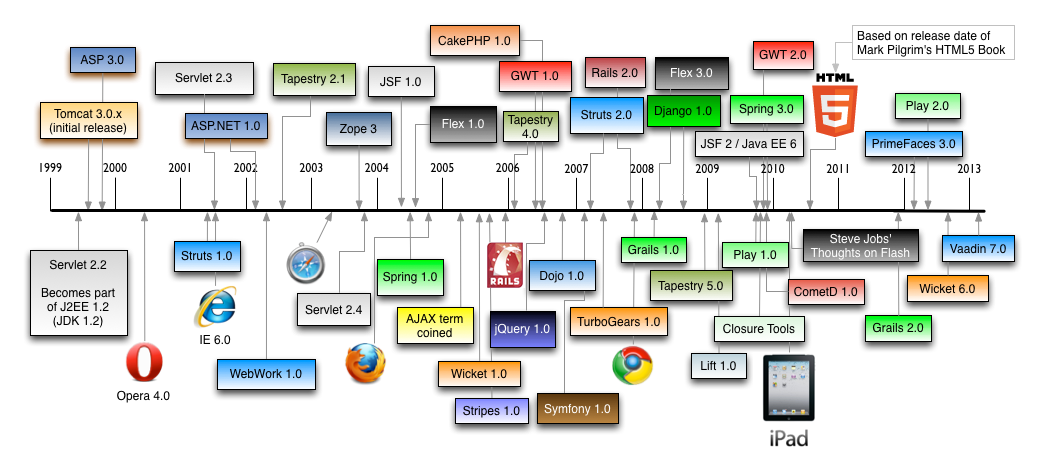
I took out the parts of the presentation that've pissed people off in the past - particular the JSF bashing by James Gosling, the Rails gushing from Craig McClanahan and the Pros and Cons sections of each framework. I added the history of web frameworks and research from InfoQ and devrates.com.

History of Web Frameworks 2013

The best part of the JVM Web Frameworks talk was the audience's reaction and enthusiasm. Devoxx always seems to attract passionate developers and Devoxx France was no different. Developers packing the room, clapping after your intro, laughing at your jokes, signifying that they agree with you about JSF. As a speaker, it's an unbelievable experience.

You can view my Comparing JVM Web Frameworks presentation below or on Slideshare.net.

Play Frameworks vs. Grails Smackdown
To prepare for James Ward and my Play vs. Grails Smackdown, we had a number of goals. First of all, we wanted to update our apps to use the latest versions of each framework. I documented what it took for Grails, James just checked in his code to GitHub. It was interesting to see that Grails 2.0.3 -> 2.2.1 caused a number of issues with testing, while Play 2.0.3 -> Play 2.1.0 required API changes, but nothing for tests. Secondly, we updated all the stats for our pretty graphs and ran load tests again.

This is where the fun started. On Tuesday evening, I decided to challenge the notion that Play was twice as fast as Grails. James had proven this with Apache Bench tests. With Play 2.0 and Grails 2.0 (last summer), we clocked Play at 251/requests per second and 198 for Grails. After upgrading each app to the latest releases, we found the numbers to be 233/second for Play and 118 for Grails.

However, Apache Bench only tests until the first byte is received. Since I've done a lot of browser optimizations recently, I fired up whichloadsfaster.com, captured a screenshot and added it to our presentation. The next day, James added a CDN and a bunch of caching to his app and re-ran his AB tests.

Now he was smoking Grails, so I added a CDN and caching as well. However, the best I could do was just over 1000/requests per second, while he was around 2200/second. When he ran live tests during our talk, Play was around 2800/sec and Grails was around 900.

It was great to see how much better performance we could get with caching and a CDN. The best part is this should be available to most applications, not just these frameworks. By adding a CDN (we used Amazon CloudFront) and caching, we were both able to 10x the performance of our apps. You can find our presentation here or view it below.

Summary
This was a very enjoyable conference to attend as a speaker. First of all, it was in one of the most beautiful cities in the world, but it's also a very special place for Trish and I. We got engaged just outside of Paris in Versailles after the last Devoxx conference I spoke at. Trish has some amazing photos from that trip. Secondly, the Devoxx conference attracts a special kind of developer - one that is passionate about and eager for knowledge. Lastly, speaking with my good friend James, in an exotic city about something we love - that was special. Asking for beers and having them brought to us at the start of our Smackdown. That was magical (thanks Nicolas!).

To all the Devoxx organizers and crew - well done on a great show!

Posted in Java at Mar 29 2013, 01:14:30 PM MDT 3 Comments

Integrating GWT into AppFuse

I've been interested in integrating GWT into AppFuse ever since I blogged about it 4 years ago. A few months after that post, I wrote about Enhancing Evite.com with GWT and Grails. After Evite, I had a gig near Boston where I developed with GXT for the remainder of the year. When all was said and done, I ended up spending a year with GWT and really enjoyed my experience. I haven't used it much since.

GWT is scheduled to be integrated into AppFuse in version 4.0. That's quite a ways off. The good news is you might not have to wait that long, thanks to Iván García Sainz-Aja. Iván let us know about his work a couple weeks ago in an email to the appfuse-dev mailing list.

It's still work in progress but it has already most of AppFuse functionality..

If you want to give it a try

https://github.com/ivangsa/appfuse.git

the quickest way to have a go would be

web/gwt> mvn -P gwtDebug -Dgwt.inplace=true gwt:compile jetty:run  

at the moment it still requires this fork of gwt-bootstrap to be compiled first

https://github.com/ivangsa/gwt-bootstrap.git

It needs a lot of testing yet but it's getting quite there

As you can imagine, I was very excited to hear about Iván's work. So I cloned his repo, built gwt-bootstrap locally and checked it out. Functionality wise, it was great! However, when I dug into the source code, I found a whole lotta code.

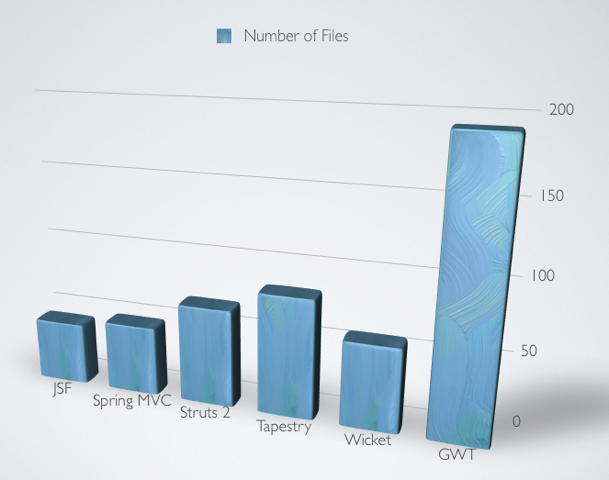
To see how the GWT flavor compared to the other implementations in AppFuse, I created a cloc report on the various web frameworks in AppFuse. I'm sure these reports could be adjusted to be more accurate, but I believe they give a good general overview. I posted some graphs that displays my findings in visual form.

Lines of Java Number of Files

When I sent this to the mailing list, Ivan responded that it was a lot of code and estimated 12 new files would be needed to CRUD an entity. This sure seems like a lot to me, but he defended this yesterday and noted that his implementation follows many of GWT's latest best practices: MVP pattern, Activities and Places, EventBus, Gin and Guice. He also shared a wiki page with explanations and diagrams of how things work.

The reason I'm writing this post is to get more feedback on this implementation. First of all, does GWT really require this much code? Secondly, are there other GWT implementations that reduce a lot of the boilerplate? SmartGWT, Vaadin* and Errai come to mind.

If you were starting a new GWT project and using AppFuse, how would you want it implemented?

* Vaadin 7 claims it can be used as a drop-in replacement for GWT. I tried replacing the gwt-servlet and gwt-user dependencies with Vaadin's, but it didn't work.

Posted in Java at Mar 07 2013, 06:49:28 PM MST 7 Comments

Switching AppFuse from MyFaces to PrimeFaces

When describing my bias against JSF back in November, I wrote:

... there's a lot of folks praising JSF 2 (and PrimeFaces moreso). That's why I'll be integrating it (or merging your pull request) into the 2.3 release of AppFuse. Since PrimeFaces contains a Bootstrap theme, I hope this is a pleasant experience and my overall opinion of JSF improves.

Shortly after the AppFuse 2.2.1 release in December, Gilberto Andrade contributed a sample project that used Mojarra (the JSF RI) and PrimeFaces instead of MyFaces and its Tomahawk components. Last week, I spent a few hours integrating Gilberto's changes into AppFuse's master branch. You can see all the changes I made (which include a Jetty plugin upgrade and some cleanup) in this Crucible review. Feel free to leave comments on ask questions in the review itself.

The first thing I noticed when integrating PrimeFaces is you have to add a custom repository in order to get its artifacts via Maven.

<repositories>
    <repository>
        <id>prime-repo</id>
        <name>Prime Repo</name>
        <url>http://repository.primefaces.org</url>
    </repository>
</repositories>

This is unfortunate since all of AppFuse's other dependencies can be found in Maven Central. It means that if you're using a JSF archetype, the PrimeFaces repo will be checked for artifacts first, causing an unnecessary slowdown in artifact resolution. I hope the PrimeFaces developers fix this soon.

While integrating these two frameworks, I ran into a number of issues.

An IllegalStateException on startup when using "mvn jetty:run"
The first issue I encountered was that I was unable to run the app in Jetty. It worked fine in Tomcat but I got the following error in Jetty:

2013-01-31 22:28:07.683:WARN:/:unavailable
java.lang.IllegalStateException: Application was not properly initialized at startup, could not find Factory: javax.faces.context.FacesContextFactory
at javax.faces.FactoryFinder$FactoryManager.getFactory(FactoryFinder.java:951)
at javax.faces.FactoryFinder.getFactory(FactoryFinder.java:316)
at javax.faces.webapp.FacesServlet.init(FacesServlet.java:302)
at org.eclipse.jetty.servlet.ServletHolder.initServlet(ServletHolder.java:492)
at org.eclipse.jetty.servlet.ServletHolder.doStart(ServletHolder.java:312)

I found the fix for this on Stack Overflow and added the following listener to my web.xml to solve it.

<listener>
    <listener-class>com.sun.faces.config.ConfigureListener</listener-class>
</listener>

Conditionally rendering a button disables its click-ability
The next thing I noticed was the Delete button didn't work when editing a user. It was hidden correctly when adding a user, but clicking on it to delete a user simply refreshes the page. Below is the code I used successfully with MyFaces. For some reason, this doesn't work with PrimeFaces.

<c:if test="${not empty userForm.user.id}">
<h:commandButton value="#{text['button.delete']}" action="#{userForm.delete}"
    styleClass="btn" onclick="return confirmMessage(msgDelConfirm)"/>
</c:if>

I also tried the following, but no dice. This is currently an open issue.

<h:commandButton rendered="${not empty userForm.user.id}" value="#{text['button.delete']}" 
    action="#{userForm.delete}" styleClass="btn" onclick="return confirmMessage(msgDelConfirm)"/>

The PrimeFaces Bootstrap theme 404s on some images
After integrating PrimeFaces' Bootstrap theme, the following error shows up in server logs.

[INFO] [talledLocalContainer] Feb 02, 2013 10:40:25 PM com.sun.faces.application.resource.ResourceHandlerImpl logMissingResource
[WARNING] [talledLocalContainer] WARNING: JSF1064: Unable to find or serve resource, images/ui-bg_highlight-hard_70_000000_1x100.png, from library, primefaces-bootstrap.

This seems to have happened before in previous releases and is currently an open issue.

Canoo WebTest doesn't work with fileUpload nor to set checkbox values
We use Canoo WebTest to run integration tests on the UI in AppFuse. For some reason, performing file uploads and setting checkbox values works fine with MyFaces/Tomahawk, but not with Mojarra/PrimeFaces. I'm not sure if this is caused by the JSF core or the component library, but it remains an open issue. For now, I've just commented out the parts of tests that used to do this.

On a related note, getting the real path of a resource from the ServletContext worked fine before the switch, but results in a null value now.

String uploadDir = getServletContext().getRealPath("/resources") + "/" + request.getRemoteUser() + "/";

PrimeFaces resources served up at /javax.faces.resource/* not found
While I didn't have problems with this in AppFuse, I did encounter it in AppFuse Light. I don't know why there was a difference between the two, but it turned out to be caused by the UrlRewriteFilter and my desire for extensionless URLs. The outbound-rule to strip .xhtml from URLs was the culprit. Adding a condition to it solved the problem. Yeah, the condition seems backwards, but it works.

<outbound-rule match-type="regex">
    <condition type="query-string" operator="equal">ln=primefaces</condition>
    <from>^(.*)\.xhtml(\?.*)?$</from>
    <to last="false">$1$2</to>
</outbound-rule>

Summary
The initial switch to Mojarra/PrimeFaces was pretty easy thanks to Gilberto's sample project. However, the small issues encountered after that turned out to be quite frustrating and you can see that several are still not fixed. I guess it just goes to show that not all web frameworks are perfect. Hopefully we'll get these minor issues fixed before the next release. In the meantime, you can checkout the updated demos for AppFuse JSF and AppFuse Light JSF.

Posted in Java at Feb 06 2013, 12:19:34 PM MST Add a Comment

AppFuse Light 2.2.1 Released!

In December, the AppFuse Team released 2.2.1. Right before that release, I decided to wait on enhancing its "light" modules, a.k.a. AppFuse Light. I'm glad I did, because it took some effort to get jQuery and Bootstrap integrated, as well as to make it more secure.

The good news is AppFuse Light 2.2.1 is released and it's sitting out on the Central Repository. This release is a refactoring of all archetypes to be up-to-date with the AppFuse 2.2.1 release. This means Java 7 compatibility, Servlet 3, Bootstrap/jQuery integration, Tapestry 5.3.6 upgrade and security improvements. I integrated Bootstrap and jQuery using WebJars Servlet 3 support since it was simple and straightforward.

You can create projects using AppFuse's light archetypes using a command such as the following:

mvn archetype:generate -B -DarchetypeGroupId=org.appfuse.archetypes 
  -DarchetypeArtifactId=appfuse-light-spring-freemarker-archetype -DarchetypeVersion=2.2.1 
  -DgroupId=com.mycompany -DartifactId=myproject 

The list of archetypes is as follows:

  • appfuse-light-jsf-archetype
  • appfuse-light-spring-archetype
  • appfuse-light-spring-freemarker-archetype
  • appfuse-light-spring-security-archetype
  • appfuse-light-stripes-archetype
  • appfuse-light-struts-archetype
  • appfuse-light-tapestry-archetype
  • appfuse-light-wicket-archetype

The QuickStart Guide will help you get setup and demos are available at the following links:

If you have questions about AppFuse, we invite you to ask them on the users mailing list or tweet using #appfuse.

For those enjoying Bootstrap in your apps, I encourage you to check out {wrap}bootstrap and Bootswatch.

Posted in Java at Jan 24 2013, 07:43:20 PM MST Add a Comment

What's the best way to compare JVM Web Frameworks?

I've been comparing web frameworks ever since 2004. It was the first time I'd ever proposed a talk for a conference. ApacheCon was in Vegas that year and my buddy Bruce suggested I speak at it. I submitted the talk, got accepted and went to work learning the frameworks I was talking about. At the time, I had a lot of Struts experience and I'd made a good living learning it, consulting on it and blogging about it. However, there was a new kid on the block (Spring MVC) that was garnishing attention and some other frameworks (WebWork and Tapestry) that had a lot of high praise from developers. I was inspired to learn why so many people hated Struts.

Fast forward 8 years and I'm still comparing web frameworks. Why? Because there still seems to be a large audience that's interested in the topic. Witness InfoQ's Top 20 JVM Web Frameworks, which was one of their most-read articles for two months in a row. One of the beauties of the Java Community is that it's very diverse. There's tons of folks that are part of this community and, like it or not, several folks that are former Java Developers. However, these developers still seem to maintain an interest in the community and it's still one of the largest pools of talent out there. Java is still quite viable and only seems to be getting better with age.

So the topic of web frameworks on the JVM is still hot, and I still like to write about it. For those of you still enthusiastic about the topic, you're in luck. The two best websites for the Java Community, InfoQ and DZone (formerly Javalobby) are still very interested in the topic too!

[Read More]

Posted in Java at Jan 09 2013, 08:29:17 AM MST 6 Comments

AppFuse News: Liquibase and wro4j Tutorials from J. García

New committer J. García has been doing a lot of work to improve i18n in AppFuse 2.2, as well as our Struts 2 support. In addition, he's written a couple articles that show you how to integrate Liquibase and wro4j in your AppFuse applications. Thanks for the great documentation J!

The 2.2 release is coming along, and we're down to 16 open issues. I've updated the Hibernate, JPA, Services and Web Services tutorials and hope to finish the web tutorials in the next week. You can try the latest code using the QuickStart Guide or check it out on the demo site:

Please see this thread on the mailing list if you have any questions or suggestions.

In related news, Roger Hughes has a good article titled Ten Things You Can Do With Spring Security. Since AppFuse uses Spring Security extensively, hopefully you can use some of Roger's tips to improve the security of your app.

Posted in Java at Nov 30 2012, 02:32:47 PM MST Add a Comment