Tuesday June 10, 2008
RE: Which is the Hottest Java Web Framework? The "Break it Down" Blog has a lengthy post on Which is the Hottest Java Web Framework? Or Maybe Not Java? Comparing Java Web Frameworks is hard because so many people are passionate about the framework they know best. Add a couple more like Flex and Ruby on Rails and its downright difficult. Nevertheless, this post is good in that it contains a lot of pretty trend graphs and it looks like the author has done some good research. It's likely the folks that will scream foul are the ones that did poor in the comparison (Tapestry and Stripes, I'm talking about you).
Surprising among the top Java Web Frameworks is the rise of Struts 2:
To quote:
Which is much more interesting I think is how Wicket adoption has stayed almost flat while Struts 2 adoption has spiked. Spring MVC/WebFlow seems to be going no where fast and racing JBoss Seam there.
The popularity of Struts 2 really caught me off guard with it being quite a bit different from Struts 1, I figured it got thrown into the "just another web framework" category, but I guess there is something in a name and it's doing quite well.
Regardless of what you think of the post and trends, you have to appreciate the amount of time the author put into it. Posted in Java at Jun 10 2008, 10:39:08 PM MDT 14 Comments
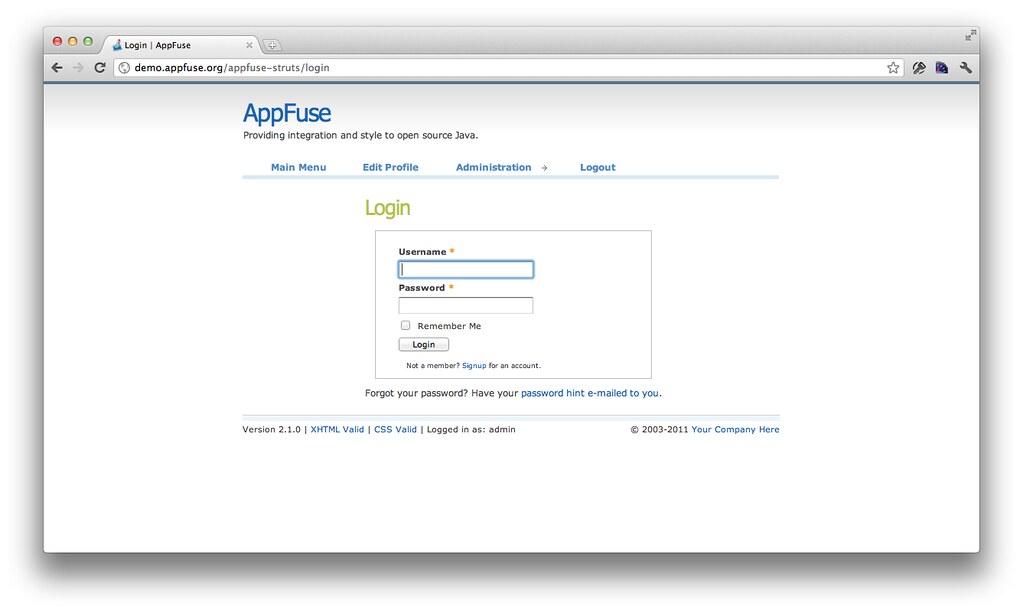
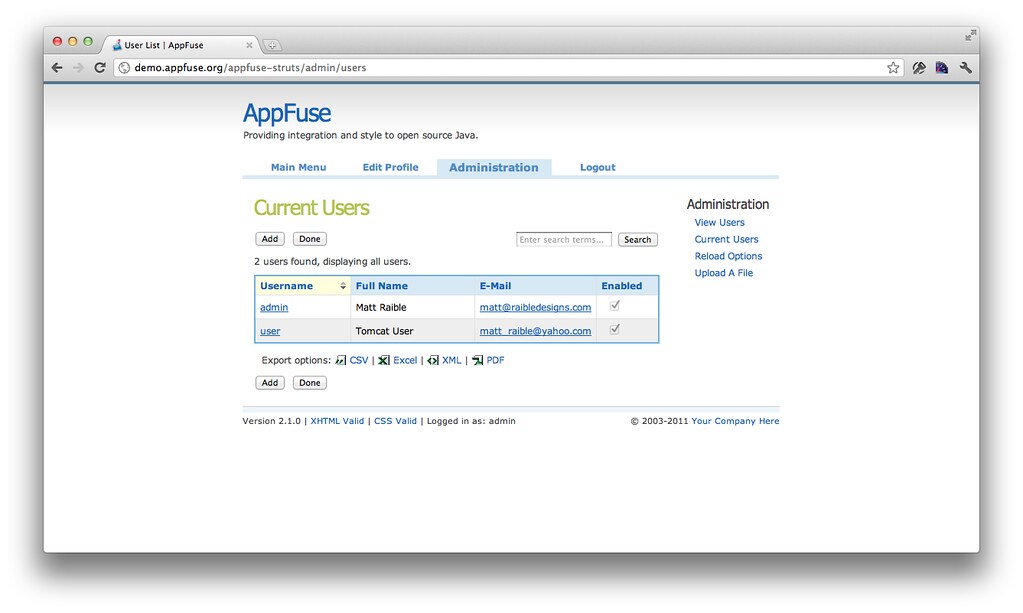
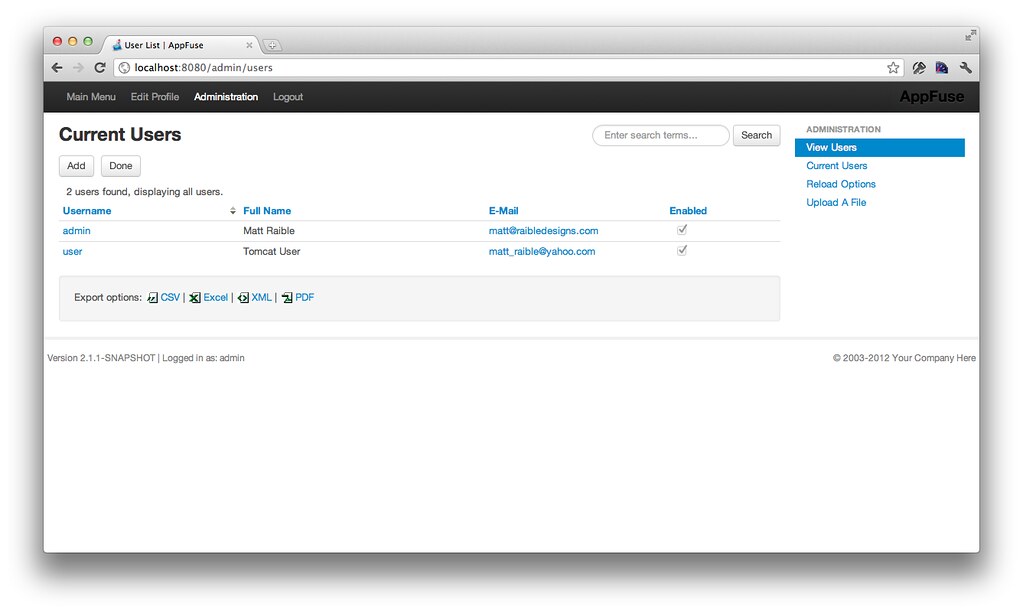
Should we change AppFuse to be Struts 2-specific? Dusty recently posted an interesting idea to the AppFuse developers mailing list:
After thinking/coding/reading for a while I think the more interesting
task is: Retool AppFuse to be one or more Struts2 plugins based on
various higher level app patterns. (AppFuse Facebook, AppFuse
Employee DB, AppFuse Blog, AppFuse Basic LDAP, AppFuse Basic Crowd).
This all comes from the fact, that I have been wanting to refactor the
AppFuse web layer for Struts. One of the interesting aspects of
AppFuse is that it works pretty much the same across all its web
frameworks. It does so with some lowest common denominator
abstractions that can be ported and look and work the same across
frameworks. I have picked my tool(s): Struts 2 and Ruby On Rails when
I want to pretend I am young again. I know Spring MVC, JSF, etc. but
I have no desire to build significant apps on those platforms. It's
not because they suck and Struts2 rules, it is because I know Struts 2
the best, I am most efficient there and it provides everything I need
to build great webapps (Let's not devolve to a framework debate). So,
I would rather have a more Struts 2-specific web stack, that really
leverages conventions born and raised there. The nice thing about the
Struts 2 web stack is that it is complemented nicely by AppFuse's data/service layer, since unlike Grails or Rails, Struts 2 has no data or service layer.
[Read More »]
Seems like a good idea to me. What do you think?
Someday I'd like to come up with a "compatibility test" that allows others to improve upon the ideas in AppFuse and develop their stacks independently. A suite of Selenium tests that require extensionless URLs might be a good start. Posted in Java at May 29 2008, 08:29:44 AM MDT 10 Comments
AppFuse 2.0.2 Released
The AppFuse Team is pleased to announce the release of AppFuse 2.0.2. This release includes upgrades to Spring Security 2.0, jMock 2.4, the ability to customize code generation templates and many bug fixes.
For information on upgrading from 2.0.1, see the Release Notes or changelog. AppFuse 2.0.2 is available as a Maven archetype. For information on creating a new project using AppFuse, please see the QuickStart Guide or the demos and videos.
To learn more about AppFuse, please read Ryan Withers' Igniting your applications with AppFuse.
The 2.0 series of AppFuse has a minimum requirement of the following specification versions:
- Java Servlet 2.4 and JSP 2.0 (2.1 for JSF)
- Java 5+
If you've used AppFuse 1.x, but not 2.x, you'll want to read the FAQ. Join the user mailing list if you have any questions.
Thanks to everyone for their help contributing code, writing documentation, posting to the mailing lists, and logging issues.
Please post any issues you have with this release to the mailing list.
Posted in Java at May 11 2008, 11:25:40 PM MDT 3 Comments
FreeMarker vs. JSP 2 I've been doing quite a bit of prototyping with Spring MVC and Struts 2 with both JSP and FreeMarker in the last few months. I'm trying to migrate a proprietary servlet-based framework with a proprietary JSP compiler to something that's open source. There's a couple of important features that the proprietary view framework has:
- It's expression language allows methods to be called with arguments.
- Templates can be loaded from a JAR on a remote server.
- XML in variables is escaped by default.
For #1, I've found this to be impossible with JSP EL or JSTL. I've created JSP functions that allow argument passing, but they don't allow overloading of functions. FreeMarker solves #1.
For #2, JSPs again fail because the templates have to be on the file system or in a WAR. FreeMarker solves this problem as well.
For #3, neither JSP or FreeMarker solve this problem. I realize it can be fixed in FreeMarker by hacking the code - I've done the same with Tomcat and solved it for JSP as well.
So based on the requirements in this project, FreeMarker is the clear winner. Here's some problems that I see with using it:
- No XML escaping of expressions by default
- No compile-time checking of expressions
- IDE support is limited to Eclipse (meaning very little in the way of code-completion)
FreeMarker users - are there other problems you've experienced when using FreeMarker in your applications? Posted in Java at Jan 17 2008, 12:37:12 PM MST 10 Comments
Java Web Framework Smackdown at TSSJS in Vegas This year's TSSJS is starting to look like an excellent conference. I'm particularly excited to be moderating the following Expert Panel.
Java Web Framework Smackdown: Struts 2, Spring MVC, Grails, Seam/JSF and Wicket
The leading advocates of today's popular Web frameworks will duel under the Vegas Lights. Come and learn when to use your favorite framework and to see if it can live up to its hype.
We're talking about productivity, scalability and maintainability of Java-based Web applications. The emerging trend is that simplicity is better and productivity matters. Furthermore, if maintainability is the most costly part of any application -- how do these frameworks perform?
Attend if you're a Java Web developer, or if you simply like good entertainment. A working knowledge of the popular Java Web framework options will make this session more fun. If you haven't worked with any framework, come and learn who has the best spokesman.
I plan on bringing the boxing bell from OSCON 2005 to make this session one of the best in the show. I'll be coming up with a list of questions for these experts in the next couple of months. In the meantime, if you have any suggestions, please let me know.
With a venue like The Venetian, why wouldn't you go?
Posted in Java
at Jan 11 2008, 12:06:24 PM MST
19 Comments
AppFuse 2.0.1 Released The AppFuse Team is pleased to announce the release of AppFuse 2.0.1. This release squashes a number of bugs and includes an upgrade to Spring 2.5. To learn more about Spring 2.5's features, see InfoQ's What's New in Spring 2.5: Part 1 article.
For information on upgrading from 2.0, see the 2.0.1 Release Notes or changelog. AppFuse 2.0.1 is available as a Maven archetype. For information on creating a new project using AppFuse, please see the QuickStart Guide or the demos and videos.
What is AppFuse? Click here to find out.
The 2.0 series of AppFuse has a minimum requirement of the following specification versions:
- Java Servlet 2.4 and JSP 2.0 (2.1 for JSF)
- Java 5+
If you've used AppFuse 1.x, but not 2.x, you'll want to read the FAQ. Join the user mailing list if you have any questions.
Thanks to everyone for their help contributing code, writing documentation, posting to the mailing lists, and logging issues.
We greatly appreciate the help from our sponsors, particularly Atlassian, Contegix, JetBrains, and Java.net. Atlassian and Contegix are especially awesome: Atlassian has donated licenses to all its products and Contegix has donated an entire server to the AppFuse project. Thanks guys - you rock!
Please post any issues you have with this release to the mailing list.
Posted in Java at Nov 26 2007, 09:29:43 AM MST 4 Comments
Go Light with Apache Struts 2 and REST by Don Brown After attending Dan's talk on REST, I stayed in the same room and listened to Don Brown talk about Struts 2's support for building RESTful applications. Below are my notes from the event.
What is wrong with today's web applications? You're using a modern web framework and you've cleanly separated your presentation and business logic. The biggest problem in modern web applications is Confusing URLs.
A URL should be a resource indicator - not a method invocation. Often, web applications have little or no caching. People use GET to perform data manipulation and POST may or may not change state (especially with JSF). Another big issue with modern web frameworks is there's too many abstraction layers that hide HTTP headers and it's difficult to manipulate them.
Today's applications are "information silos". There's a lot of information in your applications, but it's all buried in HTML, JavaScript and CSS. There's no way to get this information out of your application unless you explicitly expose it.
The answer to many of these problem is REST. It's the Way of the Web. To solve the information silo problem, you can create a single interface that has multiple representation of the same resource. There's one URI for all types of resources - be it XML, JSON or HTML. How does this work w/o modifying the URL? You modify the URL's extension.
Struts 2 has a couple of plugins that make developing RESTful services easier. The first is the Codebehind plugin and the 2nd is the REST plugin. Don is doing a demo with the REST plugin and shows that there's no Struts configuration files needed (no struts.xml and no struts.properties). The only thing that's necessary is to specify an "actionPackages" init-param on the DispatcherFilter in web.xml. This activates the Codebehind plugin that uses conventions to determine the view template's path.
In Don's demo, he's creating an "OrdersController" that implements ModelDriven. After implementing a setId() method (to set the id from the request parameters), a getModel() method (to return the Order object) and implementing a show() method that returns HttpHeaders, Don starts up his server and shows that http://localhost:8080/order/5 returns an HTML page. Changing the URL to end in /5.json returns JSON, /5.xml returns XML.
public HttpHeaders create() {
service.save(order);
return new DefaultHttpHeaders("success").setLocationId(order.getId());
}
The Poster Plugin for Firefox is great when you're working with REST services. Don used this plugin to show us that it's possible to post to JSON and get back JSON results. His demo was impressive, especially the fact that there was no XML configuration required for Struts. I also like how the DefaultHttpHeaders class allows you to manipulate headers in a type-safe manner.
To use the REST plugin, you'll want to use Struts 2.1. If you're using Maven, all you need to depend on is struts-rest-plugin. The struts-codebehind-plugin (as well as struts-core) will be pulled in by transitive dependencies.
One disadvantage of REST vs. WS-* is you can't generate client code from a WSDL. You'll have to write your client by hand. However, one advantage of REST is there's already lots of clients - your browser, curl, etc.
The Struts REST Plugin hasn't been officially released, but hopefully will be in Struts 2.1.1. You can checkout the code from SVN using the URL below. The documentation is located here.
http://svn.apache.org/repos/asf/struts/struts2/trunk/plugins/rest
Great talk Don - and excellent work on the REST plugin for Struts. I can't wait to try it out. Posted in Java at Nov 15 2007, 06:12:58 PM MST 12 Comments
Comparing JVM Web Frameworks Presentation Early this morning, I assembled a Comparing JVM Web Frameworks presentation in preparation for my talk tomorrow at ApacheCon. As mentioned on Monday, this presentation compares Flex, Grails, GWT, Seam, Struts 2 and Wicket. While I think this presentation would be fun to deliver, I don't believe it has as much meat as the original talk I was planning to give. My original talk compares JSF, Spring MVC, Stripes, Struts 2, Tapestry and Wicket. Since I've used all these frameworks, I'm able to compare them more on their technical features. Since I haven't used Flex, GWT or Seam, there was no way for me to 1) try them all before tomorrow and 2) do a thorough analysis of how well they each handle my desired features.
Since the abstract on ApacheCon's website mentions my original presentation, I don't want to yank out the carpet and present the second without asking. So my plan is to ask the audience which one they'd rather hear and continue from there. I've updated both presentations with the latest statistics and uploaded them for your review. For those of you who've used these frameworks, I'd be interested to hear how accurate you think my Pros and Cons section is. If you know of better pros or cons, please let me know and I'll adjust as needed.
- Comparing JSF, Spring MVC, Stripes, Struts 2, Tapestry and Wicket
- Comparing Flex, Grails, GWT, Seam, Struts 2 and Wicket
While creating the 2nd presentation, I found a couple things that surprised me. The first is how popular Flex is - not only in job listings, but also in skilled developers and mailing list traffic. Below is a graph that shows how there aren't many jobs for most of the frameworks, but there's lots for Flex.
The following graph illustrates while I chose to use Flex instead of OpenLaszlo as the Flash framework. OpenLaszlo has a much smaller community than Flex.
The second thing that was surprising is Seam doesn't have a logo! How does it ever expect to become a popular open source project without a logo?! It's amazing they've made it this far without having this essential feature. To motivate the creation of a Seam logo, I'm using the following butt-ugly logo in my presentation (found here). Hopefully something better comes along before I deliver my talk tomorrow.

Update: Monday's post started an interesting thread on Stripes' mailing list. Also, I really like Spring MVC's new annotation support. It'd be nice to see it go a step further and use defaults (like ControllerClassNameHandlerMapping + subpackage support) and only require annotations to override the defaults. IMO, Stripes, Spring MVC and Struts 2 are all excellent choices if a request-based framework provides the best architecture for your application.
Update 2: Comparing Flex, Grails, GWT, Seam, Struts 2 and Wicket seems to gave gained a lot of interest (and support) in the blogosphere. Because of this, I'm considering submitting it as a JavaOne talk. If I were to do this, how would you like to see this presentation changed and improved?
Update 3: I received the following Seam logo via e-mail. Thanks Christian!

Update 4: I've updated the Dice.com graph to include "Java" with every search term. To understand the comments on this entry, you might want to view the previous graph.
Update 5: This presentation was posted to the Wicket User mailing list. I followed up asking users to post the pros and cons of Wicket. Now there's a lengthy thread on Wicket's Pros and Cons. Good stuff. Posted in Java at Nov 14 2007, 03:14:53 PM MST 37 Comments
Comparing Web Frameworks: Time for a Change? I first came up with the idea to do a "Comparing Web Frameworks" talk in 2004. I submitted a talk to ApacheCon and it got accepted. From there, I outlined, created sample apps and practiced this talk before ApacheCon. Believe it or not, that was my first time speaking in front of a large audience.
Historical note: October 2004 was a pretty cool month - I discovered Rails and Roller had a 1.0 release candidate.
When I created the presentation, it was in large part due to all the WebWork and Tapestry folks harassing me on this very blog. I started using Struts in June 2001 (the same month 1.0 was released) and had used it successfully on many projects. Part of the reason this blog became so popular was I posted lots of tips and tricks that I learned about Struts (and its related project) while using it. After a while, the noise became too heavy to ignore it - especially after I'd tried Spring MVC. So in an effort to learn more about the the other frameworks, I submitted a talk and forced myself to learn them. It seems to have worked out pretty well.
With that being said, I think it's time for a change. The reason I originally wrote this was to educate developers on how the top Java web frameworks differed and encourage developers to try more than one. A while later, I realized there's different tools for different jobs and it's not a one-size-fits-all web framework world. It's not a component vs. request-based framework world either. There's lots of options now. When I've delivered this talk earlier this year, I've always felt like I've left quite a few frameworks out. The solution could be to add more and more frameworks. However, I don't think that's a good idea. The talk is already difficult to squeeze into 90 minutes and it's unlikely that adding more frameworks is going to help.
The change I'd like to do is to reduce the number of frameworks down to (what I consider) the top web frameworks for deploying to the JVM. What are those frameworks? IMHO, they are as follows, in no particular order:
- GWT-Ext
- Wicket
- Grails
- Flex/OpenLaszlo
- Seam
- Struts 2
The RIFE, Tapestry and ZK folks can start bitching now. Sorry - less frameworks make for a more interesting talk. Maybe I'll add you in the future and I can ask the audience which ones they want compared then we can choose four and go from there. Why don't I mention Spring MVC? Because I think Struts 2 is easier to learn and be productive with and I also like it's more open and active community. I've written applications with both and I like Struts 2 better. As for Flex vs. OpenLaszlo, I'm somewhat torn. It seems like learning Flex is going to be better for your career, but it's likely useless without the Flex Builder - which is not open source. However, at $250, it's likely worth its price. I know the Picnik folks used Flex for their UI - I wonder how much they used Flex Builder in the process?
What do you think? Are these the top web frameworks for JVM deployment today? The next time I give this talk is this Thursday at ApacheCon. I may try to re-write my talk and then give the audience a choice of old vs. new. The downside of doing the new talk is I won't have time to write apps with GWT, Flex or Seam. Anyone care to post their top three pros and cons for any of these frameworks? Posted in Java at Nov 12 2007, 04:46:56 PM MST 48 Comments
Roller and Struts 2 BOF at ApacheCon next week
Are you going to ApacheCon in Atlanta next week? If so, you might want to mark your calendar for the Roller + Struts 2 BOF on Wednesday night. It's from 8:30 - 9:30 in "Room 3" (whatever that means) and free beer will be sponsored by Atlassian. Thanks Guys!
Apparently, projectors aren't provided for BOFs, so we are in need of a projector to do a small presentation. If you happen to have a "projector connection" in Atlanta next week, please let me know. Posted in Java at Nov 05 2007, 08:25:26 AM MST Add a Comment
Search This Site
Recent Entries
- [OSCON 2008] Even Faster Web Sites by Steve Souders
- [OSCON 2008] CSS for High Performance JavaScript UI by Gavin Doughtie
- [OSCON 2008] The State of Lightning Talks
- [OSCON 2008] Web Frameworks of the Future: Flex, GWT, Grails and Rails
- [OSCON 2008] Caching and Performance: Lessons from Facebook by Lucas Nealan
- [OSCON 2008] Google XML Pages (GXP) by Harry Heymann and Laurence Gonsalves
- [OSCON 2008] An Introduction to Ruby Web Frameworks by Ryan Carmelo Briones
- [OSCON 2008] The Keynote
- GWT and REST
- OSCON: Where are the good parties at?