
Monday December 06, 2010

How I Calculated Ratings for My JVM Web Frameworks Comparison When I re-wrote my Comparing JVM Web Frameworks presentation from scratch, I decided to add a matrix that allows you to rate a framework based on 20 different criteria. The reason I did this was because I'd used this method when choosing an Ajax framework for Evite last year. The matrix seemed to work well for selecting the top 5 frameworks, but it also inspired a lot of discussion in the community that my ratings were wrong.
I expected this, as I certainly don't know every framework as well as I'd like. The mistake I made was asking for the community to provide feedback on my ratings without describing how I arrived at them. From Peter Thomas's blog:
What you are doing is adjusting ratings based on who in the community shouts the loudest. I can't help saying that this approach comes across as highly arrogant and condescending, you seem to expect framework developers and proponents to rush over and fawn over you to get better ratings, like waiters in a restaurant trying to impress a food-critic for Michelin stars.
I apologize for giving this impression. It certainly wasn't my intent. By having simple numbers (1.0 == framework does well, 0.5 == framework is OK and 0 == framework not good at criteria) with no rationalization, I can see how the matrix can be interpreted as useless (or to put it bluntly, as something you should wipe your ass with). I don't blame folks for getting angry.
For my Rich Web Experience presentation, I documented why I gave each framework the rating I did. Hopefully this will allow folks to critique my ratings more constructively and I can make the numbers more accurate. You can view this document below or on Google Docs.
In the end, what I was hoping to do with this matrix was to simply highlight a technique for choosing a web framework. Furthermore, I think adding a "weight" to each criteria is important because things like books often aren't as important as REST support. To show how this might be done, I added a second sheet to the matrix and made up some weighting numbers. I'd expect anyone that wants to use this to downloaded the matrix, verify the ratings are accurate for your beliefs and weight the criteria accordingly.
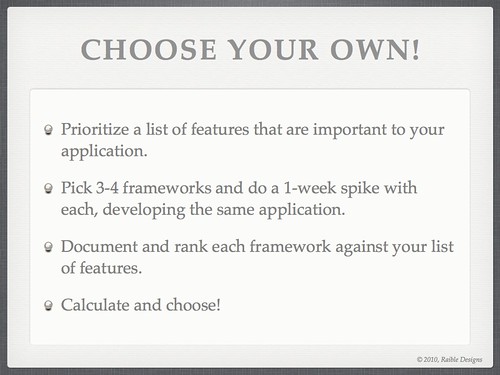
Of course, as I and many others have said, the best way to choose a web framework is to try them yourself. I emphasized this at the end of my presentation with the following two slides.
Posted in Java
at Dec 06 2010, 11:55:18 AM MST
9 Comments
My Comparing JVM Web Frameworks Presentation from Devoxx 2010 This week, I've been having a great time in Antwerp, Belgium at the Devoxx Conference. This morning, I had the pleasure of delivering my Comparing JVM Web Frameworks talk. I thoroughly enjoyed giving this presentation, especially to such a large audience. You can view the presentation below (if you have Flash installed) or download it here.
Unlike previous years, I chose to come up with a spreadsheet matrix that shows why I chose the 5 I did. This spreadsheet and rankings given to each framework are likely to be debated, as I don't know all the frameworks as well as I'd like to. Also, the missing column on this spreadsheet is a "weighting" column where you can prioritize certain criteria like I've done in the past when Comparing Ajax Frameworks. If you believe there are incorrect numbers, please let me know and I'll try to get those fixed before I do this talk again at The Rich Web Experience.
One thing that doesn't come across in this presentation is that I believe anyone can use this matrix, and weightings, to make any of these frameworks come out on top. I also believe web frameworks are like spaghetti sauce in The Ketchup Conundrum. That is, the only way to make more happy spaghetti sauce lovers was to make more types of spaghetti sauce. You can read more about this in my There is no "best" web framework article.
Update: If you disagree with the various ratings I gave to web frameworks in this presentation, please provide your opinions by filling out this survey. Thanks to Sebastien Arbogast for setting this up.
Update: Sebastien has posted his survey results at JVM Web Framework Survey, First Results.
Update 12/6: A video of this presentation is now available on Parleys.com.
P.S. My current gig is ending in mid-December. If you're looking for a UI Architect with a passion for open source frameworks, please let me know.
Posted in Java
at Nov 18 2010, 05:23:10 AM MST
37 Comments
AppFuse 2.1 Milestone 2 Released I'm pleased to announce the 2nd milestone release of AppFuse 2.1. This release includes upgrades to all dependencies to bring them up-to-date with their latest releases. Most notable are Spring 3 and Struts 2.1. This release fixes many issues with archetypes and contains many improvements to support Maven 3. For more details on specific changes see the 2.1.0 M2 release notes.
What is AppFuse?
AppFuse is an open source project and application that uses open source frameworks to help you develop Web applications quickly and efficiently. It was originally developed to eliminate the ramp-up time when building new web applications. At its core, AppFuse is a project skeleton, similar to the one that's created by your IDE when you click through a wizard to create a new web project. If you use JRebel with AppFuse, you can achieve zero-turnaround in your project and develop features without restarting the server.
Release Details
Archetypes now include all the source for the web modules so using jetty:run and your IDE will work much smoother now. The backend is still embedded in JARs, enabling you to choose with persistence framework (Hibernate, iBATIS or JPA) you'd like to use. If you want to modify the source for that, add the core classes to your project or run "appfuse:full-source".
AppFuse comes in a number of different flavors. It offers "light", "basic" and "modular" and archetypes. Light archetypes use an embedded H2 database and contain a simple CRUD example. In the final 2.1.0 release, the light archetypes will allow code generation like the basic and modular archetypes. Basic archetypes have web services using CXF, authentication from Spring Security and features including signup, login, file upload and CSS theming. Modular archetypes are similar to basic archetypes, except they have multiple modules which allows you to separate your services from your web project.
AppFuse provides archetypes for JSF, Spring MVC, Struts 2 and Tapestry 5. The light archetypes are available for these frameworks, as well as for Spring MVC + FreeMarker, Stripes and Wicket.
Please note that this release does not contain updates to the documentation. Code generation will work, but it's likely that some content in the tutorials won't match. For example, you can use annotations (vs. XML) for Spring MVC and Tapestry is a whole new framework. I'll be working on documentation over the next several weeks in preparation for the 2.1 final release.
For information on creating a new project, please see the QuickStart Guide.
If you have questions about AppFuse, please read the FAQ or join the user mailing list. If you find bugs, please create an issue in JIRA.
Thanks to everyone for their help contributing patches, writing documentation and participating on the mailing lists.
Posted in Java
at Nov 15 2010, 03:28:57 PM MST
2 Comments
AppFuse 2.1 Milestone 1 Released
The AppFuse Team is pleased to announce the first milestone release of AppFuse 2.1. This release includes upgrades to all dependencies to bring them up-to-date with their latest releases. Most notable are Hibernate, Spring and Tapestry 5.
What is AppFuse?
AppFuse is an open source project and application that uses open source tools built on the Java platform to help you develop Web applications quickly and efficiently. It was originally developed to eliminate the ramp-up time found when building new web applications for customers. At its core, AppFuse is a project skeleton, similar to the one that's created by your IDE when you click through a wizard to create a new web project.
Release Details
Archetypes now include all the source for the web modules so using jetty:run and your IDE will work much smoother now. The backend is still embedded in JARs, enabling you to choose which persistence framework (Hibernate, iBATIS or JPA) you'd like to use. If you want to modify the source for that, add the core classes to your project or run appfuse:full-source.
In addition, AppFuse Light has been converted to Maven and has archetypes available. AppFuse provides archetypes for JSF, Spring MVC, Struts 2 and Tapestry 5. The light archetypes are available for these frameworks, as well as for Spring MVC + FreeMarker, Stripes and Wicket.
Other notable improvements:
- Added Compass support thanks to a patch from Shay Banon.
- Upgraded from XFire to CXF for Web Services.
- Moved Maven repository to Sonatype's OSS Repository Hosting for snapshots and releasing to Maven Central. There are no longer any AppFuse-specific artifacts, all are available in central. Thanks to Sonatype for this great service and its excellent repository manager.
- Upgraded to Canoo WebTest 3.0. Now if we could just get its Maven Plugin moved to Codehaus.
- Added Ajaxified Body to AppFuse Light archetypes.
- Infrastructure upgrades, including JIRA 4, Confluence 3, FishEye 2, Bamboo 2 and Crowd 1.6. Many thanks to Atlassian and Contegix for their excellent products and services.
- For more details on specific changes see the release notes.
Please note that this release does not contain updates to the documentation. Code generation will work, but it's likely that some content in the tutorials won't match. For example, you can use annotations (vs. XML) for dependency injection and Tapestry is a whole new framework. I'll be working on documentation over the next several weeks in preparation for Milestone 2.
AppFuse is available as several Maven archetypes. For information on creating a new project, please see the QuickStart Guide.
To learn more about AppFuse, please read Ryan Withers' Igniting your applications with AppFuse.
The 2.x series of AppFuse has a minimum requirement of the following specification versions:
- Java Servlet 2.4 and JSP 2.0 (2.1 for JSF)
- Java 5+
If you have questions about AppFuse, please read the FAQ or join the user mailing list. If you find bugs, please create an issue in JIRA.
Thanks to everyone for their help contributing code, writing documentation, posting to the mailing lists, and logging issues.
Posted in Java
at Nov 19 2009, 07:16:36 AM MST
8 Comments
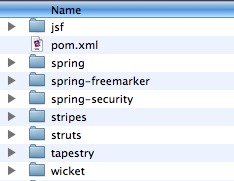
AppFuse Light converted to Maven modules, upgraded to Tapestry 5 and Stripes 1.5 This past week, I stayed up a couple of late nights to do some of the AppFuse Light work I wrote about in October. I converted all web frameworks to Maven modules, as well as made them inherit from the appfuse-web project. Below is what the new module structure looks like:

At this point, the project is ready to import into AppFuse's SVN project. Here's a list of other changes I made:
- Modules now depend on AppFuse's backend and allow you to use Hibernate, JPA or iBATIS as the persistence framework. Implementations for Spring JDBC, OJB and JDO have been removed.
- Upgraded to JWebUnit 2.1, which now uses HtmlUnit under the hood and has much better JavaScript support. It also has Selenium support, but I've yet to try it.
- Ajaxified Body integrated into all frameworks. You can easily turn it off by modifying the global.js file.
- Prototype and Scriptaculous loaded from Google's Ajax Libraries CDN.
- Upgraded to Tapestry 5. Mad props to Serge Eby and his tapestry5-appfuse project for showing me how to do this. Serge became a committer on AppFuse recently, so hopefully we'll continue to see great things from the Tapestry 5 support. I really like the clean URLs and minimum configuration required in Tapestry 5. It's testing framework is nice too, but I believe it could be improved.
- Upgraded to Stripes 1.5. This was easy and painless. I'm definitely a fan of Stripes and look forward to reading the Stripes book on my bookshelf.
- Dropped support for: Struts 1.x, WebWork, Spring MVC + Velocity.
If you want to try any of these applications, you can create archetypes using the following commands:
svn co https://appfuse-light.dev.java.net/svn/appfuse-light/trunk appfuse-light cd appfuse-light/preferred-web-framework mvn archetype:create-from-project cd target/generated-sources/archetype mvn install cd ~/dev mvn archetype:generate # The new archetype should show up as an option
Next steps include figuring out a way to flatten the inherited dependencies and plugins so archetype:create-from-project can create truly standalone projects. Please let me know if you have any questions.
Posted in Java
at Dec 20 2008, 06:42:03 PM MST
9 Comments
AppFuse Light 1.8.2 Released AppFuse Light 1.8.2 is a bug fixes release that includes upgrades for Spring, Spring Security, Hibernate, Wicket, Tapestry and many others. In addition, Spring bean definitions were replaced with annotations (@Repository, @Service and @Controller). See the Release Notes for more information on what's changed since the last release.
AppFuse Light now offers 60 possible combinations for download:
- Web Frameworks: JSF (MyFaces), Spring MVC (with Ajax, Acegi Security, JSP, FreeMarker or Velocity), Stripes, Struts 1.x, Struts 2.x, Tapestry, WebWork, Wicket
- Persistence Frameworks: Hibernate, iBATIS, JDO (JPOX), OJB, Spring JDBC
If you have any questions about this release, please subscribe to the AppFuse user mailing list by sending a blank e-mail to
users-subscribe@appfuse.dev.java.net. You can also post questions in a forum-like fashion using Nabble: http://appfuse.org/forum/user.
Posted in Java
at May 11 2008, 10:16:17 PM MDT
Add a Comment
All Java web frameworks should support hot deploy of a single class In Anyone else using Groovy?, Tim Fennell (inventor of Stripes) raves at how much he likes Groovy now that it supports Java 5 features. He writes that Groovy might offer a solution to make development with Stripes faster:
The other thing I've been wondering about is that if there were enough demand for it we could try adding "improved" groovy support. E.g. throw your groovy actions under WEB-INF and we'll use groovy's built in stuff to do auto-reloading etc.
Gregg Bolinger responds with an excellent idea:
It would be really cool if Stripes could automatically discover and load changes to action beans (including new ones) without the entire app restarting, regardless of what the action bean is written in. But I realize that is a pretty tall order. :)
I agree that it might be a tall order, but I don't think it's impossible. In fact, I think all Java-based web frameworks should support hot deploy of a single class. We shouldn't have to buy JavaRebel to do this. It should be mandatory.
When an application reaches a certain size, the startup time can get pretty lengthy. This is lost development time. Furthermore, if any part of the development cycle takes longer than 15 seconds, there's a good chance developers will do something else (check their e-mail, move onto another task, etc.). Multi-tasking may be a good skill to have, but it's a horrible way to be productive.
Of the frameworks I'm familiar with, only Tapestry 5 and Seam support reloading single classes without restarting the whole application. Why can't the other frameworks "borrow" Tapestry 5's code? Maybe someone should just buy ZeroTurnaround and give away JavaRebel for free.
If I had one wish for 2008, it would be for all Java web frameworks to support this feature. Pretty Please?
Posted in Java
at Jan 24 2008, 03:11:18 PM MST
21 Comments
AppFuse Light 1.8.1 Released: includes upgrades to Spring 2.5 and Wicket 1.3 AppFuse Light 1.8.1 is a bug fixes release that includes an upgrade to Spring 2.5 and Wicket 1.3 RC1. See the Release Notes for more information on what's changed since the last release.
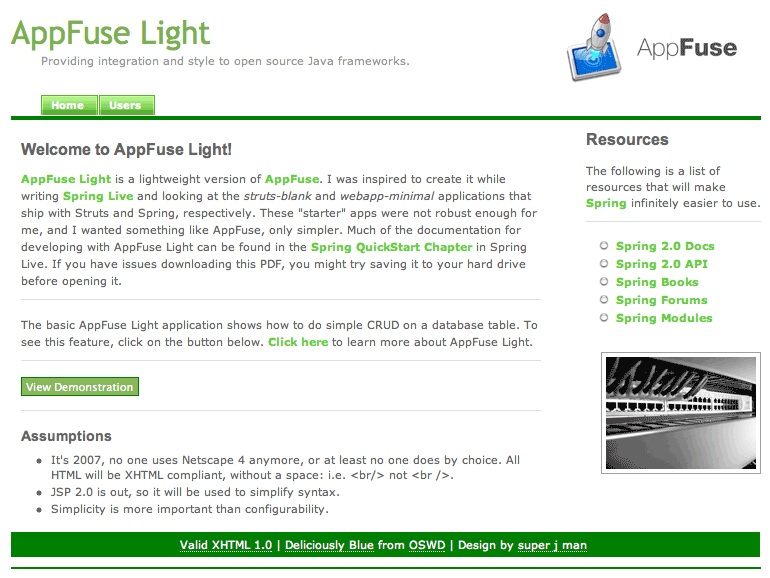
What is AppFuse Light? Click here to find out.
AppFuse Light now offers 60 possible combinations for download:
- Web Frameworks: JSF (MyFaces), Spring MVC (with Ajax, Acegi Security, JSP, FreeMarker or Velocity), Stripes, Struts 1.x, Struts 2.x, Tapestry, WebWork, Wicket
- Persistence Frameworks: Hibernate, iBATIS, JDO (JPOX), OJB, Spring JDBC
If you have any questions about this release, please subscribe to the AppFuse user mailing list by sending a blank e-mail to users-subscribe@appfuse.dev.java.net. You can also post questions in a forum-like fashion using Nabble: http://appfuse.org/forum/user.
If you're a developer of one of the frameworks that AppFuse Light uses - I'd love a code review to make sure I'm "up to snuff" on how to use your framework. I'm also more than willing to give commit rights if you'd like to improve the implementation of your framework.
Live demos are available at:
- Spring · Spring + Ajax · Spring + Acegi
- MyFaces + Facelets
- Stripes
- Struts 1 · Struts 2
- Tapestry
- WebWork
- Wicket
What's on tap for AppFuse Light 2.0? Here's what I'm hoping to do:
- Drop the seldom-used persistence frameworks: JDBC, JDO and OJB.
- Drop Struts 1.x and WebWork as web frameworks (replaced by Struts 2).
- Support the same persistence frameworks as AppFuse: Hibernate, iBATIS and JPA.
- Re-use appfuse-service, appfuse-hibernate, appfuse-ibatis and appfuse-jpa in AppFuse Light. I'll likely include the core classes (User, Role) since AppFuse Light is more "raw" than AppFuse.
- Require Java 5.
Let me know if you disagree with any of these items or would like to see other enhancements.
Posted in Java
at Nov 29 2007, 09:28:06 AM MST
3 Comments
AppFuse Light 1.8 Released AppFuse Light 1.8 adds CSS Framework integration, as well as support for Stripes (1.4.2) and Wicket (1.2.6). It also has significant upgrades for JSF and Tapestry; to versions 1.2 and 4.1.3 respectively. See the Release Notes for more information on what's changed since the the beta release of 1.8.
What is AppFuse Light? Click here to find out.
AppFuse Light now offers 60 possible combinations for download:
- Web Frameworks: JSF (MyFaces), Spring MVC (with Ajax, Acegi Security, JSP, FreeMarker or Velocity), Stripes, Struts 1.x, Struts 2.x, Tapestry, WebWork, Wicket
- Persistence Frameworks: Hibernate, iBATIS, JDO (JPOX), OJB, Spring JDBC
If you have any questions about this release, please subscribe to the AppFuse user mailing list by sending a blank e-mail to users-subscribe@appfuse.dev.java.net. You can also post questions in a forum-like fashion using Nabble: http://appfuse.org/forum/user.
If you're a developer of one of the frameworks that AppFuse Light uses - I'd love a code review to make sure I'm "up to snuff" on how to use your framework. I'm also more than willing to give commit rights if you'd like to improve the implementation of your framework.
Live demos are available at:
- Spring · Spring + Ajax · Spring + Acegi
- MyFaces + Facelets
- Stripes
- Struts 1 · Struts 2
- Tapestry
- WebWork
- Wicket
Yes, I realize that 60 combinations is ridiculous. I didn't create the frameworks, I'm just integrating them so you don't have to.
Unfortunately, it's a real pain to create Maven archetypes or they'd all be as easy as mvn archetype:create. Rumor is that the archetype plugin will allow you to create-from-project in the future. When that happens, I'll make sure all the combinations are available as archetypes.
Posted in Java
at Sep 14 2007, 11:01:46 AM MDT
2 Comments
Does Struts 2 suck? As far as I can tell, Struts 2 sucks. To be fair, so does Stripes. Why? Because there's no developer feedback for invalid properties or OGNL Expressions. What does this mean? It means if you fat-finger a property name, nothing happens. The OGNL exception is swallowed and you never know you did anything wrong. Furthermore, no one seems to care. The XWork folks will help you build, but not solve the problem. This seems like a major deal-breaker to me, However, I also believe it can be fixed - so maybe there's hope.
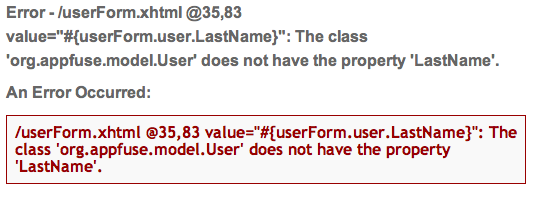
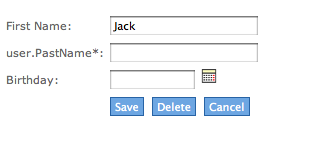
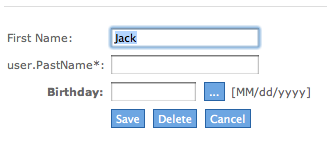
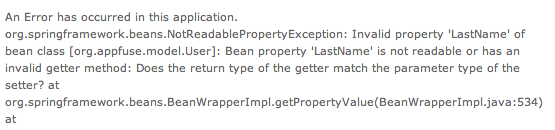
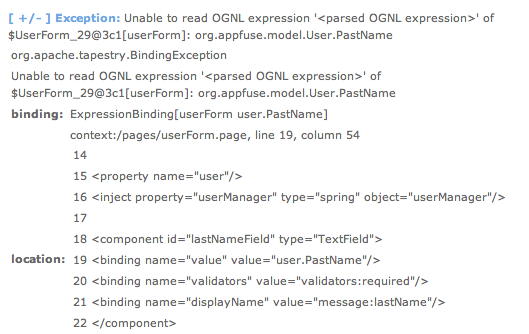
To demonstrate the problem, I did an experiment. I used the "user details" page in AppFuse Light to fat-finger a property name for the following frameworks: Struts 1, WebWork, Struts 2, JSF, Spring MVC, Stripes, Tapestry and Wicket. First, I tried changing the "lastName" property to "LastName" to see if the framework's property evaluation was case-sensitive. I found that with WebWork/Struts 2, Stripes and Tapestry, the property is not case-sensitive. I prefer case-sensitivity, but maybe that's because I prefer Unix over Windows.
The 2nd thing I tried was changing "lastName" to "pastName" to see if I'd get an error. An error occurred for all the frameworks mentioned, except for WebWork/Struts 2 and Stripes. This makes me believe these frameworks suck. The both use OGNL, so they could blame it on that, but Tapestry uses OGNL and it presents an error message. After this small experiment, my conclusion is the following frameworks have the best developer feedback:
- Struts 1
- JSF
- Spring MVC
- Tapestry
- Wicket*
* Wicket seems like it needs some work as all it presents is "Internal Error" and makes you dig through your log files to find the problem.
Without good developer feedback, how can you have good productivity?
Dear Struts 2 and Stripes Developers,
What do you think about improving your error messages for invalid properties and expressions? Is this a feature you think you could add? We'd love it if you did.
Sincerely,
Your Users
Click here for some screenshots of how a fat-fingered property looks in various frameworks:
Update: Stripes doesn't suck and Wicket has excellent error reporting. See my comment below for more details.
Update 2: I've created a patch to (hopefully) solve this issue in XWork. If you have any feedback on ways to improve this patch, I'd love to hear about it.
Posted in Java at Sep 05 2007, 11:21:57 AM MDT 39 CommentsSearch This Site
Recent Entries
- Wine Tasting in Napa Valley
- How to build a Shot-Ski
- Bus Project Update
- Farewell to the 2011-2012 Ski Season
- Cruising around the Western Caribbean
- Spring Break!
- A Spectacular Trip to Stockholm and Madrid
- Comparing Web Frameworks and HTML5 with Play Scala at Jfokus 2012
- Play Framework 2.0 with Peter Hilton at Jfokus
- Secure JSON Services with Play Scala and SecureSocial