Monday June 14, 2010

My Incredible Trip to Ireland If you ever get a chance to travel to Ireland, take it! I don't know when I heard these words, or how they came into my head, but I remembered them clearly when I was first introduced to Barry Alistair by Jeff Genender. Soon after, I was able to negotiate my way into being a speaker at The 2010 Irish Software Show.
The show was last week and I had a blast traveling to Dublin to speak and explore. My sister came me on this trip, but missed a connection in Seattle and had to join me a day late. I left Denver at noon on Monday and arrived at Dublin Airport at 7 am. I was on the same flight as Josh Long and thoroughly enjoyed my iPad as a travel companion. When I got off the plane, my battery life was at 60% and I'd been watching movies and listening to music for 6 hours.
I took a cab through the misty, cool morning to my hotel. I grabbed a coffee, cleaned up, and walked a few blocks to Trinity College for the conference. I made it in time for the opening keynote by Chris Horn. It was an interesting talk, focusing on what needed to happen to make Ireland the Innovation Hub of Europe. After that, I attended Tim Berglund's session on Complexity Theory and Software Development. After lunch and a few more talks, I teamed up with Andres Almiray and Josh Long for a pint at the hotel bar.
That evening, we attended Jeff Genender's talk on Getting into Open Source. The free drinks loosened everyone up and Jeff did a great job with a humorous presentation on how to get Committer Status. After Jeff's talk, about 10 of us headed to a Moroccan restaurant for a late dinner. I was in bed around midnight.
Wednesday morning, my sister arrived in my hotel room at 8 and promptly fell into bed. I set my alarm to sleep an hour and closed the Vegas-style, no-light-allowed curtains. We awoke much later (12:30) than we'd planned (9:00). We quickly got up and headed for some sight-seeing in Dublin. First off, we hit Dublinia and Christ Church Cathedral. Both sites were spectacular and we both learned a lot about the history of Dublin. From there, we skipped across the bridge to The Old Jameson Distillery for a tour and a bit of whiskey.
The picture below was taken on the Ha'penny Bridge as we were heading back from Jameson. The expression of the girl on the left is priceless.
A couple hours later and I was delivering my talk on The Future of Web Frameworks. The crowd was lively; the Guinness I drank while talking was lovely. My session was followed by a Web Framework Experts Panel with Peter Ledbrook (Grails), Jamie van Dyke (Rails), Shay Friedman (ASP.NET MVC), Julian Fitzell (Seaside) and myself (Java Frameworks). The debate was good and there was much discussion about the right apps for each framework and how important statelessness is for scalable applications. After 3 hours of talking, my sister and I headed back to the hotel. I was particularly happy about the evening since it was the first time a family member of mine had seen me speak.
Correction from my Dad: This wasn't the first time a family member saw me speak. He attended my talk at ApacheCon EU 2007.
A block from the hotel, we spotted a nice looking pub (Doyles) and stopped in for a pint. As we bellied up to the end of the bar, we recognized Jamie (from the panel) and got introduced to his friend Rob. We quickly got lost in conversation, stories and laughter and were surprised when we discovered it was 2:30am. Since I had a talk first thing in the morning, we ducked out shortly after.
Thursday started with my talk Comparing Kick-Ass Web Frameworks. Then my sister and I did some more site-seeing, starting at the Guinness Storehouse. We met Josh and John Willis as they were leaving and they advised we go straight to The Gravity Bar at the top. We took there advise and were getting great views of Dublin and savoring sweet pints of Guinness moments later. The tour facility was freakin' awesome and I loved how it was shaped like a pint glass.
We grabbed some gear from the gift shopped and landed (by accident) at The Brazen Head (Ireland's Oldest Pub, Est. 1198) for a pint of cider and Guinness. Since my sister used to be in the cider business, she was particularly happy there was so much on tap in Ireland.
From the pub, we headed to John Willis's session on The Cambrian Cloud Explosion. Following John's session, we headed to the Speaker's Dinner for a very fun evening with the hosts and speakers of the conference.
On Friday, we woke up in the early afternoon and quickly decided the Book of Kells was our best chance of getting some site seeing in. After visiting the Book of Kells, my favorite quote of the conference happened in the courtyard.
Josh looked at Jamie (with his bad hangover) and exclaimed, "My God Man. Your skin is so white it's hurting my eyes!". You probably had to be there (or know Josh) to enjoy the humor, but I wanted to capture the memory in this post so I could laugh whenever I read this in the future. After that, Jamie, Josh, Kalin and I enjoyed a Starbuck's patio talking about living in the South of France for a couple hours. Then we walked 2 blocks to the Porterhouse Brewing Co. to watch the World Cup and enjoy more interesting conversations.
Jamie left the conference that evening and we joined a whole slew of other speakers for dinner at an excellent Lebanese restaurant near Temple Bar. Good times where had afterwards at a nearby Silent Disco.
Saturday, we woke up early to catch a tour bus out to Glendalough with Josh and John. The bus ride was not pleasant, but the destination was spectacular. We hung out there for several hours, exploring the buildings, walking to the lake and humoring each other.
Our last night in Dublin was an early, relaxing one. As you can tell, I really enjoyed this trip, particularly hanging out with my sister and all the cool people we met. I can easily say that this trip registers as one of my favorite conference experiences to date.
To see all the pictures I took on this trip, check out my Irish Software Show 2010 set on Flickr.
Posted in Java at Jun 14 2010, 11:42:55 PM MDT Add a Comment
My Presentations from The Irish Software Show 2010 This week I've been enjoying Dublin, Ireland thanks to the 2nd Annual Irish Software Show. On Wednesday night, I spoke about The Future of Web Frameworks and participated in a panel with Grails, Rails, ASP.NET MVC and Seaside developers. It was a fun night with lots of lively discussion. Below is my presentation from this event.
This morning, I delivered my Comparing Kick-Ass Web Frameworks talk. This presentation contains updated statistics for various metrics comparing Rails vs. Grails and Flex vs. GWT.
Thanks to all who attended my talks this week!
P.S. I believe audio was recorded on Wednesday night, but I'm unsure how it turned out. I'm pretty sure no recordings were done on this morning's session.
Posted in Java at Jun 10 2010, 07:11:35 AM MDT 9 Comments
My TSSJS 2010 Presentations and Summary This afternoon, I delivered my last talk at TSSJS 2010 on The Future of Web Frameworks. It's true that I made some bold statements, but please remember that this is my personal opinion, based on my experience. For the most part, I've been involved in super high-traffic websites for the last few years and this has influenced my opinion on web frameworks. Just because I don't recommend your favorite framework doesn't mean it won't work for you. In fact, many of the best web applications today were built without an open source (or commercial) web framework. In the end, it's not as much about the web framework you're using as it is about hiring smart people. Below is my slide deck from this talk.
Yesterday, I did a GWT vs. Flex Smackdown with James Ward. While there wasn't as much trash talking as I'd hoped, I enjoyed delivering it and disputing the greatness of Flex. Below is the presentation that James and I delivered.
The show itself was great this year. It had more attendees than I've seen in a long time. There were a lot of really interesting sessions and and an often humorous Twitter back-channel. I attended quite a few talks and jotted down my notes from several of them. Please see the links below if you're interested in the sessions I attended. You can view all of the presentations from TSSJS 2010 on SlideShare.
- What's Happening in the Java World?
- Software Quality: The Quest for the Holy Grail?
- The Cloud Computing Continuum with Bob McWhirter
- Highly Interactive Software with Java and Flex
- C++, Java and .NET: Lessons Learned from the Internet Age
- Developing Rich Web Service APIs with Java
- What's New in Spring 3.0
Thanks to everyone who came to Vegas and to TheServerSide for an excellent conference. Posted in Java at Mar 19 2010, 05:29:08 PM MDT 8 Comments
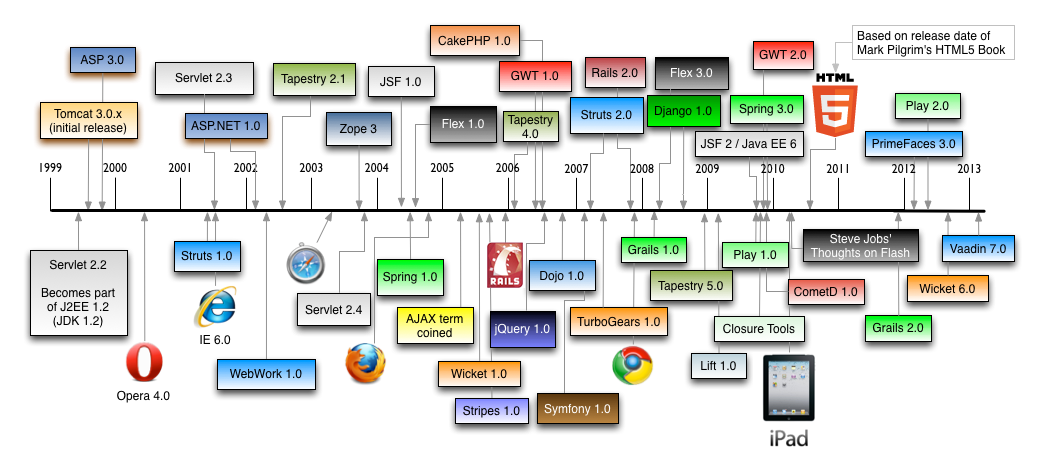
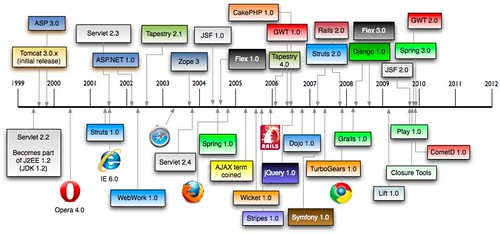
My Future of Web Frameworks Presentation Earlier this week, I tweeted about a history of web frameworks timeline I created for my upcoming Future of Web Frameworks talk at TSSJS Vegas 2010. I immediately received a lot of feedback and requests for adding new frameworks and releases. The image below is the result of that Twitter conversation. Thanks to everyone who contributed.
Back in November, I wrote about my proposals for TSSJS. I've been thinking a lot about web frameworks lately and I can't help but think we live in a very exciting time. As a Java developer, I've been exposed to one of the most vibrant language ecosystems on the planet. As Tim Bray talks about, the Java Platform has 3 legs: the language, the virtual machine and a huge, immense library of APIs (both in the JDK and in open source libraries). The diagram below is something I created based on Tim's podcast.
Tim says, "One of those legs is replaceable and that's the language." And he's right, there's many Java.next languages that run efficiently on the JVM. This is one of the most exciting parts of being a Java web developer today. There's many proven web frameworks and languages that you can pick to build your next web application.
The best part is many of the best web frameworks run on the JVM. Not only that, but the best code editors are the IDEs that you're familiar with and have grown to love. Furthermore, much of the literature for Java.next languages is written for Java developers. As someone who knows Java, you have wealth of web frameworks and languages just waiting for you to learn them.
To create my presentation on the future of web frameworks, I followed the outline I posted previously. I plan on explaining the evolution and history of web frameworks and how we got to where we are today. From there, I'll be speculating on what web applications we'll be developing in the future. Finally, I'll touch on the necessary features of web frameworks that will allow us to develop these applications.
Of course, I haven't actually presented this talk yet, so it's likely to change in the coming weeks before the conference. The good news is this gives you the opportunity to provide constructive criticism on this presentation and help make it better. I realize that a presentation rarely represents the conversation that takes place during a conference. However, I believe it can portray the jist of my thinking and lead to a meaningful conversation in the comments of this post. Below is the presentation I created - thanks in advance for any feedback.
For those who will be joining me at TSSJS ... it's gonna be a great show. St. Patrick's Day in Vegas, what more could you ask for? 
Update: This article has been re-posted on Javalobby and contains additional community feedback in the comments. Posted in Java at Feb 26 2010, 08:55:39 AM MST 5 Comments
AppFuse 2.1 Milestone 1 Released
The AppFuse Team is pleased to announce the first milestone release of AppFuse 2.1. This release includes upgrades to all dependencies to bring them up-to-date with their latest releases. Most notable are Hibernate, Spring and Tapestry 5.
What is AppFuse?
AppFuse is an open source project and application that uses open source tools built on the Java platform to help you develop Web applications quickly and efficiently. It was originally developed to eliminate the ramp-up time found when building new web applications for customers. At its core, AppFuse is a project skeleton, similar to the one that's created by your IDE when you click through a wizard to create a new web project.
Release Details
Archetypes now include all the source for the web modules so using jetty:run and your IDE will work much smoother now. The backend is still embedded in JARs, enabling you to choose which persistence framework (Hibernate, iBATIS or JPA) you'd like to use. If you want to modify the source for that, add the core classes to your project or run appfuse:full-source.
In addition, AppFuse Light has been converted to Maven and has archetypes available. AppFuse provides archetypes for JSF, Spring MVC, Struts 2 and Tapestry 5. The light archetypes are available for these frameworks, as well as for Spring MVC + FreeMarker, Stripes and Wicket.
Other notable improvements:
- Added Compass support thanks to a patch from Shay Banon.
- Upgraded from XFire to CXF for Web Services.
- Moved Maven repository to Sonatype's OSS Repository Hosting for snapshots and releasing to Maven Central. There are no longer any AppFuse-specific artifacts, all are available in central. Thanks to Sonatype for this great service and its excellent repository manager.
- Upgraded to Canoo WebTest 3.0. Now if we could just get its Maven Plugin moved to Codehaus.
- Added Ajaxified Body to AppFuse Light archetypes.
- Infrastructure upgrades, including JIRA 4, Confluence 3, FishEye 2, Bamboo 2 and Crowd 1.6. Many thanks to Atlassian and Contegix for their excellent products and services.
- For more details on specific changes see the release notes.
Please note that this release does not contain updates to the documentation. Code generation will work, but it's likely that some content in the tutorials won't match. For example, you can use annotations (vs. XML) for dependency injection and Tapestry is a whole new framework. I'll be working on documentation over the next several weeks in preparation for Milestone 2.
AppFuse is available as several Maven archetypes. For information on creating a new project, please see the QuickStart Guide.
To learn more about AppFuse, please read Ryan Withers' Igniting your applications with AppFuse.
The 2.x series of AppFuse has a minimum requirement of the following specification versions:
- Java Servlet 2.4 and JSP 2.0 (2.1 for JSF)
- Java 5+
If you have questions about AppFuse, please read the FAQ or join the user mailing list. If you find bugs, please create an issue in JIRA.
Thanks to everyone for their help contributing code, writing documentation, posting to the mailing lists, and logging issues. Posted in Java at Nov 19 2009, 07:16:36 AM MST 8 Comments
The Future of Web Frameworks at TSSJS
For TSSJS Vegas 2010, I submitted two proposals for talks: GWT vs. Flex Smackdown and The Future of Web Frameworks. As of today, the 2nd is the only one that shows up on the conference agenda, but hopefully the former will get accepted too. Here's a description of this talk:
With rich Ajax applications and HTML5 on the horizon, are web frameworks still relevant? Java web frameworks like Struts and Spring MVC were all the rage 5 years ago. Component-based frameworks like Tapestry, JSF and Wicket made it easier to create re-usable applications. But what about the Mobile Web and offline applications?
Are Titanium, Adobe Air and Gears the future? If you're embracing the RESTfulness of the web, do you even need a web framework, or can you use use JAX-RS with an Ajax toolkit?
These questions and many more are examined, answered and debated in this lively session. Bring your opinions and experiences to this session to learn about what's dead, what's rising and what's here to stay. If you're a web framework fan, this session is sure to please.
I believe this talk will be a lot of fun to create and deliver. To create it, I'd like to make it a collaborative effort with the web framework community (users and developers). To kick things off, below is an initial rough outline/agenda:
- Title
- Introduction
- Problem/Purpose
- Agenda
- How did we get here?
- Where are we going?
- How do we get there?
- Q and A
- History of Web Frameworks
- Deep History (CGI, etc.)
- Java's Rise
- PHP
- Rails -> Grails
- Ajax Frameworks
- RESTify!
- SOFEA, APIs, etc.
- The Future
- HTML5
- GWT, Cappucino and Spoutcore (compare to Java and compilers)
- The Binary Players (Flex, JavaFX and Silverlight)
- Getting Rich
- Speed (is it a problem? YES!)
- IE 6 will die.
- Chrome OS
- The Mobile Web
- Desktop Webapps (Titanium, AIR, etc.)
- Or is this the present? Future is bleeding edge.
- Getting There: It's all about the APIs
- Allows for any client
- Web Framework skills transfer to desktop - and phone!
- Speed will continue to be *very* important
- Innovation, something we haven't thought of
- Fallout
- Interest in server-side frameworks will continue, but frameworks will become unmaintained
- Ajax Frameworks will continue to innovate
- HTML5 Frameworks?
- IE 6 (hopefully!)
- Desktop and Mobile with Web Technologies
- Watch out for the next big thing! (or What do you think is the next big thing?)
- Conclusion
- Q and A
Is there anything I'm missing that's important for the future of web frameworks? Are there items that should be removed? Any advice is most welcome.
Reminder: I'll be speaking at tomorrow's DJUG if you'd like to discuss your thoughts in person.
Posted in Java at Nov 10 2009, 01:24:39 PM MST 11 Comments
Optimizing a GWT Application with Multiple EntryPoints Building a GWT application is an easy way for Java Developers to write Ajax applications. However, it can be difficult to release a GWT application to production before it's finished. One of the most important things I've learned in Software Development is to get a new application into production as soon as possible. Not only does getting it from dev → qa → prod verify your process works, it also can do a lot to test the viability of the new application.
One of the biggest issues with GWT applications is size. The project I'm working on compiles Java to JavaScript and creates ~570K *.cache.html files (one for each modern browser). These files end up being around 180K gzipped. I believe this is an OK size for an entire application. However, if you're going to release early, release often with GWT, chances are you'll just want to release one feature at a time.
When the first feature was completed on my project, the *.cache.html files were around 300K. Rather than using branches to release to QA and UAT, bug fixes and new features were developed on trunk. Unfortunately, the QA and UAT process took several weeks longer than expected so by the time the feature was ready to release, the *.cache.html files had grown to around ~570K. The reason the file had grown so much was because it included all of the other features.
Earlier this week, while running to a dentist appointment, I thought of a solution to this problem. The basic idea was to optimize the compilation process so only the to-be-released feature was included. Even better, the solution didn't require more modularization. The results:
Before: *.cache.html -> 569K, gzipped 175K After: *.cache.html -> 314K, gzipped 100K
According to my calculations, that's a 56% reduction in size. How did I do it?
- Created a new
FeatureName.javaEntryPoint with only the to-be-released features imported. - Created a new
FeatureName.gwt.xmlthat references the new EntryPoint. - Copied old (kitchen-sink) EntryPoint.html to
FeatureName.htmland changed the reference to the nocache.js file. - Created a Maven profile that allows using -PFeatureName to build a FeatureName-only module.
One downside to doing things this way is it's possible to create a WAR that has the same name and different features. Surely the Maven Overlords would frown upon this. Since this is just a temporary solution to release features incrementally, I'm not too worried about it. A possible workaround is to create different WAR names when a feature's profile is activated. I believe the true "Maven way" would be to make the "kitchen sink" application into a JAR and have several WAR modules with the different EntryPoints. Seems a bit complicated to me.
Other than this Maven publishing issue, the only other issue I can foresee is keeping the two EntryPoints and HTML files in synch. Then again, the separate files allow a feature to be customized for the release and can be deleted when its no longer needed.
What do you think? Do you know of a better way to compile a GWT application so it only contains certain features? Posted in Java at Mar 25 2009, 04:00:37 PM MDT 11 Comments
Comparing Web Frameworks Book A publisher recently sent me an e-mail asking some advice. They received a proposal for a book that compares CakePHP, Symfony, Zend, TurboGears, Django, Struts, RoR. Here's a quote from the proposal:
We would like to compare a couple of frameworks and present their advantages and disadvantages in various applications.
Obviously, that kind of manual would be very useful for readers who are starting their 'adventures' with web applications, as it would facilitate their choosing the best framework for their particular application. The manuscript would offer a comparison of the most popular solutions (CakePHP, Symfony, Zend Framework, TurboGears, Django, Struts, Ruby on Rails) and demonstrate the main differences between each.
Therefore, the target audience would mainly be project managers, responsible for deciding on the technologies to be used for in-house projects, as well as less experienced, web application beginners.
Another purpose of the book would be to present 'good practices' in various frameworks, such as code re-factoring, design patterns and application security. From this point of view, it could become a valuable asset for experienced and learner programmers alike.
Since I got a lot of feedback from my tweet on this subject, I figured I'd ask it here.
What do you think of such a book?
Here's my response:
How do PHP books do these days? Of the list of frameworks (CakePHP,
Symfony, Zend Framework, TurboGears, Django, Struts, Ruby on Rails), I
think there's interest in Django and Rails, but not so much the
others. And Struts sucks, so having that as a comparison is obviously
going to make it look bad. I wouldn't buy it, but I'm a Java guy
that's mostly interested in web frameworks that make developing
SOFEA-based applications easier. In my mind, these are Flex and GWT.
The book I'd like to see would cover developing RESTful backends and
SOFEA front-ends. RoR, Grails or Django could be used to develop the
backend and Flex, GWT and X could be for the front-end. In reality,
this is probably a tough book to write b/c things move so fast. If you
decide to do it, I'd keep it short and sweet so you can get it to
market and update it quickly.
Posted in Java at Feb 23 2009, 09:49:15 AM MST 17 Comments
Choosing an Ajax Framework This past week, my colleagues and I have been researching Ajax Frameworks. We're working on a project that's following SOFEA-style architecture principles and we want the best framework for our needs. I'm writing this post to see 1) if you, the community, agree with our selection process and 2) to learn about your experiences with the frameworks we're evaluating. Below is the process we're following to make our choice.
- Choose a short list of frameworks to prototype with.
- Create an application prototype with each framework.
- Document findings and create a matrix with important criteria.
- Create presentation to summarize document.
- Deliver document, presentation (with demos) and recommendation.
For #1, we chose Ext JS, Dojo, YUI and GWT because we feel these Ajax libraries offer the most UI widgets. We also considered Prototype/Scriptaculous, jQuery and MooTools, but decided against them because of their lack of UI widgets.
For #2, we time-boxed ourselves to 3 days of development. In addition to basic functionality, we added several features (i.e. edit in place, drag and drop, calendar widgets, transitions, charts, grid) that might be used in the production application. We all were able to complete most of the functionality of the application. Of course, there's still some code cleanup as well as styling to make each app look good for the demo. The nice thing about doing this is we're able to look at each others code and see how the same thing is done in each framework. None of us are experts in any of the frameworks, so it's possible we could do things better. However, I think it's good we all started somewhat green because it shows what's possible for someone relatively new to the frameworks.
For #3, we're creating a document with the following outline:
Introduction Ajax Framework Candidates (intro and explanation) Project Information (history) (license / cost) (number of committers) (support options) (mailing list traffic (nov/dec 2008)) Matrix and Notes Conclusion
For the Matrix referenced in the outline above, we're using a table with weights and ranks:
| Weight | Criteria | Dojo | YUI | GWT | Ext JS | Notes |
|---|---|---|---|---|---|---|
| # | Important Criteria for Customer | 0..1 | 0..1 | 0..1 | 0..1 | Notes about rankings |
Our strategy for filling in this matrix:
- Customer adjusts the weight for each criteria (removing/adding as needed) so all weights add up to 1.
- We rank each framework with 0, .5 or 1 where 0 = doesn't satisfy criteria, .5 = partially satisfies, 1 = satisfies.
The list of criteria provided to us by our client is as follows (in no particular order).
- Quality of Documentation/Tutorials/Self Help
- Browser support (most important browsers/versions based on web stats)
- Testability (esp. Selenium compatibility)
- Licensing
- Project health/adoption
- Performance
- Scalability
- Flexibility/extensibility
- Productivity (app dev, web dev)
- Richness of widget/component library
- Charting capability
- Ability to create new widgets
- Match to existing Java team skill-set
- Ease of deployment (on Ops, QA, Users)
- Degree of risk generally
- Ability to integrate with existing site (which includes Prototype)
- Easy to style with CSS
- Validation (esp. marking form elements invalid)
- Component Theme-ing/Decoration
- CDN Availability (i.e. Google's Ajax Libraries API or Ext CDN)
What do you think? How could this process be improved? Of course, if you have framework answers (0, .5 or 1) for our matrix, we'd love to hear your opinions. Posted in Java at Jan 08 2009, 09:36:22 PM MST 39 Comments
Dojo/Comet support in Java Web Frameworks
This week I'm doing a research project for a client. The main purpose of the project is to find out which Java-based web framework works best with Dojo and Comet. Here's the key requirement from the client:
It's all about Comet, we want Comet everywhere we can put it, but we want to isolate the icky bits of fiddling with pages with JavaScript. We're kind of wed to the Dojo implementation of the client-side bit, so we may as well use more of the Dojo widgets for a richer UI. For us, "works best with" needs to pay a certain amount of consideration to "fits naturally with", if you understand what I mean. I know that any framework that lets you spit out raw HTML will let you hand code in your Dojo / Comet, but that's certain to become very tiresome very quickly.
The candidate frameworks they asked me to look at are Wicket and Tapestry 5. They're willing to upgrade to Struts 2 since they're already using Struts 1. However, they don't feel that action-based frameworks naturally lead to rich UIs, so they'd prefer a component-based framework. They're currently using Seam for an administration-type application and feel it's too heavy for their customer-facing application.
Here's what I've found so far in my research. Please let me know if anything is incorrect.
- Tapestry 5 doesn't have Dojo or Comet support (Prototype and Scriptaculous are the baked-in Ajax frameworks).
- Struts 2 has old (version 0.4.3) and somewhat deprecated Dojo support. The developers seem to be in favor of removing it and promoting people hand-code Dojo instead. Struts 2 doesn't have support for Comet.
- Wicket has support for Dojo 1.1 that includes Comet support. This was written by Stefan Fußenegger and posted to the mailing list last month. I e-mailed Stefan and asked him about documentation. His response: "I lost my ambition to document it properly since I didn't receive any feedback on the mailing list. :)"
At this point, it seems that if the client really wants to use Dojo, they should use Wicket, and possibly pay Stefan to document it properly. However, they're willing to consider other options, as long as they have Comet support.
One option I thought of is to use DWR and its Reverse Ajax/Comet support. Another option would be to add better Dojo support to Tapestry 5. However, I don't think this is possible since the Prototype/Scriptaculous code is generated by the framework and would likely require a changes to switch it to Dojo.
Are there any other Java-based web frameworks that support easily creating Dojo widgets and working with Comet? Keith Donald tweeted that Spring MVC has Dojo support. However, I believe it's only for widgets and it still requires you to write JavaScript. If your framework doesn't have Dojo/Comet support, how hard would it be to add it?
Update: I also posted this question on LinkedIn. Make sure and check my question for additional thoughts from folks. Posted in Java at Dec 18 2008, 03:58:37 PM MST 17 Comments
Search This Site
Recent Entries
- The First Day of School
- Happy 8th Birthday to this blog!
- Jess and Lili's Legendary Wedding on The Lost Coast
- Scaling Flash Movies to match Browser Zoom Levels
- My Summer Vacation in Montana
- Another Fun Father's Day at The Great Sand Dunes
- My Incredible Trip to Ireland
- My Presentations from The Irish Software Show 2010
- A Nice Riding Weekend before heading to the Emerald Isle
- Running Selenium Tests on Sauce Labs